Which was revealed in Makkah
بِسْمِ اللَّهِ الرَّحْمَـنِ الرَّحِيمِ
(In the Name of Allah, the Most Gracious, the Most Merciful.
The Reason for the Revelation of Surat Ad-Duha
Imam Ahmad recorded from Jundub that he said, "The Prophet became ill, so he did not stand for prayer for a night or two. Then a woman came and said, `O Muhammad! I think that your devil has finally left you.' So Allah revealed,
وَالضُّحَى - وَالَّيْلِ إِذَا سَجَى - مَا وَدَّعَكَ رَبُّكَ وَمَا قَلَى
(By the forenoon. By the night when it darkens. Your Lord has neither forsaken you nor hates you.)" Al-Bukhari, Muslim, At-Tirmidhi, An-Nasa'i, Ibn Abi Hatim and Ibn Jarir, all recorded this Hadith. This Jundub (who narrated it) is Ibn `Abdullah Al-Bajali Al-`Alaqi. In a narration from Al-Aswad bin Qays, he said that he heard Jundub say that Jibril was slow in coming to the Messenger of Allah . So the idolators said, "Muhammad's Lord has abandoned him." So Allah revealed,
Continue reading the tafsir of ayahs 1–11Ma'arif al-Qur'an
Mufti Muhammad Shafi
Injunction [ 3]
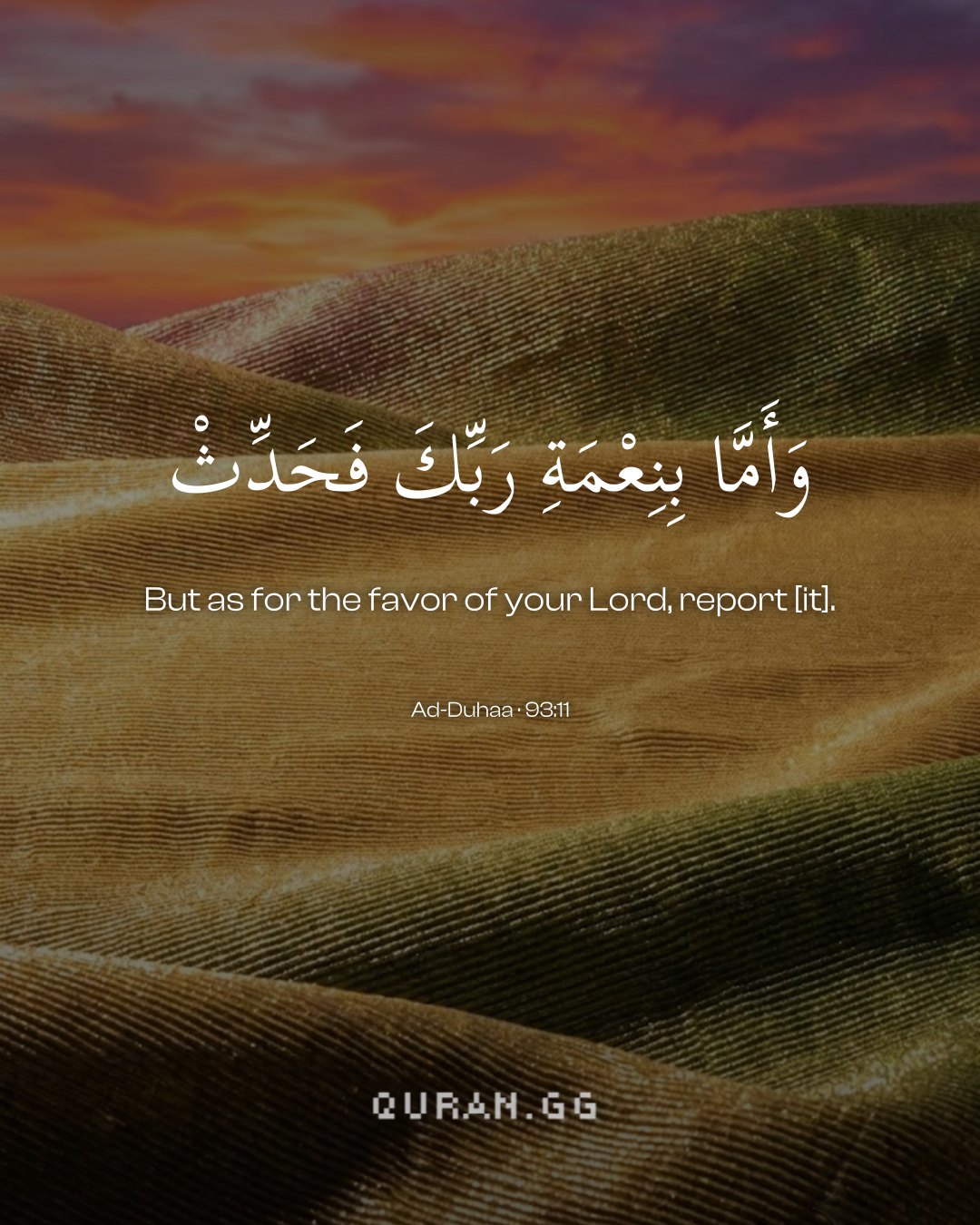
وَأَمَّا بِنِعْمَةِ رَبِّكَ فَحَدِّثْ (And about the bounty of your Lord, do talk....93:11). The verb haddith is derived from tahdith which means 'to talk' meaning, 'just as you were poor and needy, and Allah made you wealthy, then talk about Allah's favours upon you'. Talking about Divine favours to people is one way of thanking Allah. If a person has done something good to another, he should be thanked. Therefore, the Holy Prophet is reported to have said: "Whoever is not thankful to people on their favours is not thankful to Allah." [ This is transmitted by Ahmad. The chain of authorities are reliable - vide Mazhari ].
The Holy Prophet ﷺ is reported to have said: "Whoever has done good to you, you ought to return the good. If you are unable to return the pecuniary good, then praise him in public, because he who praises people in public fulfils his moral obligation." [ Al-Baghawi transmitted it from Jabir Ibn ` Abdullah, vide Mazhari ].
Ruling
It is obligatory to offer gratitude to Allah on every favour He has bestowed. (But the way of offering gratitude may be different.) If Allah has granted a person wealth, a part of that wealth may be spent with the sincerity in Allah's way. If Allah has given a person strong body, his bodily strength may be utilised in fulfilling Divine obligations. If Allah has granted a person Divine knowledge, he should impart it to others. [ Mazhari ].
Ruling
It is sunnah to recite takbir at the beginning of every Surah from Surah Duha to the end of the Qur'an. The wordings of the takbir, according to Shaikh Salih al-Misri, are as follows:
لَٓا اَلٰہَ اِلَّا اللہُ وَ اللہُ اَکبَرُ
'There is no god except Allah and Allah is the greatest' [ Mazhari ].
According to Ibn Kathir, the takbir may be recited at the end of every Surah and, according to Baghawi, it may be recited once at the beginning of every Surah. [ Mazhari ]. Either way the requirement of sunnah will be fulfilled. And Allah knows best!
Note
In most Surahs from Surah Duha to the end of Qur'an, Allah's special favours upon the Holy Prophet ﷺ and his special virtues and characteristics are mentioned. In a few of the Surahs, the Day of Judgment and its conditions are mentioned. The earlier part of the Qur'an asserts the greatness and authenticity of the Qur'an, while the later part asserts the greatness of the personality to whom the Qur'an was revealed.
Al-hamdulillah
The Commentary on
Surah Ad-Duha
Ends here
Uthmani text of the Madinah mushaf (King Fahd Complex). Translation: Saheeh International. Tafsir via Quran.com.