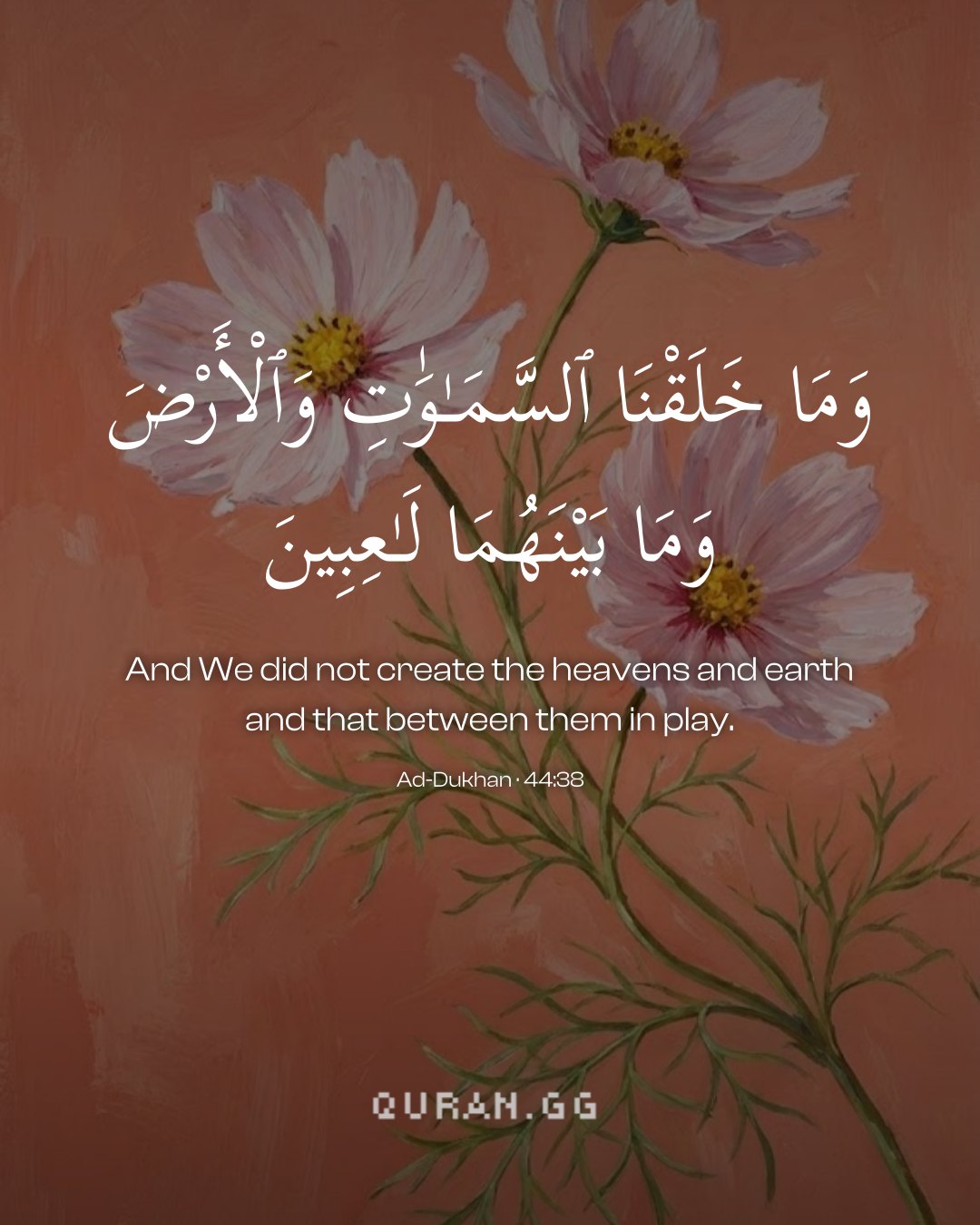
This World was created for a Wisdom
Here Allah tells us of His justice, and that He is far above mere play, folly and falsehood. This is like the Ayah:
وَمَا خَلَقْنَا السَّمَآءَ وَالاٌّرْضَ وَمَا بَيْنَهُمَا بَـطِلاً ذَلِكَ ظَنُّ الَّذِينَ كَفَرُواْ فَوَيْلٌ لِّلَّذِينَ كَفَرُواْ مِنَ النَّارِ
(And We created not the heaven and the earth and all that is between them without purpose! That is the consideration of those who disbelieve! Then woe to those who disbelieve from the Fire!) (38:27)
أَفَحَسِبْتُمْ أَنَّمَا خَلَقْنَـكُمْ عَبَثاً وَأَنَّكُمْ إِلَيْنَا لاَ تُرْجَعُونَ - فَتَعَـلَى اللَّهُ الْمَلِكُ الْحَقُّ لاَ إِلَـهَ إِلاَّ هُوَ رَبُّ الْعَرْشِ الْكَرِيمِ
(Did you think that We had created you in play, and that you would not be brought back to Us So Exalted be Allah, the True King: La ilaha illa Huwa, the Lord of the Supreme Throne!) (23:115-116) Then Allah says:
إِنَّ يَوْمَ الْفَصْلِ مِيقَـتُهُمْ أَجْمَعِينَ
(Verily, the Day of Judgement is the time appointed for all of them) This is the Day of Resurrection, when Allah will judge between all creatures, and He will punish the disbelievers and reward the believers.
مِيقَـتُهُمْ أَجْمَعِينَ
(is the time appointed for all of them) means, He will gather all of them, the first and the last of them.
يَوْمَ لاَ يُغْنِى مَوْلًى عَن مَّوْلًى شَيْئاً
(The Day when a near relative cannot avail a near relative in aught,) means, no relative will be able to help another relative. This is like the Ayah:
فَإِذَا نُفِخَ فِى الصُّورِ فَلاَ أَنسَـبَ بَيْنَهُمْ يَوْمَئِذٍ وَلاَ يَتَسَآءَلُونَ
(Then, when the Trumpet is blown, there will be no kinship among them that Day, nor will they ask of one another.) (23:101)
وَلاَ يَسْـَلُ حَمِيمٌ حَمِيماً يُبَصَّرُونَهُمْ
(And no friend will ask a friend (about his condition). Though they shall be made to see one another) (70:10-11) which means, he will not ask his brother about how he is, even though he can see him with his own eyes.
وَلاَ هُمْ يُنصَرُونَ
(and no help can they receive,) means, no relative will help another, and no help will come to him from outside.
إِلاَّ مَن رَّحِمَ اللَّهُ
(Except him on whom Allah has mercy.) means, and nothing will be of any avail that Day except the mercy of Allah towards His creation.
إِنَّهُ هُوَ الْعَزِيزُ الرَّحِيمُ
(Verily, He is the All-Mighty, the Most Merciful.) means, he is the Almighty, with immense mercy.
The Story of Tubba'
أَهُمْ خَيْرٌ أَمْ قَوْمُ تُبَّعٍ "Are they better or the people of Tubba? (44:37) ". The people of Tubba` have been referred to twice in the Qur'an. Here and in Surah Qaf. In both places only their name has been mentioned without recounting their chronicle. Therefore, the commentators have discussed extensively about the people of Tubba' , trying to identify them and their history. Tubba' is not the name of a particular individual, but is said to be the royal title of the kings of Himyar in Yemen. The Kings of Yemen were only known by this title when held sway over Himyar, Arabia, Syria, ` Iraq and parts of Africa for a long time; western part of Yemen was their capital. Therefore, the plural of Tubba' is Tababi'ah, and the kings are called Tababi` ah of Yemen. It is not clear which of the Tababi` ah is referred to here. Hafiz Ibn Kathir's research and conclusion would appear to be most plausible. His conclusion is that Tubba' here refers to Tubba' Ausat (Middle Tubba`) whose name was As` ad Abu Kuraib Ibn Ma` dikarab Yamani. This King ruled at least seven hundred years before the advent of the Holy Prophet of Allah ﷺ . Among the Himyari Kings, he ruled the longest. During his rule, he went on a journey of conquest invading many regions and annexing them to his domain until he reached Samarqand, expanding his kingdom. According to Muhammad Ibn Ishaq's narration, during his conquests once he passed by the area of Madinah and intended to attack it. The inhabitants of Madinah adopted the attitude that during the day they used to resist his attacks and during the night they entertained him. He felt embarrassed and abandoned the intention of fighting. During this period, two Jewish Rabbis warned him that that was the place of migration of the Final Prophet of Allah ﷺ ، and that he would never be able to prevail over that city. He was thus persuaded and left Madinah and went away with the two Rabbis to Yemen. The Rabbis invited him to embrace the Mosaic religion, and he did accept it. As a result, his people were also influenced by him and they too embraced the Mosaic religion. However, after his death they went astray and reverted to idolatry and fire-worship. This brought down on them the Divine wrath, the details of which are available in Surah Saba'. (Condensed from Tafsir Ibn Kathir: vol. 4 /p 144). This incident shows that the Tubba` mentioned here had himself embraced Islam, but his people later went astray. On both occasions the Qur'an has made reference to the 'people of Tubba', and not to Tubba' himself . This is supported by the narratives of Sayyidna Sahl Ibn Sa'd and Ibn ` Abbas ؓ which are recorded by Ibn Abi Hatim, Imam Ahmad, Tabarani and others that the Messenger of Allah ﷺ said: لا تسبّو تبّعافانّہ، قد کان اسلم "Do not revile Tubba', because he had embraced Islam." (ibidem).
Continue reading the tafsir of ayahs 37–38 In every period the root cause of a man’s going astray has been his loss of belief in the life after death. The disbelief of some finds expression in their utterances. Others may not openly express it, but their hearts are devoid of the belief that they have to rise after death and face the reckoning of their deeds before God. The reason for this misunderstanding is generally that man, in view of his strong position in this world, presumes that he is never going to lose his elevated status, though the history of past nations ought to be enough to dispel this illusion. Tubba‘ was the title of the Kings of the ancient Himyar tribe of Yemen. These people enjoyed prominence from 300 B.C. to 115 B.C. and their greatness was much talked about in ancient Arabia. The rise and fall of the Tubba‘ people, a piece of history well-known to the initial addressees of the Quran (the Quraysh), gave proof of the fact that the law of ‘crime and punishment’ was prevalent in this world. Similarly, for every community there is a ‘Tubba‘’ which, by its example, teaches them a lesson. But, man is wont to take such occurrences as being nothing out of the ordinary. The result is that he does not learn those lessons which, by God’s will, are latent in events.
Uthmani text of the Madinah mushaf (King Fahd Complex). Translation: Saheeh International. Tafsir via Quran.com.