The Qur'an is Allah's True Speech and the Position of the Disbelievers and the Muslims towards it
Allah says,
قُلْ
(Say) meaning, `O Muhammad to these idolators who disbelieve in the Qur'an.'
أَرَءَيْتُمْ إِن كَانَ
(Tell me! If it was) meaning, this Qur'an.
مِنْ عِندِ اللَّهِ وَكَفَرْتُمْ بِهِ
(from Allah, and you disbelieved in it) meaning, `what do you think that Allah will do to you if this Book that I have come to you with is actually revealed to me from Him in order that I convey it to you, and yet you disbelieve in it and deny it
((at the same time), a witness from among the Children of Israel has testified to something similar) meaning, `the previous Scriptures that were revealed to the Prophets before me all testify to its truthfulness and authenticity. They have prophecied, well in advance, about things similar to that which this Qur'an informs of.' Concerning Allah's statement,
The first two of the above verses are a complement to the previous verses which announce punishment for the unjust, and glad tidings of success and reward for the virtuous Muslims. In the first verse إِنَّ الَّذِينَ قَالُوا رَبُّنَا اللَّـهُ ثُمَّ اسْتَقَامُوا "Surely, those who said, 'Our Lord is Allah' then stayed firm, (46:13) " all the basic faith and virtuous deeds required by Islam have been comprehensively referred to with great eloquence. The admission that رَبُّنَا اللَّـهُ "Our Lord is Allah." is the whole of faith, and staying firm in it includes holding on to it till death, as well as carrying out all its obligations. The meaning and importance of istiqamah ('Staying firm), have been explained in detail in the commentary of Sarah Ha Meem As-Sajdah (41:30). In this verse here, those who embrace faith and remain steadfast to it are being promised freedom from anxiety and suffering in future, and dispelling of their grief and sorrow over past sufferings. The following verse gives glad tidings of the permanence and continuity of this matchless comfort. In the four verses which follow, man is being directed to behave beautifully with his parents, and is being censured for ill-behaviour towards them; and in this context, the kindness of the parents to him and the parents' bearing hard labor and toiling for their children have been mentioned, and then man has been advised to repent and turn towards Allah Ta’ ala when he gets older. The connection between these verses and the earlier ones, according to Ibn Kathir, is that the usual style of the Holy Qur'an is to instruct man to behave beautifully, to serve and to obey his parents along with the call to obey and worship Allah Almighty. Many verses of the Holy Qur'an in various Surahs bear witness to this style. Here also, in the same way, mention has been made of beautiful behaviour for parents alongwith the call to believe in the Oneness of Allah Ta’ ala. And Qurtubi, with reference to Qushairi has stated the connection to be that there is a kind of solace in it for the Holy Prophet ﷺ that he should continue calling people towards faith and 'tauhid' (the Oneness of Allah) and should not be disheartened if some people do not accept his invitation, because men, by nature, are of diverse characteristics, and some of them do not refrain even from ill-treatment to their parents. (Allah knows best)
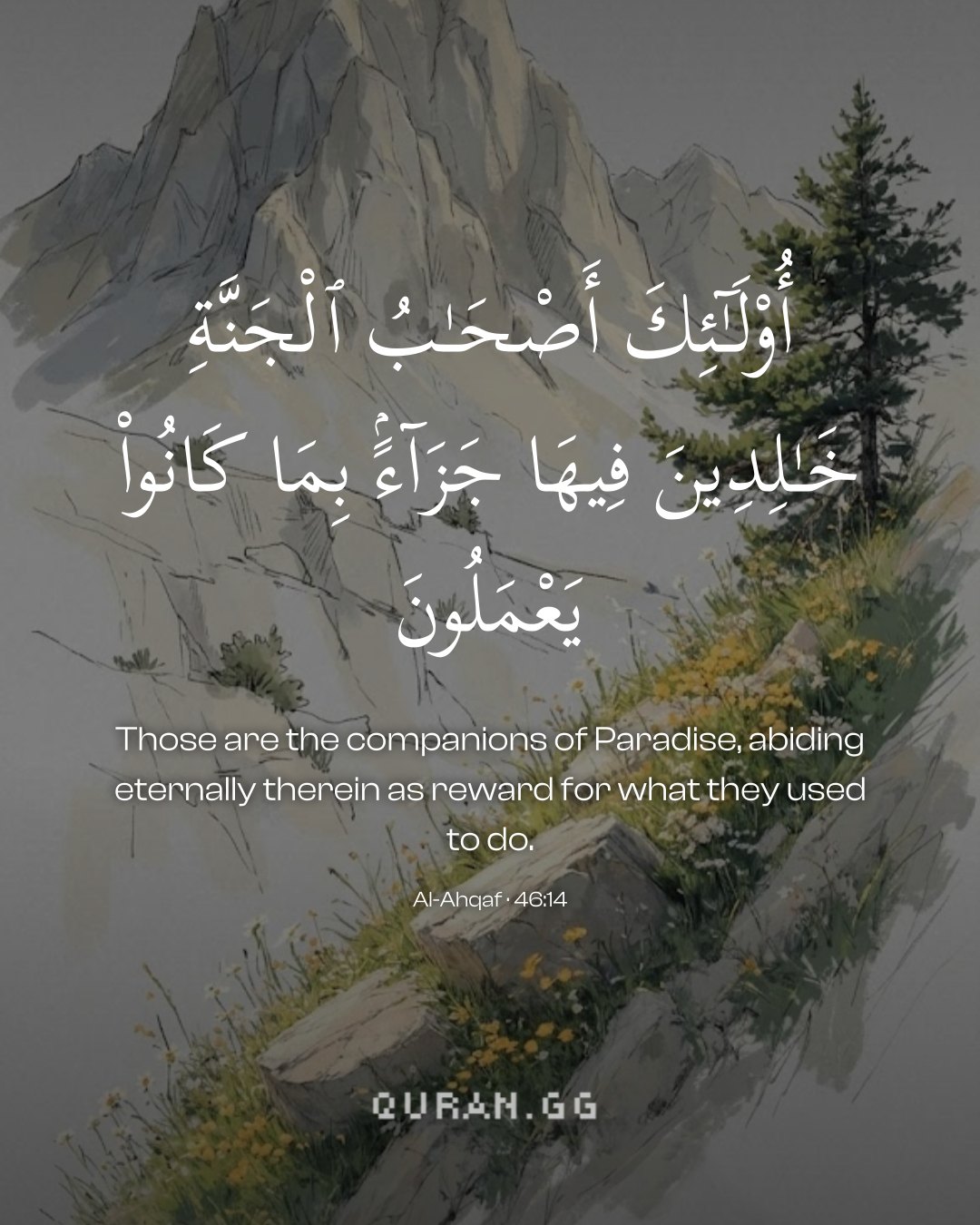
One argument in favour of the veracity of the Quran is that the previous revealed scriptures predicted it. These predictions are still found in the Bible (Injeel) and the Torah. The Quran thus came as a realisation of earlier divine predictions, giving concrete shape to what had been foreseen many centuries before. This is a clear indication that the Quran is really a divine Book; otherwise how could it have been possible to give advance information about it hundreds and thousands of years ago? It is reported on the authority of ‘Abdullah ibn ‘Abbas that verse 13, broadly interpreted, means being steadfast in the discharge of duties attached to Faith. (Tafsir ibn Kathir). Faith (iman) is a sacred pledge or vow. Time and again, moments of trial occur in the life of a man when he either keeps his pledge of Faith, or he breaks it. On such occasions, one who acts in accordance with his pledge of Faith, shows his steadfastness, while one who fails to do so, shows his lack of devotion. Those unable to prove their steadfastness are transgressors, while those who prove to be steadfast are the ones who will be lodged in the eternal gardens of Paradise.
Uthmani text of the Madinah mushaf (King Fahd Complex). Translation: Saheeh International. Tafsir via Quran.com.