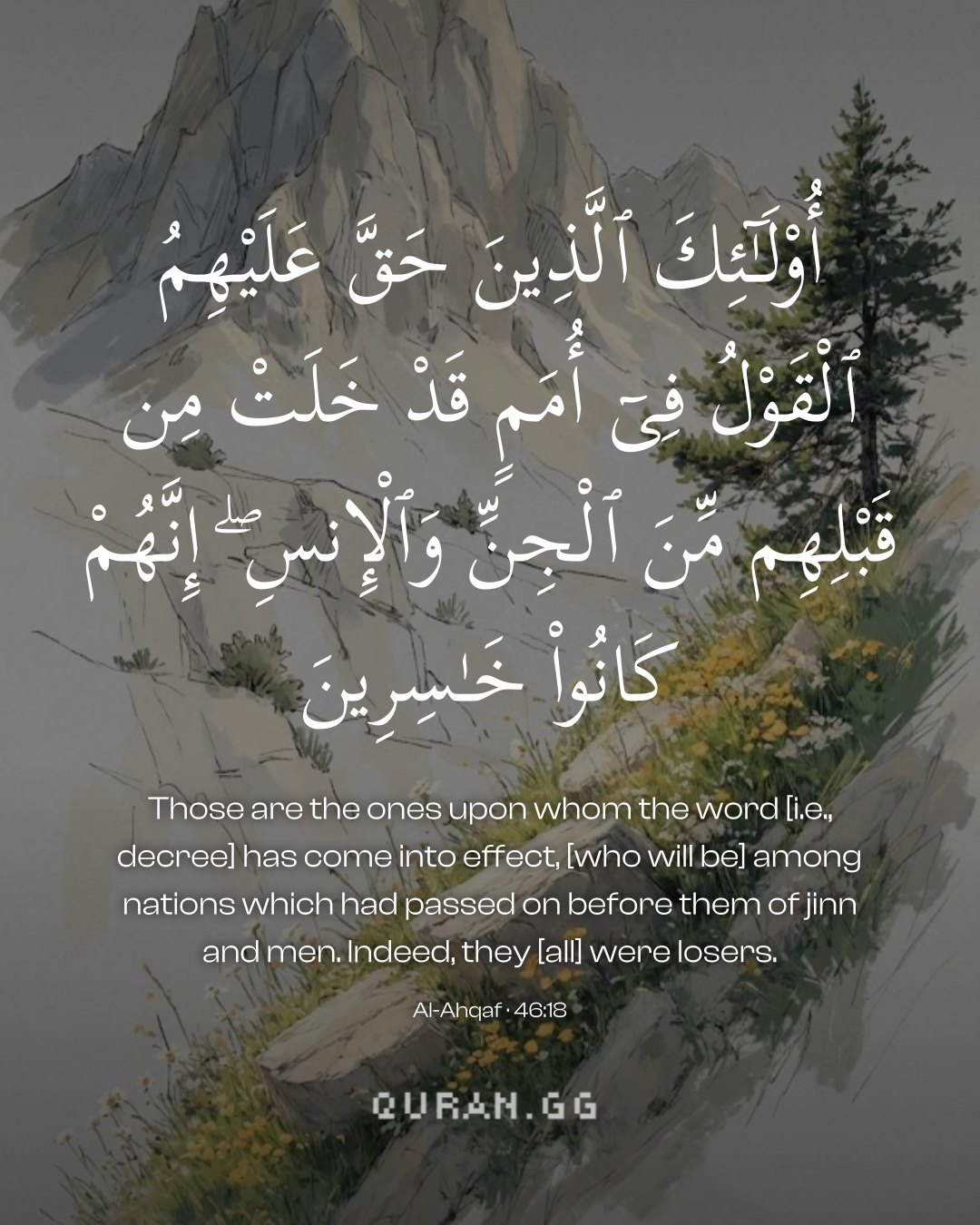
Those are the ones upon whom the word [i.e., decree] has come into effect, [who will be] among nations which had passed on before them of jinn and men. Indeed, they [all] were losers.
In the previous Ayat, Allah mentions the dutiful offspring who supplicate for their parents and treat them with kindness. He describes the success and salvation He has prepared for them. Here He connects to that discussion the situation of the wretched offspring who are undutiful toward their parents. Allah says,
وَالَّذِى قَالَ لِوَلِدَيْهِ أُفٍّ لَّكُمَآ
(But he who says to his parents: "Uff to you! ...") As for the saying "Uff" in this Ayah, it is a general description applying to anyone who says it to his parents. Some people claim that it was revealed about `Abdur-Rahman bin Abi Bakr. But this claim is weak and rejected, because `Abdur-Rahman bin Abi Bakr embraced Islam after this was revealed. His adherence to Islam was excellent, and he was among the best of his contemporaries. Al-Bukhari recorded from Yusuf bin Mahak that Marwan (bin Al-Hakam) was governor of Hijaz (Western Arabia), appointed by Mu`awiyah bin Abi Sufyan. He (Marwan) delivered a speech in which he mentioned Yazid bin Mu`awiyah and urged the people to give a pledge of allegiance after his father. `Abdur-Rahman bin Abi Bakr said something to him in response to that, upon which Marwan commanded his men: "Arrest him!" But he entered `Aishah's house, and they were not able to capture him. Marwan then said: "This is the one about whom Allah revealed:
وَالَّذِي قَالَ لِوَالِدَيْهِ أُفٍّ لَّكُمَا (And, [ contrary to this is the case on the one who said to his parents, 'Fie upon you both!' - 46:17). The previous verse has laid down the order to serve and obey the parents; this verse announces punishment for one who maltreats his parents and is impertinent to them, especially when they are calling him towards Islam and virtuous deeds, because rejecting their call is a double sin. Ibn Kathir has said that the verse is general and applies to anyone who maltreats his parents.
Marwan's saying, in one of his addresses, that this verse holds true for ` Abdur Rahman Ibn Abi Bakr ؓ has been contradicted by Sayyidah ` A'ishah ؓ ، as narrated in Sahih of Bukhari. The fact of the matter is that the verse is general in sense, and there is no correct narration which states this verse to hold true for a particular person.
Tazkirul Quran
Maulana Wahiduddin KhanOn ayahs 18–19
Children who are obedient to their parents are also obedient to God. Contrary to this, the behaviour of disobedient children is such that, when they grow up, they forget that their parents had to endure innumerable troubles to bring them to adulthood. The best well-wishers of the individual are his parents. Whatever advice parents offer their children is based on absolutely selfless well-wishing. Therefore, one should give more weight to the advice of righteous parents. One who rebukes his righteous parents for their advice proves by his behaviour that he is a very hard-hearted person. It is such as he who will suffer heavy losses.
Uthmani text of the Madinah mushaf (King Fahd Complex). Translation: Saheeh International. Tafsir via Quran.com.