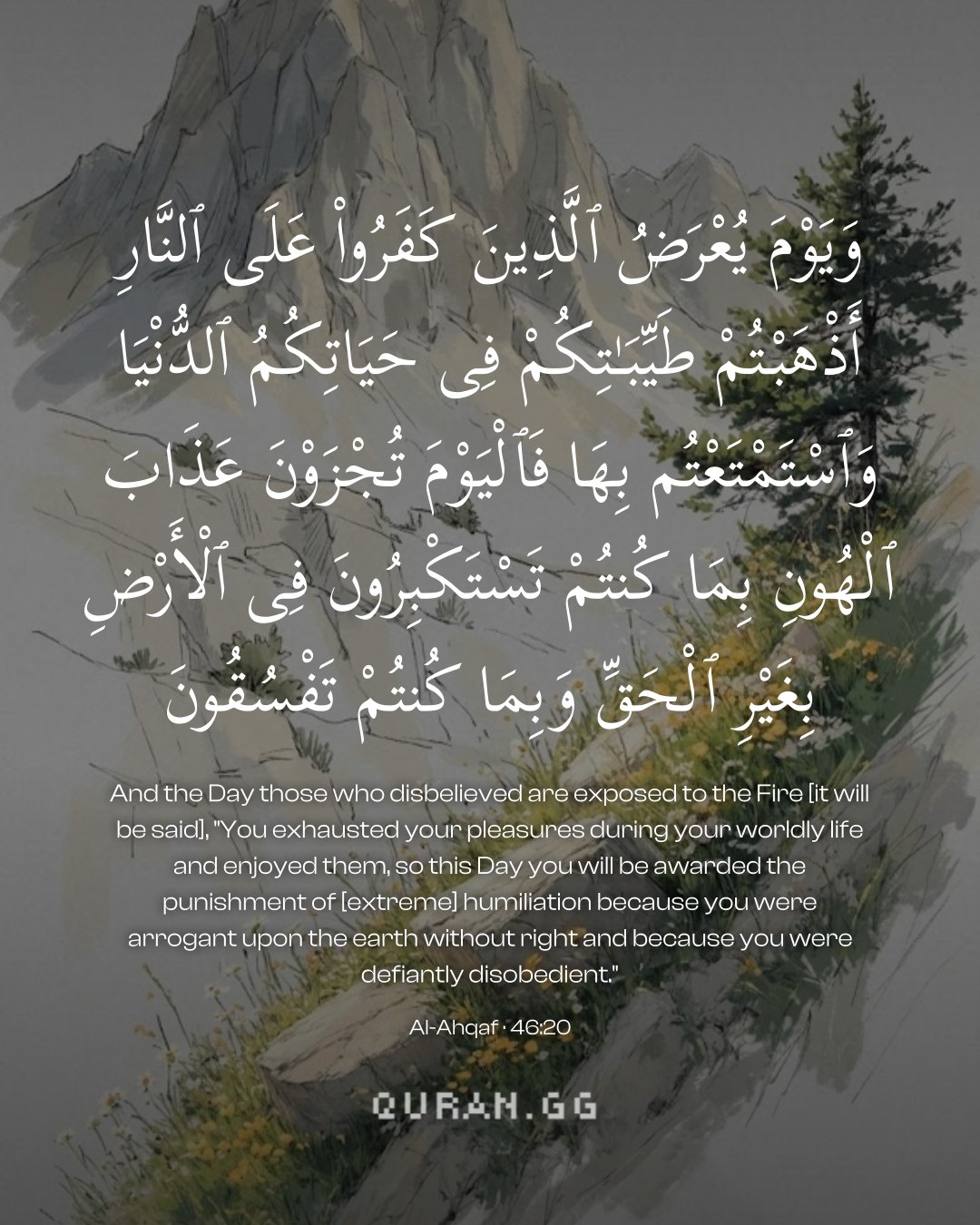
And the Day those who disbelieved are exposed to the Fire [it will be said], "You exhausted your pleasures during your worldly life and enjoyed them, so this Day you will be awarded the punishment of [extreme] humiliation because you were arrogant upon the earth without right and because you were defiantly disobedient."
In the previous Ayat, Allah mentions the dutiful offspring who supplicate for their parents and treat them with kindness. He describes the success and salvation He has prepared for them. Here He connects to that discussion the situation of the wretched offspring who are undutiful toward their parents. Allah says,
وَالَّذِى قَالَ لِوَلِدَيْهِ أُفٍّ لَّكُمَآ
(But he who says to his parents: "Uff to you! ...") As for the saying "Uff" in this Ayah, it is a general description applying to anyone who says it to his parents. Some people claim that it was revealed about `Abdur-Rahman bin Abi Bakr. But this claim is weak and rejected, because `Abdur-Rahman bin Abi Bakr embraced Islam after this was revealed. His adherence to Islam was excellent, and he was among the best of his contemporaries. Al-Bukhari recorded from Yusuf bin Mahak that Marwan (bin Al-Hakam) was governor of Hijaz (Western Arabia), appointed by Mu`awiyah bin Abi Sufyan. He (Marwan) delivered a speech in which he mentioned Yazid bin Mu`awiyah and urged the people to give a pledge of allegiance after his father. `Abdur-Rahman bin Abi Bakr said something to him in response to that, upon which Marwan commanded his men: "Arrest him!" But he entered `Aishah's house, and they were not able to capture him. Marwan then said: "This is the one about whom Allah revealed:
أَذْهَبْتُمْ طَيِّبَاتِكُمْ فِي حَيَاتِكُمُ الدُّنْيَا ("You have consumed your good things in your worldly life - 46:20), It means that the infidels will be told that they had already been awarded delights, luxuries and enjoyment in the worldly life for whatever good deeds they had done there; now there is nothing left for them in the Hereafter. It is known from this verse that the good deeds of disbelievers do not have any worth in the Hereafter due to lack of belief or faith, but Allah Ta’ ala compensates them in this world. The riches and wealth, honour and dignity, etc., which are enjoyed by disbelievers in this world are all recompense for their good deeds, benevolence, sympathy, truthfulness, etc. This rule does not apply to Mu'mins (believers) that if they get any delights, riches and wealth in this world, they would be deprived of their right in the Hereafter.
Incentive for avoiding worldly delights and luxuries
The punishment stated in this verse for the disbelievers is because of their being engrossed in worldly enjoyments. So, the Holy Prophet ﷺ ، his noble companions and Tabi` in رحمۃ اللہ علیہم had made it a habit to avoid worldly enjoyments, as is evident from their lives. The Holy Prophet ﷺ had charged Sayyidna Mu` adh ؓ ، when sending him to Yemen, to keep on avoiding the luxuries of this world. Sayyidna ‘Ali ؓ has reported the Holy Prophet ﷺ saying that one who is happy with Allah Ta’ ala giving him scanty sustenance finds Allah Ta’ ala also happy at his meager deeds. (Mazhari from al-Baghawi)
Tazkirul Quran
Maulana Wahiduddin KhanOn ayahs 20–22
The Truth appears before a man, but, unwilling to relinquish worldly goals and material gain, he rejects it. This means that he sets worldly interests above the exigencies of the Hereafter; he wants to pursue the attractions of this world rather than seek the good things of the afterlife. Then, when he is required to demolish the structure of self-aggrandisement in order to accept the Truth, he prefers to reject it, so as to save his empty prestige: after all, he relishes the feeling of being a great man. At that point, in effect, he shows his preference for the enticements of this world over the blessings of the Hereafter, treating them as unworthy of consideration.
Uthmani text of the Madinah mushaf (King Fahd Complex). Translation: Saheeh International. Tafsir via Quran.com.