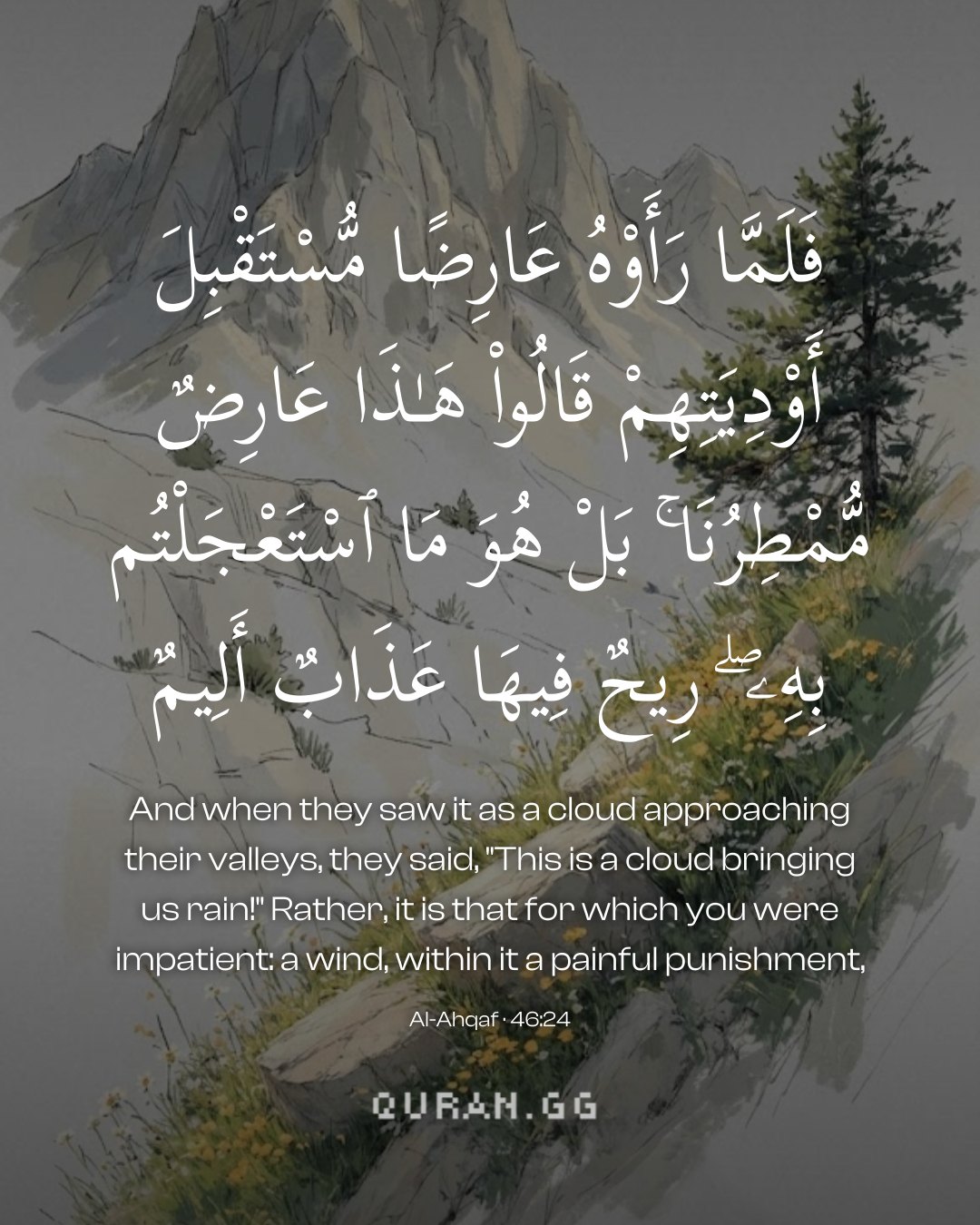
And when they saw it as a cloud approaching their valleys, they said, "This is a cloud bringing us rain!" Rather, it is that for which you were impatient: a wind, within it a painful punishment,
Allah says, consoling His Prophet in regard to the rejection of those who opposed him among his people,
وَاذْكُرْ أَخَا عَادٍ
(And remember the brother of `Ad,) This refers to Hud, peace be upon in him. Allah sent him to the first people of `Ad who inhabited Al-Ahqaf. Ahqaf is plural of Haqf. According to Ibn Zayd, it means a sand dune; and according to `Ikrimah, it means a mountain or a cave. Qatadah said: "We were informed that `Ad was a tribe in Yemen. They dwelt among sand (hills), and overlooked the sea in a land called Ash-Shihr." Under the chapter, "He Who supplicates should first mention Himself," Ibn Majah recorded that Ibn `Abbas narrated that the Prophet said:
{ 1} The reference here is to the towns of Thamud and the people of Sayyidna Lut (علیہ السلام) that were in the way of the people of Arabia while they travelled to Syria. The people of ` Ad were in Yemen, towards South from Makkah, while the towns of Thamud and those of Sayyidna Lut (علیہ السلام) were towards North, hence the words, "around you"
Commentary
These verses are to remind the infidels of the severe punishments faced by earlier people who rejected the messengers sent to them. Special reference is made to ` Ad, the people of Sayyidna Hud (علیہ السلام) who has been described as their 'brother', firstly because he belonged to their tribe, and secondly because he was their well-wisher as a brother. Since this nation lived in valleys surrounded by long, curved sand dunes, called in Arabic Ahqaf , special reference is made to these dunes, so that one could find out their places, if he so wishes when traveling to their localities. It is mentioned in verse 22 that they themselves demanded Allah's punishment to be brought upon them. Then verse 24 states that the punishment was sent to them in the form of a cloud that appeared to be benign, and therefore they were happy to see it in the hope that it would bring rain to them, but in fact it contained the divine punishment in the form of a violent wind that destroyed everything, leaving nothing except their empty homes that remained as a sign for those who might learn a lesson. The detailed account of the story of ` Ad and Thamud has already been given in Surah Hud (11:50) for which volume 4, page 643 of this book may be consulted. Mention of these events in these verses is in the form of a brief reference, and in verse 26 the infidels of Makkah are reminded that those nations were much more powerful and well-established than the people of Makkah. Still, their power and strength was of no use to them against Allah's punishment. Moreover, verse 28 points out that the false gods believed by them to be their patrons could not save them from the torment they faced, because they were coined only by their false imagination, having no real existence at all.
The people of ‘Ad once inhabited that area of southern Arabia which is now known as ar-Rub al-Khali. They made considerable progress, but their development pushed them into arrogance and neglectfulness. Then Almighty God made Hud, a member of that community, a prophet, and sent him to them. Hud warned his community of God’s displeasure but, unwilling to be reformed, it received its prophet with rudeness. Ultimately, God’s wrath descended upon it and it received such a severe punishment that its glorious and lush green surroundings turned into a totally arid desert.
Uthmani text of the Madinah mushaf (King Fahd Complex). Translation: Saheeh International. Tafsir via Quran.com.