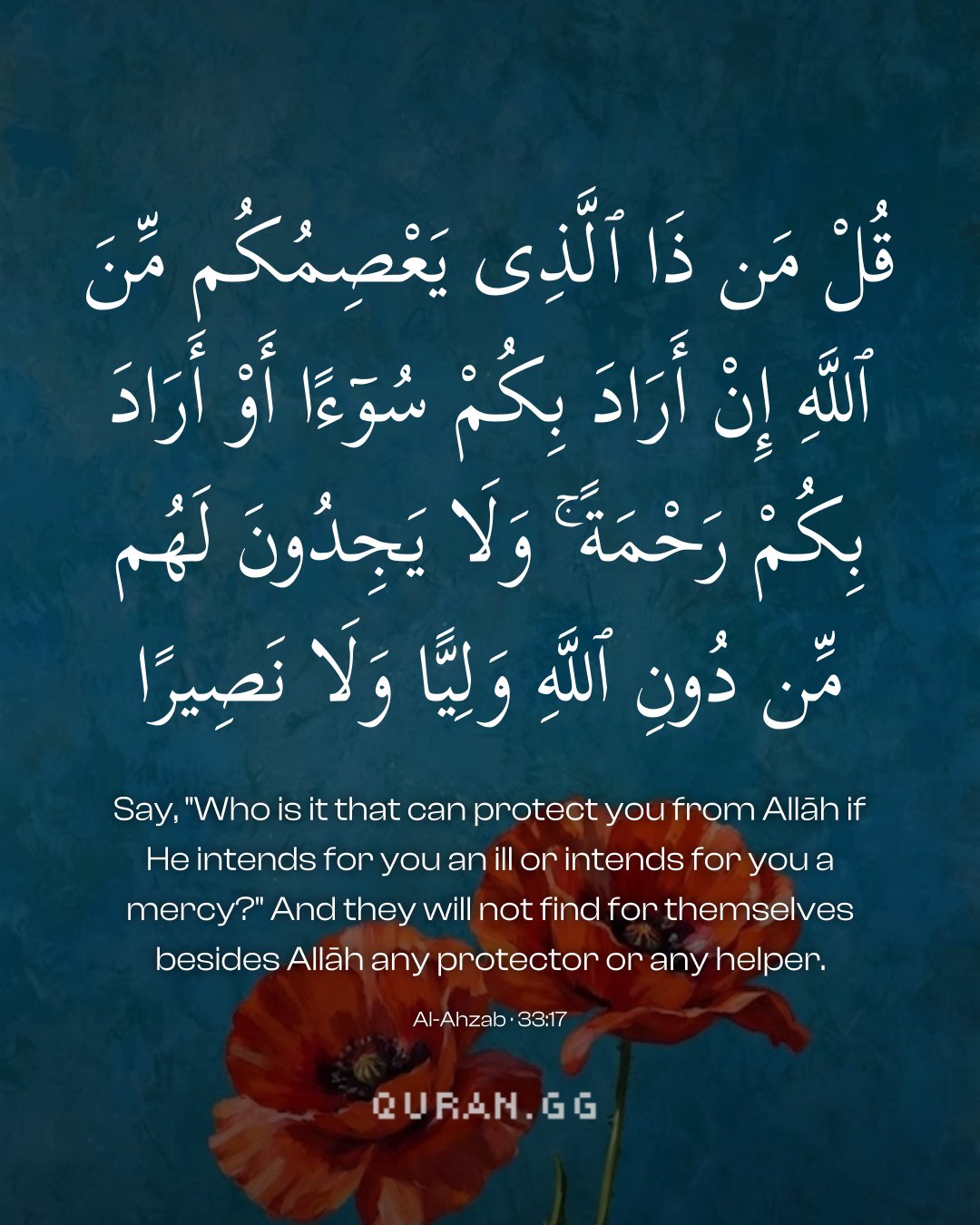
Say, "Who is it that can protect you from Allāh if He intends for you an ill or intends for you a mercy?" And they will not find for themselves besides Allāh any protector or any helper.
("Truly, our homes lie open." And they lay not open. They but wished to flee.) If the enemy had entered upon them from every side of Al-Madinah and from every direction, then demanded that they become disbelievers, they would have promptly done so. They would not have adhered to their faith or remained steadfast in it if they were faced with the slightest fear. This is how it was interpreted by Qatadah, `Abdur-Rahman bin Zayd and Ibn Jarir. This is a condemnation of them in the clearest terms. Then Allah reminds them of the promise they had made to Him before this fear struck them, that they would not turn their backs or flee from the battlefield.
The second state mentioned here is that of the hypocrites for they had started saying that the promises of Allah and His Rasul ﷺ were a web of deception: إِذْ يَقُولُ الْمُنَافِقُونَ وَالَّذِينَ فِي قُلُوبِهِم مَّرَضٌ مَّا وَعَدَنَا اللَّـهُ وَرَسُولُهُ إِلَّا غُرُورًا (And (remember) when the hypocrites and those having malady in their hearts were saying, "Allah and His messenger did not promise us but deceitfully; -12). This was an externalized demonstration of their inner disbelief. Onward from here, mention has been made of two groups of hypocrites who were practically a part of the Jihad effort along with Muslims, though outwardly only. One of the two groups started running without any permission saying: وَإِذْ قَالَت طَّائِفَةٌ مِّنْهُمْ يَا أَهْلَ يَثْرِبَ لَا مُقَامَ لَكُمْ فَارْجِعُوا (and when a group of them said, "0 people of Yathrib (Madinah), there is no place for you to stay; so go back. - 13" And the other group requested the permission of the Holy Prophet ﷺ to go back on the basis of false excuses. Their conduct has been mentioned as: وَيَسْتَأْذِنُ فَرِيقٌ مِّنْهُمُ النَّبِيَّ يَقُولُونَ إِنَّ بُيُوتَنَا عَوْرَةٌ (And a group of them was seeking permission (to leave) from the prophet, saying, "In fact our homes are vulnerable," while they were not vulnerable - 13). Thus, the Qur'an exposed the hollowness of their excuses as a pack of lies. The truth of the matter was no more than that they intended to run from the battlefront:إِن يُرِيدُونَ إِلَّا فِرَارًا (They wanted nothing but to escape - 13). Taken up in the next several verses is their mischief-making and enmity with Muslims following which their sad end has been pointed out.
Realizing that the situation at the battle of Ahzab, was fraught with danger, the hypocrites were terrified and started exploring ways and means of fleeing. But the true and faithful ones firmly placed their reliance on God. They knew very well that God was before them and He was behind them. To run away from the danger of the enemies of Islam amounted to placing oneself in danger of God’s chastisement, which was by far the greater hazard. They firmly believed that if they were steadfast in the face of their enemies, God’s help would be forthcoming. On the other hand, they knew that if they fled the Islamic front, they would not be able to save themselves from either destruction in this world or God’s terrible scourge in the Hereafter.
Uthmani text of the Madinah mushaf (King Fahd Complex). Translation: Saheeh International. Tafsir via Quran.com.