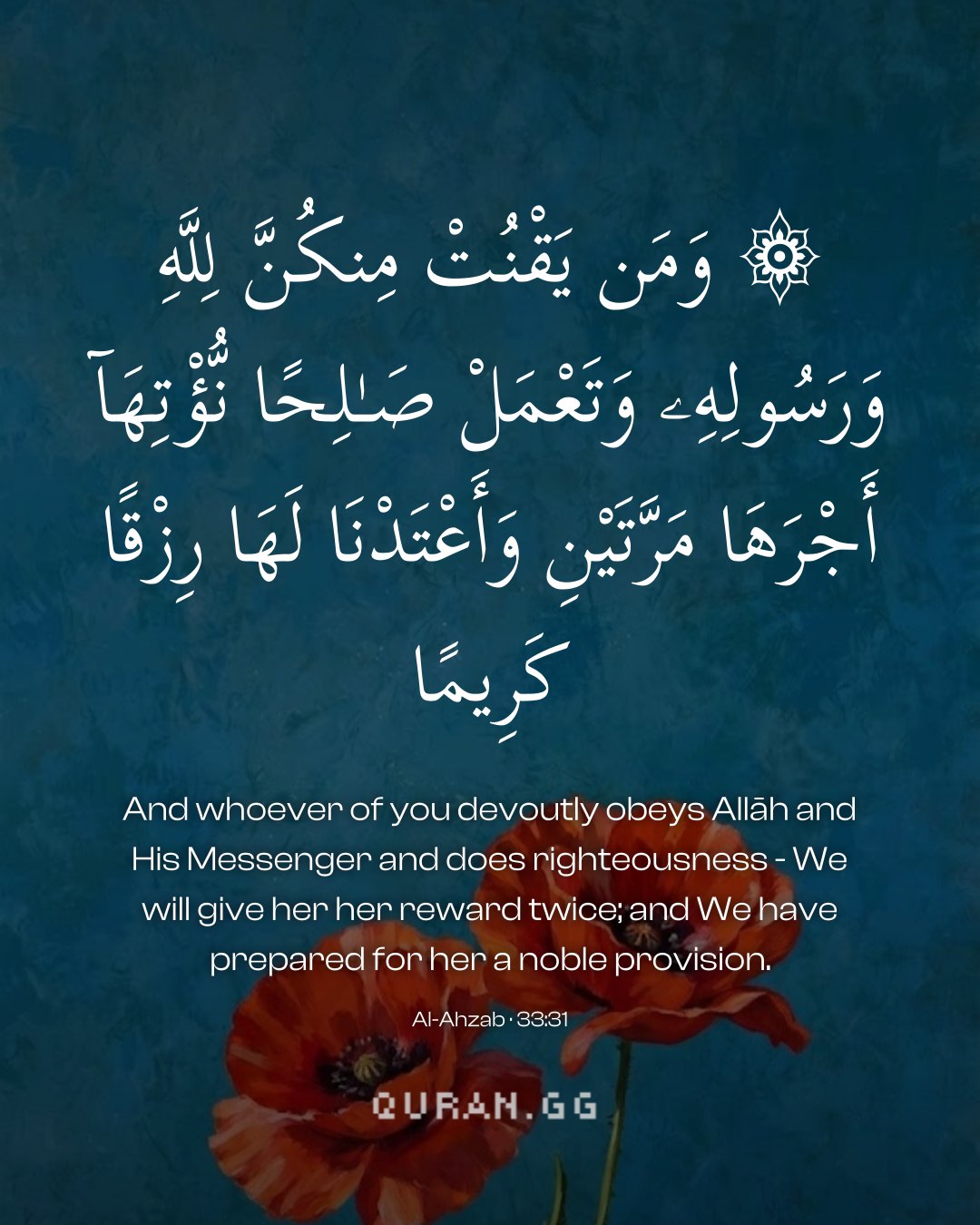
And whoever of you devoutly obeys Allāh and His Messenger and does righteousness - We will give her her reward twice; and We have prepared for her a noble provision.
This Ayah is addressed to the wives of the Prophet who chose Allah and His Messenger and the Home of the Hereafter, and remained married to the Messenger of Allah ﷺ. Thus it was befitting that there should be rulings which applied only to them, and not to other women, in the event that any of them should commit open Fahishah. Ibn `Abbas, may Allah be pleased with him, said: "This means Nushuz (rebellion) and a bad attitude." Whatever the case, this is a conditional phrase and it does not imply that what is referred to would actually happen. This is like the Ayat:
O wives of the Prophet, whoever from among you will commit a clearly shameful act, the punishment will be doubled for her. And it is easy for Allah to do so. [ 30] And whoever of you stays obedient to Allah and His messenger, and acts righteously, We shall give her twice her reward, and We have prepared for her a prestigious provision. [ 31]
The Hijrah (migration to Madinah) had greatly disrupted the economy of the Muslims. Moreover, after the Hijrah, the enemies of Islam kept the Muslims continuously engaged in wars. As a result, the economic condition of the Muslims had seriously deteriorated. The greatest impact of this condition was on the Prophet Muhammad. It was difficult to provide even the bare necessities of life to the members of his household. Things reached the stage when his consorts were forced to demand maintenance. What his consorts asked for was basic necessities, but this was mentioned by God as a demand for worldly glitter—possibly too forceful an expression, just like the expression ‘shameful acts’ (fahishah). The Prophet had been assigned the most important mission in history, i.e. bringing to an end the age of polytheism and ushering in an era of monotheism. Under these circumstances, it was not possible for him to give importance to anything else. So, the consorts of the Prophet were told that either they should live contentedly with the Prophet and display greater endurance or, if that was not acceptable, to seek separation gracefully, but that raising domestic problems and thus diverting the attention of the Prophet could not be countenanced.
Uthmani text of the Madinah mushaf (King Fahd Complex). Translation: Saheeh International. Tafsir via Quran.com.