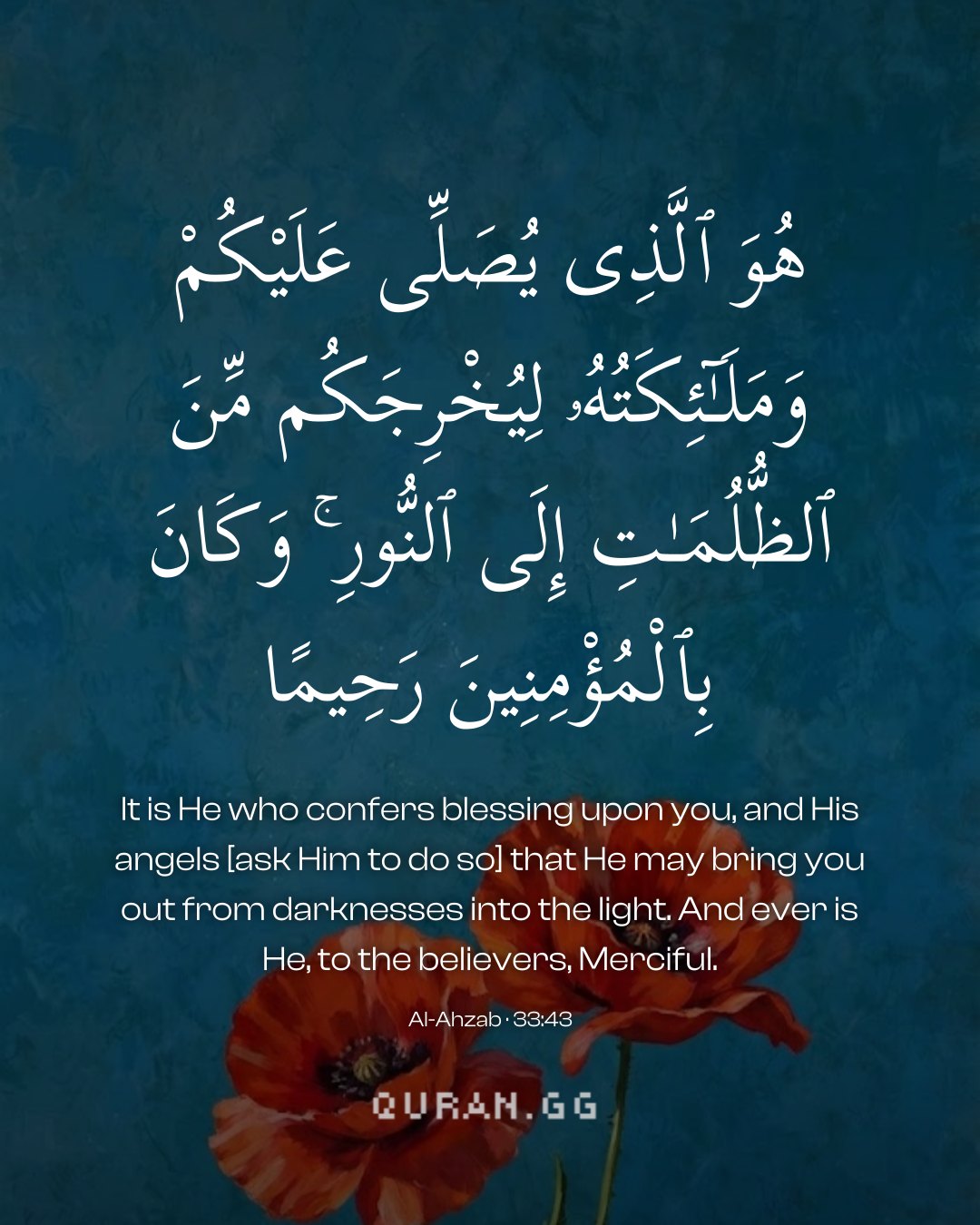
It is He who confers blessing upon you, and His angels [ask Him to do so] that He may bring you out from darknesses into the light. And ever is He, to the believers, Merciful.
Allah commands His believing servants to remember their Lord much, Who has bestowed upon them all kinds of blessings and favors, because this will bring them a great reward and a wonderful destiny. Imam Ahmad recorded that `Abdullah bin Busr said: "Two bedouins came to the Messenger of Allah ﷺ and one of them said: `O Messenger of Allah, which of the people is best' He said:
«مَنْ طَالَ عُمْرُهُ وَحَسُنَ عَمَلُه»
(The one whose life is long and whose deeds are good.) The other one said: `O Messenger of Allah, the laws of Islam are too much for us. Teach me something that I can adhere to.' He said,
هُوَ الَّذِي يُصَلِّي عَلَيْكُمْ وَمَلَائِكَتُهُ (He is such that He and His angels send blessings to you. 33:43) It means that when you have become used to dhikrullah in abundance and have become regular in recounting the perfections of Allah morning and evening, Allah would honor you and respect you by bestowing His Blessings and by the angels supplicating for you.
The word 'Salah' has been used in this verse for Allah Ta’ ala as well as for the angels but the applicable meaning are different. For Allah it means His bestowing blessings, and for angels who have no volition on their own, it means their supplication to Allah to bestow His blessings.
Tazkirul Quran
Maulana Wahiduddin KhanOn ayahs 40–43
After the above-mentioned incident, there was as expected, a great deal of propaganda against the Prophet Muhammad. It was alleged that the Prophet had married his own daughter-in-law and such a marriage was illegal. To counter this, it was clarified that, in Muhammad’s case, the fact was that he had only daughters—no sons. Zayd, son of Harithah, was only his adopted son and not his real son. So how could a woman, married to and divorced by him, be illegal for one who was not his real father? Why is it that the Prophet had to face so many ups and downs, in spite of being the Prophet? The reason is that though the Prophet received divine revelation, he had to lead his life as a common man. In the world of trial, he faced the same circumstances as others had to face. Had it not been so, the Prophet’s life would not have been an example for the common people. That is why prophetic guidance is given within the framework of realistic events, rather than under unrealistic or artificial conditions. The Prophet Muhammad was the seal of the prophets. The word ‘khatam’ is used for ‘seal’, i.e. the final act. To seal an envelop means closing it finally, after which nothing can either be extracted or inserted into it. That is why in Arabic, the ‘khatam’ of a community means the last person of that community. The announcement that the Prophet Muhammad was the ‘khatemun-Nabiyyin’ means that no prophet was going to come after him and, as such, it was necessary that all godly matters be revealed through him.
Uthmani text of the Madinah mushaf (King Fahd Complex). Translation: Saheeh International. Tafsir via Quran.com.