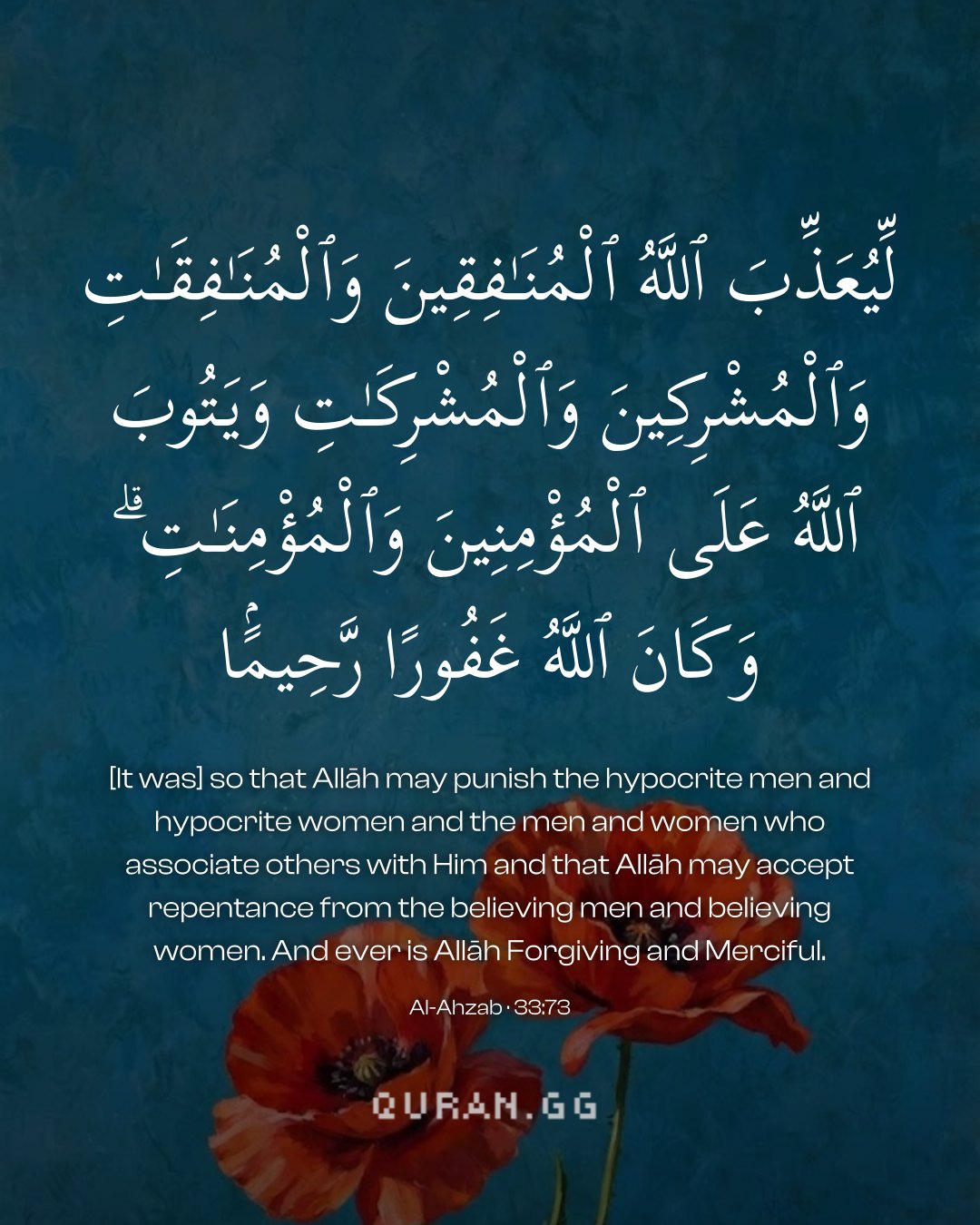
[It was] so that Allāh may punish the hypocrite men and hypocrite women and the men and women who associate others with Him and that Allāh may accept repentance from the believing men and believing women. And ever is Allāh Forgiving and Merciful.
Al-`Awfi reported that Ibn `Abbas said, "Al-Amanah means obedience. This was offered to them before it was offered to Adam, and they could not bear it. Then Allah said to Adam: `I have offered the Amanah to the heavens and the earth and the mountains, and they could not bear it. Will you take it on' He said, `O Lord, what does it involve' He said, `If you do good, you will be rewarded, and if you do evil, you will be punished.' So Adam took the Amanah and bore it, and this is what is referred to in the Ayah:
(But man bore it. Verily, he was unjust and ignorant.)" `Ali bin Abi Talhah reported that Ibn `Abbas said, "Al-Amanah means Al-Fara'id (the obligatory duties). Allah offered them to the heavens and the earth and the mountains, (on the grounds that) if they fulfilled them, He would reward them; and if they failed, He would punish them. But they did not want to do that, and they were afraid of it, not because their intention was sinful, but because of their respect for the religion of Allah, in case they could not fulfill the obligations involved. Then Allah offered it to Adam, and he accepted it with all that it entailed. This is what is referred to in the Ayah:
لِّيُعَذِّبَ اللَّـهُ الْمُنَافِقِينَ وَالْمُنَافِقَاتِ (with the result that Allah will punish the hypocrites, men and women, and the Mushriks, men and women, and will accept the repentance of the believing men and women. Surely Allah is Most-Forgiving, Very-Merciful. [ 73]) The letter 'lam' used in the beginning of this verse is not for mentioning the cause or aim, as generally understood in common usage, but it is the lam of 'aqibah in the terminology of Arabic linguistics. It points out to the end of something, as it appears in a line of Arabic poetry which reads:
لِدُوا لِلمَوتِ وَ ابنُوا لِلخَرَابِ
'Be born only to be dead and build only to be ruined'.
It does not mean that the aim of one's birth was to be dead or that the aim of constructing of a building was that it could be ruined, but it simply means that the end of everyone born is death and the end of every building is falling into ruins.
The sense of the verse is that, as a result of man's assumption of responsibility for the trust, mankind will split in two groups: (1) Disbelievers, hypocrites and others who will rebel against Divine orders and become wasters of the great 'trust'. They will be punished. (2) There will be believing men and believing women who, through their obedience to Divine injunctions, will fulfill the dictates of the trust reposed in them. They will be treated with mercy and forgiveness.
The Tafsir of the two words: Zalum and Jahul that has been reported above from most Tafsir authorities finds additional support in this last sentence as well - that these words are not meant for the whole mankind. In fact, they particularly refer to those individuals who wasted away the Divine trust reposed in them. And Allah, Pure and High, knows best.
The Commentary on
Surah Al-Ahzab ends here
With the help of and praise for Allah Ta’ ala
Tazkirul Quran
Maulana Wahiduddin Khan
The offering of ‘trust’ here means a transference of power, to be used at man’s discretion. This power is something with which God has entrusted man temporarily, by way of trial, so that man of his own volition, should become obedient to God. Acceptance of this trust amounts to becoming God’s representative. One has to impose upon oneself what the stars and planets do under compulsion. In other words, surrender voluntarily to God’s will. In this universe, only God is the Lord and all things are His subjects. But, Almighty God willed that He should create independent creatures who, without any compulsion, would voluntarily do whatever God wanted them to do. This voluntary obedience constituted a great trial for mankind. The heavens, the earth and the mountains could not undertake it. However, man accepted it, in spite of the serious risks involved. Now man is God’s trustee in this world. He has to apply the rule of God to himself just as God applies it to others according to His will. Man is being put to the test and the present world is a vast examination hall. God’s trust is an extremely crucial responsibility, because it gives rise to the problem of reward and punishment. Other creatures, being helpless, are bound to conform to the will of God. So there is no question of reward or punishment for them. But, man enjoys freedom and this being so, he is deserving of reward or punishment. There is a tradition handed down from ‘Abdullah ibn ‘Abbas, which says that when Almighty God mentioned the subject of trust to Adam, he asked what was meant by trust. Almighty God replied: ‘If you perform good deeds, you will receive a reward, but if you perform bad deeds, you will be punished.’ (Tafsir ibn Kathir). The will of God has been enforced on the whole world. This same will of God has to be imposed on man of his own accord.
Uthmani text of the Madinah mushaf (King Fahd Complex). Translation: Saheeh International. Tafsir via Quran.com.