Tafsir Ibn Kathir (abridged)
Ismail ibn Kathir
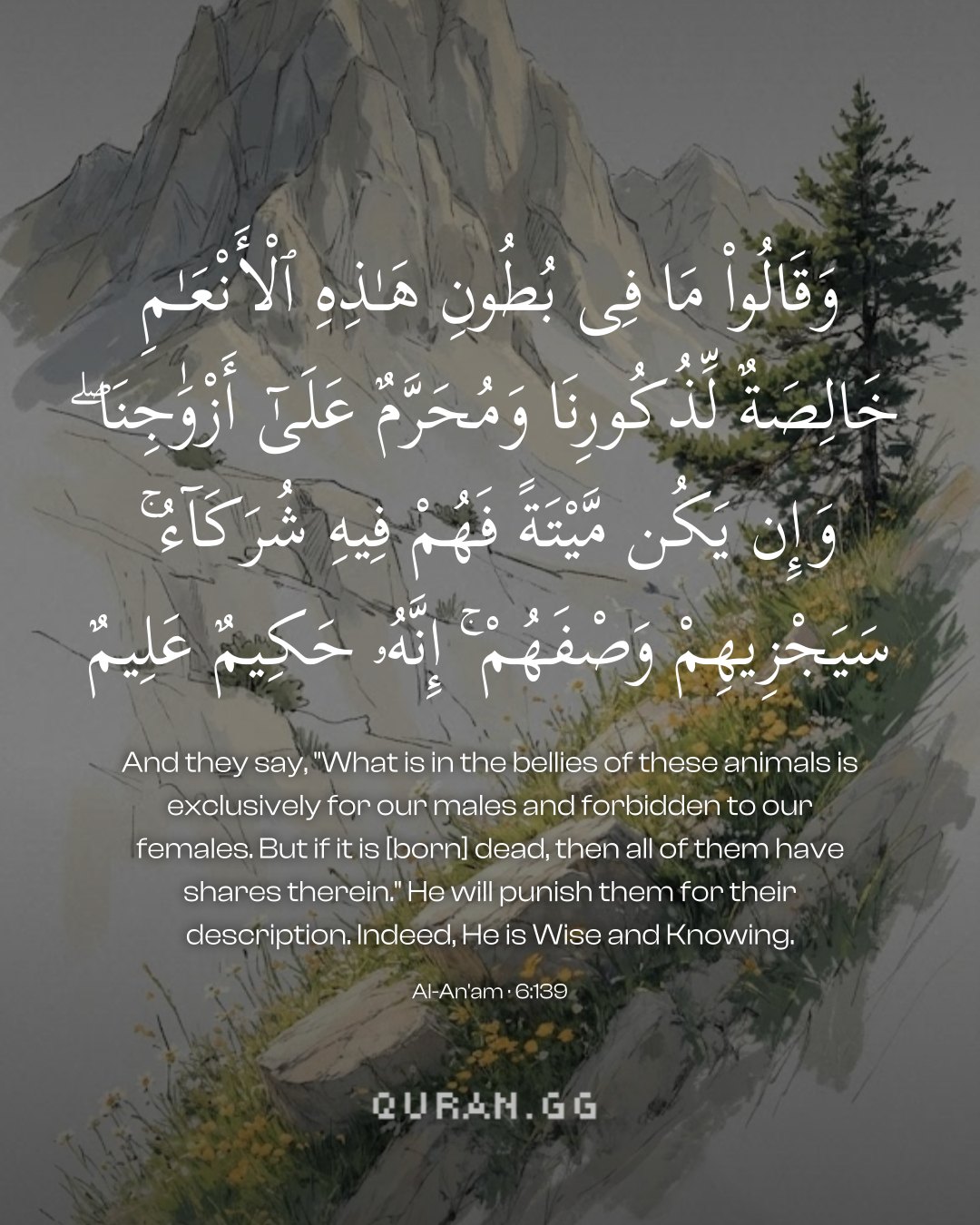
وَقَالُواْ مَا فِى بُطُونِ هَـذِهِ الأَنْعَـمِ خَالِصَةٌ لِّذُكُورِنَا
(And they say: "What is in the bellies of such and such cattle is for our males alone...") refers to milk. `Awfi said that Ibn `Abbas said about this Ayah,
وَقَالُواْ مَا فِى بُطُونِ هَـذِهِ الأَنْعَـمِ خَالِصَةٌ لِّذُكُورِنَا
(And they say: "What is in the bellies of such and such cattle is for our males alone...") "It is about milk, which they prohibited for their females and allowed only their males to drink. When a sheep would give birth to a male sheep, they would slaughter it and feed it to their males, but not to their females. If the newly born lamb was a female, they would not slaughter it, but if it was stillborn, they would share in it (with their females)! Allah forbade this practice." Similar was said by As-Suddi. Ash-Sha`bi said, "The Bahirah's milk was only given to the men. But if any cattle from the Bahirah died, both men and women would share in eating it." Similar was said by `Ikrimah, Qatadah and `Abdur-Rahman bin Zayd bin Aslam. Mujahid commented;
وَقَالُواْ مَا فِى بُطُونِ هَـذِهِ الأَنْعَـمِ خَالِصَةٌ لِّذُكُورِنَا وَمُحَرَّمٌ عَلَى أَزْوَجِنَا
(And they say: "What is in the bellies of such and such cattle is for our males alone, and forbidden to our females...") "It refers to the Sa'ibah and the Bahirah." Abu Al-`Aliyah, Mujahid and Qatadah said that Allah's statement,
سَيَجْزِيهِمْ وَصْفَهُمْ
(He will punish them for their attribution. ) means, uttering such falsehood. This is explained by Allah's statement,
وَلاَ تَقُولُواْ لِمَا تَصِفُ أَلْسِنَتُكُمُ الْكَذِبَ هَـذَا حَلَـلٌ وَهَـذَا حَرَامٌ لِّتَفْتَرُواْ عَلَى اللَّهِ الْكَذِبَ إِنَّ الَّذِينَ يَفْتَرُونَ عَلَى اللَّهِ الْكَذِبَ لاَ يُفْلِحُونَ
(And say not concerning that which your tongues falsely utter: "This is lawful and this is forbidden." so as to invent lies against Allah. Verily, those who invent lies against Allah will never prosper.) 16:116 Allah said,
إِنَّهُ حَكِيمٌ
(Verily, He is All-Wise.) in His actions, statements, Law and decree,
عَلِيمٌ
(All-Knower), in the actions of His servants, whether good or evil, and He will recompense them for these deeds completely.
Linkage of Verses
Described in the previous verses were false beliefs of the mushriks of Arabia while the present verses recount their practical errors and ignorant customs. The customs of Jahiliyyah mentioned in these verses are: (1) They took out a portion in the name of Allah from grains and fruits, and some in the name of idols and Jinns. Then, if by chance, some part of what belonged to the portion of Allah got mixed up with the portion reserved for idols, they would let it stay mixed as it was. When the position was the reverse of it, they would take it out and make the portion set for idols even. The excuse was that Allah is need-free. A cut in His share does not harm Him while the partners need it - so, their share should not be decreased. This evil custom was mentioned earlier in verse 136.
Continue reading the tafsir of ayahs 137–141Tazkirul Quran
Maulana Wahiduddin Khan
In ancient times, the people of Arabia used to attribute their religion to Abraham and Ishmael. But, in practice, the religion prevalent there was a self-made one, which their leaders had invented and introduced among them. The offering of their produce and cattle made in the name of God and His alleged partners were subject to strict restrictions of their own conception. For instance, if a freed animal was sacrificed and if a live offspring came out of its womb, then it was held that its meat could be eaten only by males and should not be eaten by females, whereas if the offspring was a dead one, it could be eaten by both males and females. Similarly, it was forbidden to ride on the back of certain animals or to place loads on them. In respect of some animals, it was their belief that God’s name should not be taken while riding, slaughtering or milking them. Such people are far removed from the real requirements of religion, i.e. the human being’s devotion to God and his concern about the Hereafter. Every day, they go beyond the limits fixed by God, but take care to strictly observe rules about irrelevant matters of minor importance. This is one of Satan’s complex strategies. He alienates people from the real religion by introducing unrelated matters among them in the name of religion. By creating a tendency to extremism in them, he instils the misunderstanding in man that he (the latter) is steadfast in God’s religion. Extremism in the outer formalities of prayers is the special product of this psychology. A man devoid of sincerity and humility pays meticulous attention to externals, imagining that he has performed the act of prayer to the utmost perfection.
Uthmani text of the Madinah mushaf (King Fahd Complex). Translation: Saheeh International. Tafsir via Quran.com.