Tafsir Ibn Kathir (abridged)
Forbidden Things
Allah commands His servant and Messenger, Muhammad ,
قُلْ
(Say) O Muhammad to those who prohibited what Allah has provided them, claiming this falsehood to be from Allah,
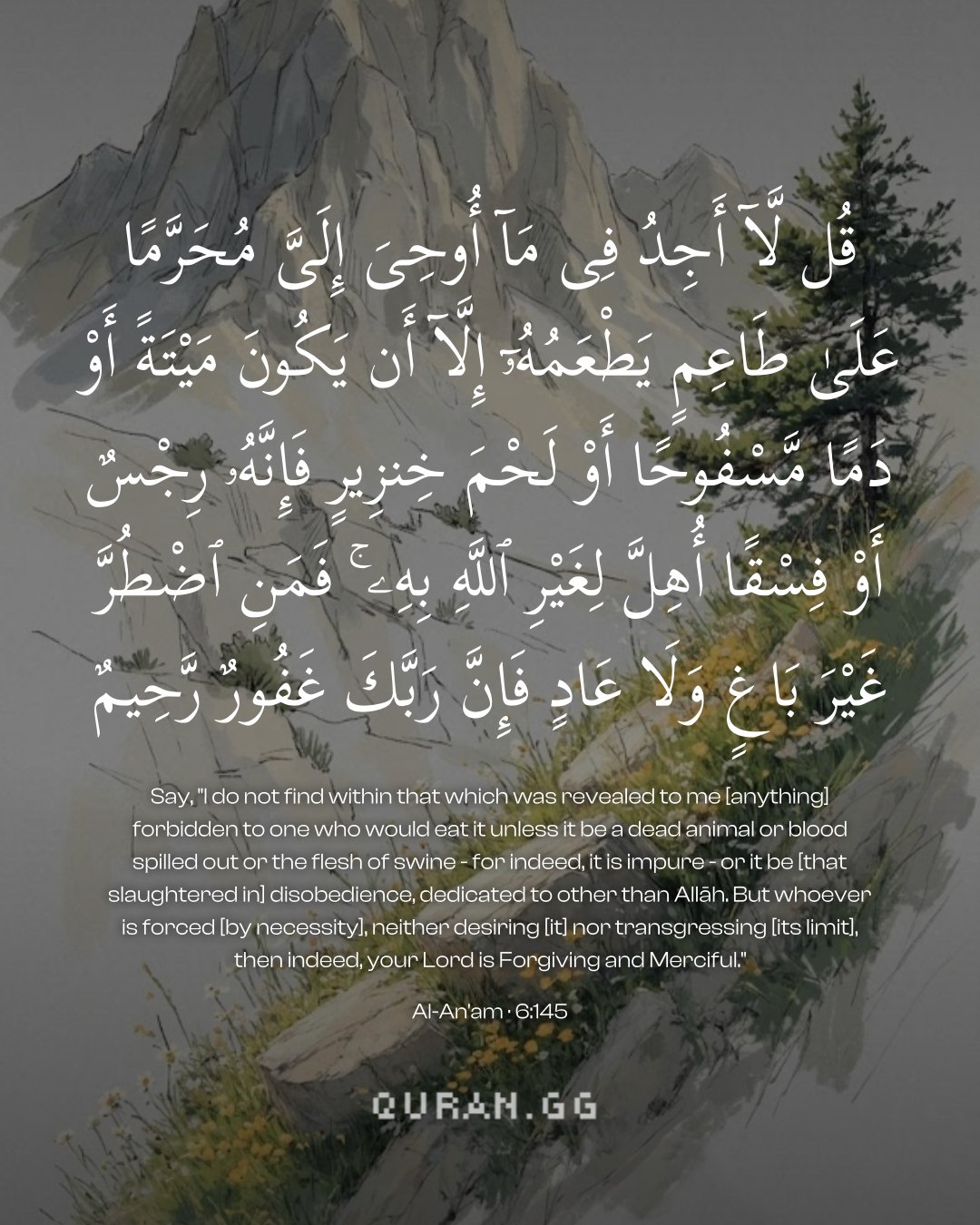
لاَ أَجِدُ فِى مَآ أُوْحِىَ إِلَىَّ مُحَرَّمًا عَلَى طَاعِمٍ يَطْعَمُهُ
(I find not in that which has been revealed to me anything forbidden to be eaten by one who wishes to eat it,) This Ayah means, I do not find any animals that are prohibited, except these mentioned here. We should mention here that the prohibited things mentioned in Surat Al-Ma'idah and the Hadiths on this subject amend the meaning of this Ayah.
أَوْ دَمًا مَّسْفُوحًا
(or blood poured.) Qatadah commented, "Poured blood was prohibited, but the meat that still has some blood in it is allowed." Al-Humaydi said that Sufyan narrated to us that `Amr bin Dinar narrated to us, "I said to Jabir bin `Abdullah, `They claim that the Messenger of Allah ﷺ prohibited the meat of donkeys during (the day of) Khaybar.' He said, `Al-Hakam bin `Amr narrated that from the Messenger of Allah ﷺ. That scholar - refering to Ibn `Abbas - denied it, reciting the Ayah;
قُل لاَ أَجِدُ فِى مَآ أُوْحِىَ إِلَىَّ مُحَرَّمًا عَلَى طَاعِمٍ يَطْعَمُهُ
(Say: "I find not in that which has been revealed to me anything forbidden to be eaten by one who wishes to eat it...")"' Al-Bukhari and Abu Dawud collected it. Abu Bakr bin Marduwyah and Al-Hakim, in his Mustadrak, recorded that Ibn `Abbas said, "During the time of Jahiliyyah, the people used to eat some things and avoid some other things, because they disliked them. Later on, Allah sent His Prophet , revealed His Book, allowed what He allowed, and prohibited what He prohibited. Therefore, whatever Allah allowed is lawful and whatever He prohibited is unlawful. Whatever He did not mention, there is no sin in it." He then recited the Ayah,
قُل لاَ أَجِدُ فِى مَآ أُوْحِىَ إِلَىَّ مُحَرَّمًا عَلَى طَاعِمٍ يَطْعَمُهُ
(Say: "I find not in that which has been revealed to me anything forbidden to be eaten by one who wishes to eat it...") This is the wording with Ibn Marduwyah. Abu Dawud also recorded this statement, and Al-Hakim said, "Its chain is Sahih and they did not record it." Imam Ahmad recorded that Ibn `Abbas said, "A sheep belonging to Sawdah bint Zam`ah died and she said, `O Allah's Messenger! So-and-so (sheep) has died.' He said,
«فَلِمَ لَا أَخَذْتُمْ مَسْكَهَا؟»
(Why did you not use its skin) She said, `Should we use the skin of a sheep that has died' Allah's Messenger ﷺ said,
«إِنَّمَا قَالَ اللهُ:
قُل لاَ أَجِدُ فِى مَآ أُوْحِىَ إِلَىَّ مُحَرَّمًا عَلَى طَاعِمٍ يَطْعَمُهُ إِلاَ أَن يَكُونَ مَيْتَةً أَوْ دَمًا مَّسْفُوحًا أَوْ لَحْمَ خِنزِيرٍ
وَإِنَّكُمْ لَا تَطْعَمُونَهُ أَنْ تَدْبَغُوهُ فَتَنْتَفِعُوا بِه»
(Allah only said, (Say: "I find not in that which has been revealed to me anything forbidden to be eaten by one who wishes to eat it, except Maytah (a dead animal) or blood poured forth, or the flesh of swine....) You will not be eating it if you tan its skin and benefit from it.) So she had the sheep skinned, the skin was tanned and made into a water skin that she kept until it wore out." Al-Bukhari and an-Nasa'i collected a similar Hadith. Allah said,
فَمَنِ اضْطُرَّ غَيْرَ بَاغٍ وَلاَ عَادٍ
(But whosoever is forced by necessity without willful disobedience, nor transgressing due limits;) Therefore, whoever is forced by necessity to eat anything that Allah has forbidden in this honorable Ayah, without transgressing his limits, then for him,
فَإِنَّ رَبَّكَ غَفُورٌ رَّحِيمٌ
(certainly, your Lord is Oft-Forgiving, Most Merciful.) We mentioned the explanation of this Ayah in Surat Al-Baqarah. This honorable Ayah contradicts the idolators' innovated prohibitions for certain kinds of wealth, relying merely on their misguided ideas, such as the Bahirah, Sa'ibah, Wasilah and Ham. Allah commanded His Messenger to inform them that he does not find that such types of animals are prohibited in what Allah revealed to him. In this Ayah, Allah only prohibited dead animals, poured blood, the flesh of swine and what has been slaughtered for something other than Allah. Other things were not prohibited here, but rather treated as that which does not have a ruling, i.e., permissible. Therefore, how do you -- idolators -- claim that such items are prohibited, and why did you prohibit them when Allah did not prohibit them