Surah Al-An'am Ayah 148 (6:148) — Meaning & Tafsir | Quran.GG

Surah Al-An'am, Ayah 148

6:148 · Meaning and tafsir

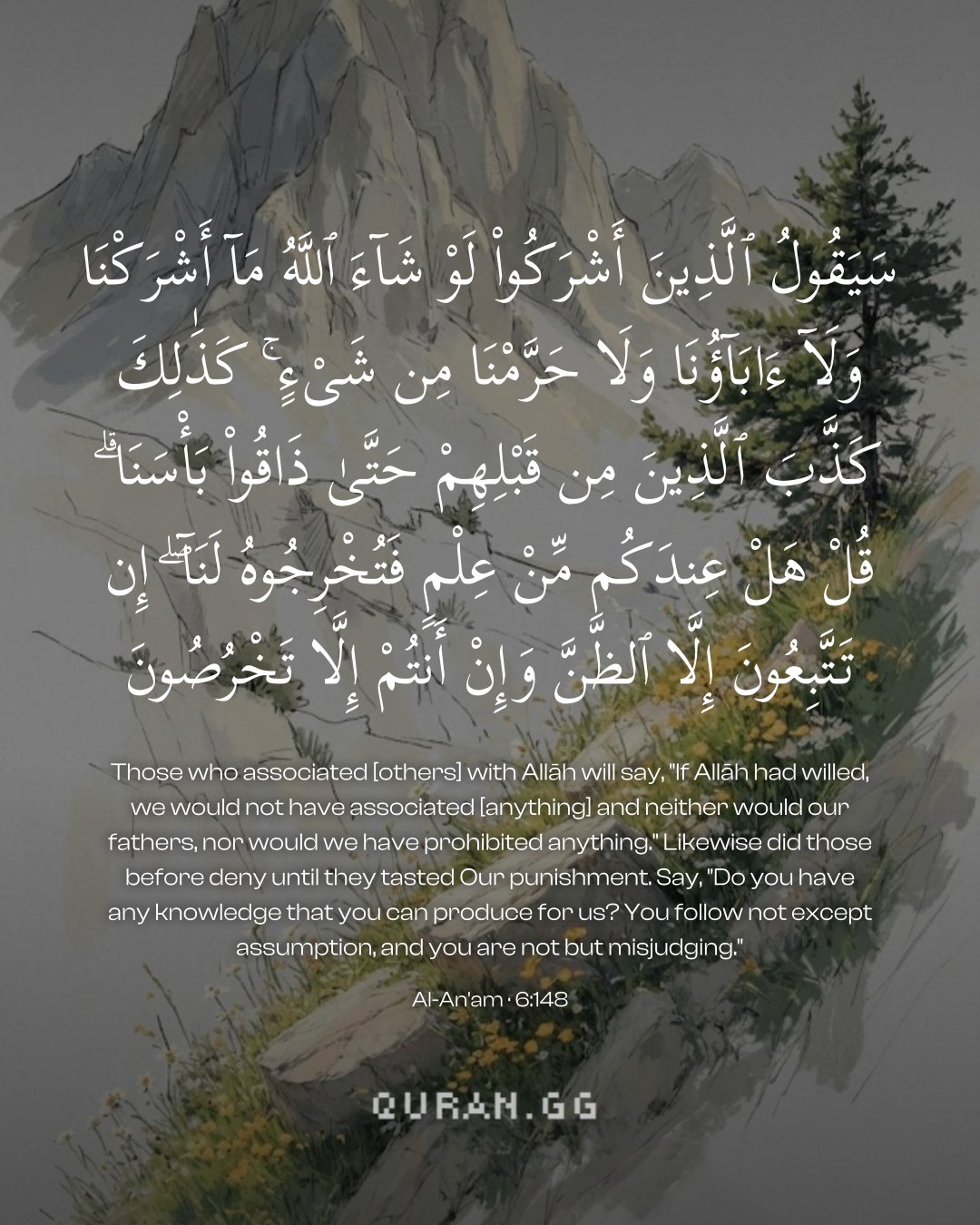
سَيَقُولُ ٱلَّذِينَ أَشْرَكُوا۟ لَوْ شَآءَ ٱللَّهُ مَآ أَشْرَكْنَا وَلَآ ءَابَآؤُنَا وَلَا حَرَّمْنَا مِن شَىْءٍ ۚ كَذَٰلِكَ كَذَّبَ ٱلَّذِينَ مِن قَبْلِهِمْ حَتَّىٰ ذَاقُوا۟ بَأْسَنَا ۗ قُلْ هَلْ عِندَكُم مِّنْ عِلْمٍ فَتُخْرِجُوهُ لَنَآ ۖ إِن تَتَّبِعُونَ إِلَّا ٱلظَّنَّ وَإِنْ أَنتُمْ إِلَّا تَخْرُصُونَ ١٤٨

Those who associated [others] with Allāh will say, "If Allāh had willed, we would not have associated [anything] and neither would our fathers, nor would we have prohibited anything." Likewise did those before deny until they tasted Our punishment. Say, "Do you have any knowledge that you can produce for us? You follow not except assumption, and you are not but misjudging."

Surah Al-An'am 6:148 in Arabic with its translation: “Those who associated [others] with Allāh will say, "If Allāh had willed, we would not have associated…”

Make something with this ayah

Turn it into a video for Stories, Reels or TikTok, recited by the reciter you pick, or an image on a background you choose. Free, in your browser.

Download this image

Tafsir Ibn Kathir (abridged)

A False Notion and its Rebuttal

Here Allah mentioned a debate with the idolators, refuting a false notion they have over their Shirk and the things that they prohibited. They said, surely, Allah has full knowledge of the Shirk we indulge in, and that we forbid some kinds of wealth. Allah is able to change this Shirk by directing us to the faith, - they claimed - and prevent us from falling into disbelief, but He did not do that. Therefore - they said Allah indicated that He willed, decided and agreed that we do all this. They said,

لَوْ شَآءَ اللَّهُ مَآ أَشْرَكْنَا وَلاَحَرَّمْنَا مِن شَىْءٍ

("If Allah had willed, we would not have taken partners (in worship) with Him, nor would our fathers, and we would not have forbidden anything.") Allah said in another Ayah,

وَقَالُواْ لَوْ شَآءَ الرَّحْمَـنُ مَا عَبَدْنَـهُمْ

(And they said: "If it had been the will of the Most Gracious (Allah), we should not have worshipped them (false deities)") 43:20. Similar is mentioned in Surat An-Nahl. Allah said next,

كَذَلِكَ كَذَّبَ الَّذِينَ مِن قَبْلِهِمْ

(Likewise belied those who were before them,) for by using and relying on this understanding, the misguided ones before them were led astray. This notion is false and ungrounded, for had it been true, Allah would not have harmed them, destroyed them, aided His honorable Messengers over them, and made them taste His painful punishment.

قُلْ هَلْ عِندَكُم مِّنْ عِلْمٍ

(Say: "Have you any knowledge...") that Allah is pleased with you and with your ways,

فَتُخْرِجُوهُ لَنَآ

(that you can produce before us.) and make it plain, apparent and clear for us. However,

إِن تَتَّبِعُونَ إِلاَّ الظَّنَّ

(Verily, you only follow the Zann) doubts and wishful thinking,

وَإِنْ أَنتُمْ إِلاَّ تَخْرُصُونَ

(and you do nothing but lie) about Allah in the false claims that you utter. Allah said next,

قُلْ فَلِلَّهِ الْحُجَّةُ الْبَـلِغَةُ فَلَوْ شَآءَ لَهَدَاكُمْ أَجْمَعِينَ

(Say: "With Allah is the perfect proof and argument; had He so willed, He would indeed have guided you all.") Allah said to His Prophet

قُلْ

(Say) O Muhammad, to them,

فَلِلَّهِ الْحُجَّةُ الْبَـلِغَةُ

("With Allah is the perfect proof and argument. ..") the perfect wisdom and unequivocal proof to guide whom He wills and misguide whom He wills.

فَلَوْ شَآءَ لَهَدَاكُمْ أَجْمَعِينَ

(had He so willed, He would indeed have guided you all.) All of this happens accordng to His decree, His will, and His choice. So in this way, He is pleased with the believers, and angry with the disbelievers. Allah said in other Ayat,

وَلَوْ شَآءَ اللَّهُ لَجَمَعَهُمْ عَلَى الْهُدَى

(And had Allah willed, He could have gathered them together (all) on true guidance,) 6:35 and

وَلَوْ شَآءَ رَبُّكَ لآمَنَ مَن فِى الاٌّرْضِ

(And had your Lord willed, those on earth would have believed, all of them together.) 10:99 and,

وَلَوْ شَآءَ رَبُّكَ لَجَعَلَ النَّاسَ أُمَّةً وَاحِدَةً وَلاَ يَزَالُونَ مُخْتَلِفِينَ

إِلاَّ مَن رَّحِمَ رَبُّكَ وَلِذلِكَ خَلَقَهُمْ وَتَمَّتْ كَلِمَةُ رَبّكَ لاَمْلاَنَّ جَهَنَّمَ مِنَ الْجِنَّةِ وَالنَّاسِ أَجْمَعِينَ-

(And if your Lord had so willed, He could surely have made mankind one Ummah, but they will not cease to disagree. Except him on whom your Lord has bestowed His mercy and for that did He create them. And the Word of your Lord has been fulfilled: "Surely, I shall fill Hell with Jinns and men all together.") 11:118-119 Ad-Dahhak said, "No one has an excuse if he disobeys Allah. Surely, Allah has the perfect proof established against His servants." Allah said,

قُلْ هَلُمَّ شُهَدَآءَكُمُ

(Bring forward your witnesses,) produce your witnesses,

الَّذِينَ يَشْهَدُونَ أَنَّ اللَّهَ حَرَّمَ هَـذَا

(who can testify that Allah has forbidden this.) which you have forbidden and lied and invented about Allah in this regard,

فَإِن شَهِدُواْ فَلاَ تَشْهَدْ مَعَهُمْ

(Then if they testify, do not testify with them.) because in this case, their testimony is false and untrue,

وَلاَ تَتَّبِعْ أَهْوَآءَ الَّذِينَ كَذَّبُواْ بِآيَـتِنَا وَالَّذِينَ لاَ يُؤْمِنُونَ بِالاٌّخِرَةِ وَهُم بِرَبِّهِمْ يَعْدِلُونَ

(And do not follow the vain desires of those who belie Our Ayat, and such as believe not in the Hereafter, and they hold others as equal with their Lord.) by associating others with Allah in worship and treating them as equals to Him.

Ma'arif al-Qur'an

Commentary

Mentioned in the previous verses was how astray the disbelievers of Makkah had gone when they had taken their self-carved, lifeless, insensate idols as partners in the Divinity of Allah as they made them share in animals created by Him and in many other blessings which were bestowed on them. Their transgression went to the limits when they would take out charities from these blessings as an act of worship, setting aside a portion for Allah and another for their idols. Then, they would employ different excuses to take out what belonged to the portion set aside for Allah and put it in the portion reserved for the idols. Similarly, there were many other ignorance-based arbitrary customs which they had given legal status.

Continue reading the tafsir of ayahs 142–150

Tazkirul Quran

According to the divine Shariah (Islamic regulations), the truly forbidden things have always been the same as mentioned in the foregoing verse, viz. carrion, out-pouring blood, the meat of pigs and animals slaughtered in the name of any thing or being other than God. Anything else which is forbidden falls into a sub-group of the above-mentioned as a matter of detail. But along with this, among God’s prohibitory laws, another principle is at work, namely, that when a community blessed with His Book adopts the way of arrogance instead of obedience, it is subjected to new difficulties by way of punishment, i.e. such things as were not originally forbidden them in the Divine Shariah are now banned. One way in which this change comes about is that in such a community, leaders arise who are completely ignorant of the reality of the religion. They are conversant only with its outward formalities. The meticulousness which they should apply to the meaningful realities of religion is reserved by them for outward formalities and rites. The result is that unnecessary hair-splitting over externals becomes a set pattern in religion. Such leaders devise self-made outward standards of religion. By a process of extreme exaggeration, they make a simple commandment complicated and a legitimate thing unlawful. For instance, when arrogance set in among the Jews, certain scholars arose among them who, by their hair-splitting arguments, made the rule that for an animal to be deemed fit to eat, it should possess two qualities—one, that its hooves should be cloven or divided, and second, that it should be a cud-chewing animal. Even if one of these conditions was not fulfilled, that animal, according to them, was forbidden. Due to this self-imposed condition, even animals like the camel and the rabbit, etc., were unnecessarily banned. Similarly, by taking up an extreme position about the importance attached to claws, they unnecessarily placed ostriches, swans and ducks in the forbidden category. These unnatural restrictions narrowed their lives, whereas God had intended to give them wider latitude. After rejecting the Truth, man is not immediately seized upon by God. He finds himself free and his life as full as before. For this reason, he erroneously imagines that he is not going to lose anything by not accepting the Truth. He forgets that if he remains safe, it is simply because of the merciful forbearance of God. In spite of man’s arrogance, God gives him the opportunity to redeem himself till the very last moment. Finally, when he has not changed his behaviour, all of a sudden God swoops down on him—sometimes in this world and sometimes both in this world and the Hereafter.

Continue reading the tafsir of ayahs 147–148

Uthmani text of the Madinah mushaf (King Fahd Complex). Translation: Saheeh International. Tafsir via Quran.com.