The Qur'an is Allah's Proof Against His Creation
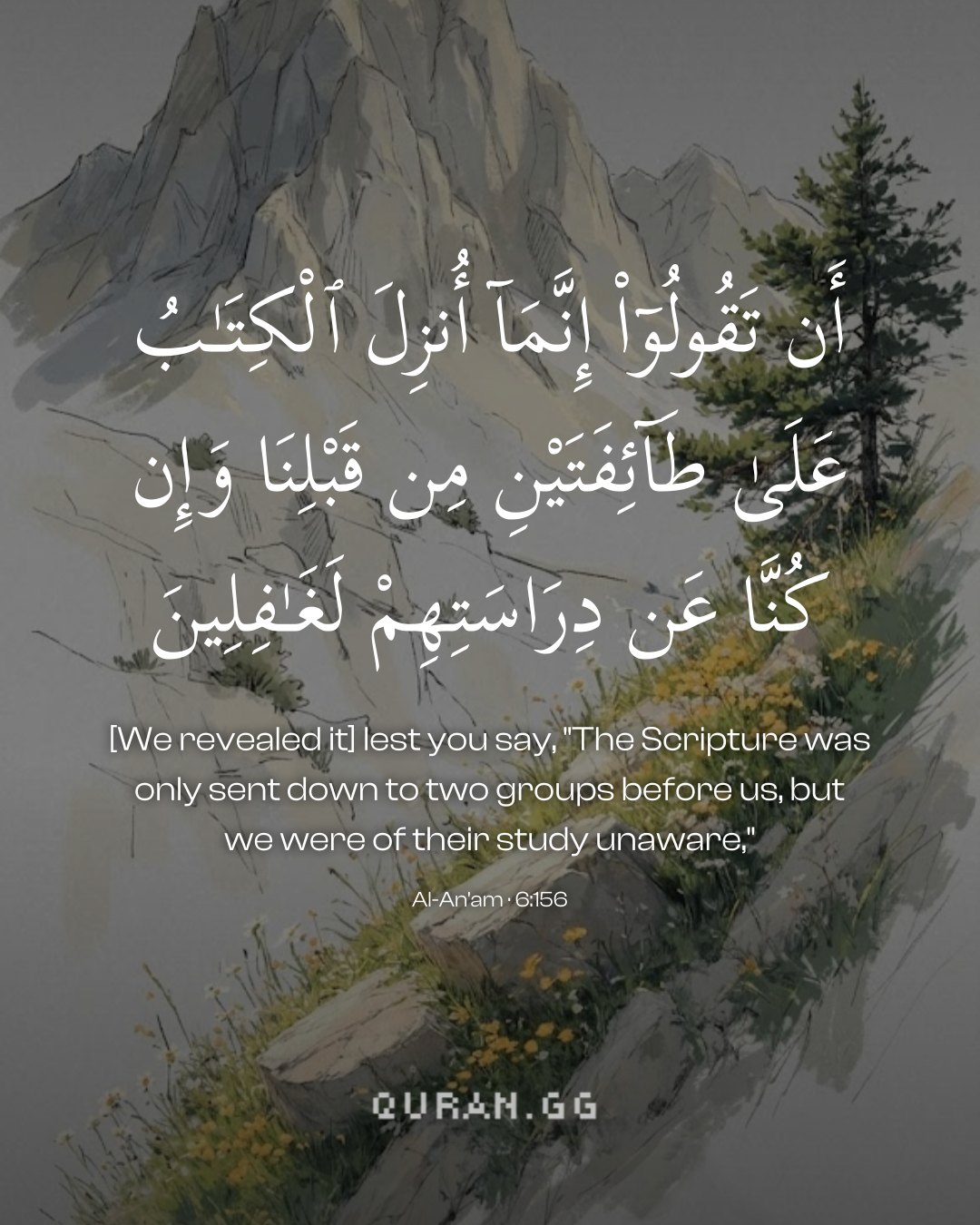
Ibn Jarir commented on the Ayah, "The Ayah means, this is a Book that We sent down, so that you do not say,
إِنَّمَآ أُنزِلَ الْكِتَـبُ عَلَى طَآئِفَتَيْنِ مِن قَبْلِنَا
("The Book was sent down only to two sects before us.") This way, you will have no excuse. Allah said in another Ayah,
وَلَوْلا أَن تُصِيبَهُم مُّصِيبَةٌ بِمَا قَدَّمَتْ أَيْدِيهِمْ فَيَقُولُواْ رَبَّنَا لَوْلا أَرْسَلْتَ إِلَيْنَا رَسُولاً فَنَتِّبِعَ ءايَـتِكَ
(Otherwise, they would have suffered a calamity because of what their hands sent forth, and said: "Our Lord! Why did You not send us a Messenger We would then have followed Your Ayat.")28:47." The Ayah,
عَلَى طَآئِفَتَيْنِ مِن قَبْلِنَا
(to two sects before us) refers to the Jews and Christians, according to `Ali bin Abi Talhah who narrated it from Ibn `Abbas. Similar was reported from Mujahid, As-Suddi, Qatadah and several others. Allah's statement,
وَإِن كُنَّا عَن دِرَاسَتِهِمْ لَغَـفِلِينَ
("...and for our part, we were in fact unaware of what they studied.") meaning: `we did not understand what they said because the revelation was not in our tongue. We, indeed, were busy and unaware of their message,' so they said. Allah said next,
أَوْ تَقُولُواْ لَوْ أَنَّآ أُنزِلَ عَلَيْنَا الْكِتَـبُ لَكُنَّآ أَهْدَى مِنْهُمْ
(Or lest you should say: "If only the Book had been sent down to us, we would surely, have been better guided than they.") meaning: We also refuted this excuse, had you used it, lest you say, "If a Book was revealed to us, just as they received a Book, we would have been better guided than they are." Allah also said.
وَأَقْسَمُواْ بِاللَّهِ جَهْدَ أَيْمَـنِهِمْ لَئِن جَآءَهُمْ نَذِيرٌ لَّيَكُونُنَّ أَهْدَى مِنْ إِحْدَى الاٍّمَمِ
(And they swore by Allah their most binding oath that if a warner came to them, they would be more guided than any of the nations (before them).) 35:42 Allah replied here,
فَقَدْ جَآءَكُمْ بَيِّنَةٌ مِّن رَّبِّكُمْ وَهُدًى وَرَحْمَةٌ
(So now has come unto you a clear proof from your Lord, and a guidance and a mercy.) Allah says, there has come to you from Allah a Glorious Qur'an revealed to Muhammad ﷺ, the Arab Prophet. In it is the explanation of the lawful and unlawful matters, guidance for the hearts and mercy from Allah to His servants who follow and implement it. Allah said;
فَمَنْ أَظْلَمُ مِمَّن كَذَّبَ بِآيَـتِ اللَّهِ وَصَدَفَ عَنْهَا
(Who then does more wrong than one who rejects the Ayat of Allah and Sadafa away therefrom) This refers to the one who neither benefited from what the Messenger brought, nor followed what he was sent with by abandoning all other ways. Rather, he Sadafa from following the Ayat of Allah, meaning, he discouraged and hindered people from following it. This is the explanation of As-Suddi for Sadafa, while Ibn `Abbas, Mujahid and Qatadah said that Sadafa means, he turned away from it.
Commentary
The reason of being ` ignorant of (or heedless to) what they studied - 156' was not that the Torah and the Injil were non-existent in the Arabic language because it is possible to become informed of the contents through a translation, in fact, this happens. Instead, this is because the people of the Book never took steps to educate and inform the people of Arabia in the mores of monotheism. That something falls within hearing distance casually is customarily ineffective as a meaningful warning - though, this much note of warning makes search and consideration obligatory, and on this basis, the coming of Divine punishment against the abandonment of Tauhid (the belief in the Oneness of Allah) was possible. However, this raises no doubts about the universal nature of the prophetic mission of Sayyidna Musa (علیہ السلام) and Sayyidna ` Isa (علیہ السلام) because the particularization of this universality of message is with our master, may the blessing of Allah be upon him, and peace - and this particularization is in terms of the totality of fundamentals and subsidiaries, otherwise, in fundamentals, following all prophets is obligatory on all peoples. So, the punishment would have been proper on this basis. But, this would have been an excuse advanced initially. Now that too is no more valid. The argument of Allah is already established.
Continue reading the tafsir of ayahs 154–157 The orphan is the least likely to receive good treatment, because he is the weakest member of any society. In his case, any of the factors which would predispose an individual to behave well towards others are unlikely to come into play. Shouldering responsibility in the case of an ‘orphan’ can be done only by one who has become a man of character purely out of principle and not on the basis of self-interest. Such a person who is the well-wisher of an orphan will also give exceptionally good treatment to other people. All things in the universe are so interrelated as to ensure that giving and taking are done on an equitable basis and are mutually beneficial. This very principle has to be adopted by man in his life. If an individual has to measure out something for others, he should measure it out properly and, if he has to weigh out something, he should weigh it out properly. It should never happen that he uses one scale for himself and a different scale for others. It happens from time to time that a man is required to express an opinion against somebody. On such occasions, the way to win God’s approval is to utter such views as meet the standards of justice. Whether the person in question is one of his own or a stranger; whether his relations with him are friendly or inimical, whether or not his interests are linked with him, he should remain uninfluenced by all these factors and should say only what is right and proper. Every man is bound by certain vows. Some are in writing and others are purely verbal. But a man’s Faith, his humanity and his nobility demand that right action should be taken in the fulfilment of pledges of any form. The Muslim is duty- bound to fulfil both the written and the verbal kind—all this is very clear. Heavenly revelation and man’s mind both bear testimony to this being proper. But, only that person will learn a lesson from divine revelation who himself wants to learn. These commandments (verses 151- 53) are basic sections of the divine Shariah. To follow these within their strict and direct meaning is in fact to follow the straight highway of God. But if, by means of hair-splitting, different by-ways are introduced and if all emphasis is laid on them, this amounts to going astray on various paths (other than the straight highway) which will never lead a man towards God.
Continue reading the tafsir of ayahs 153–156 Uthmani text of the Madinah mushaf (King Fahd Complex). Translation: Saheeh International. Tafsir via Quran.com.