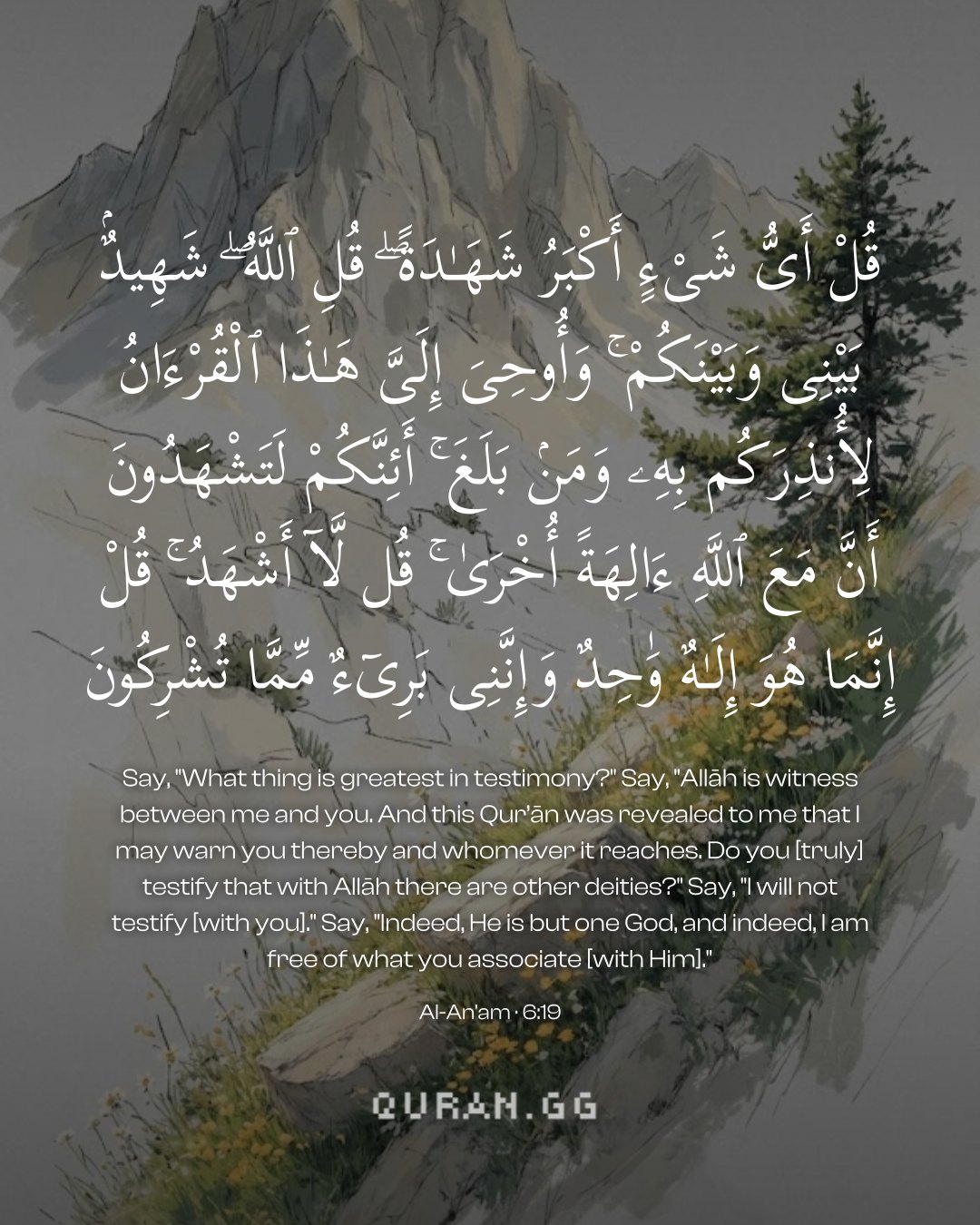
Say, "What thing is greatest in testimony?" Say, "Allāh is witness between me and you. And this Qur’ān was revealed to me that I may warn you thereby and whomever it reaches. Do you [truly] testify that with Allāh there are other deities?" Say, "I will not testify [with you]." Say, "Indeed, He is but one God, and indeed, I am free of what you associate [with Him]."
Allah is the Irresistible, Able to Bring Benefit and Protect from Harm
Allah states that He Alone brings benefit or harm, and that He does what He wills with His creatures, none can resist His judgment or prevent what He decrees,
(And if Allah touches you with harm, none can remove it but He, and if He touches you with good, then He is able to do all things.) Similarly, Allah said,
(Whatever mercy, Allah may grant to mankind, none can withhold it, and whatever He may withhold, none can grant it thereafter) 35:2. It is recorded in the Sahih that the Messenger of Allah ﷺ used to supplicate,
A particular event which is the cause of the revelation of this verse has been generally reported by commentators. It is said that once a deputation of the people of Makkah came to the Holy Prophet ﷺ . They said: ` You claim to be a Messenger of Allah. Who is your witness on this? We have yet to see a man who attests to its truth, although we have tried our best to confirm it from the Jews and Christians.'
Thereupon, the verse: قُلْ أَيُّ شَيْءٍ أَكْبَرُ شَهَادَةً which means: You tell them whose witness could be greater than that of Allah, within whose power lies the gain and loss of everyone in the world? Then, you tell them that Allah is the witness between me and you The witness of Allah refers to those miracles and signs which Allah Ta` ala made manifest to confirm the veracity of the prophethood of the Holy Prophet ﷺ . Therefore, addressing the people of Makkah, it was said: أَئِنَّكُمْ لَتَشْهَدُونَ أَنَّ مَعَ اللَّـهِ آلِهَةً أُخْرَىٰ. It means: Do you, even after the witness of Allah Ta` ala Himself, stand to witness against Him by saying that there are other gods too along with Allah? If that is so, you are responsible for your fate. As for me, I bear no such witness. Then, the Holy Prophet ﷺ ، is asked to tell them: قُلْ إِنَّمَا هُوَ إِلَـٰهٌ وَاحِدٌ that is, He is one God, the only one worthy of worship who has no partners, sharers or associates in His pristine Divinity.
This proves that the Holy Prophet ﷺ is the Last Prophet and the Qur’ an will keep reaching until the day of Qiyamah. It will continue to be recited and taugh right through the day of Qyiamah, and people will remain obliged to follow it.
Sayyidna Said ibn Jubayr ؓ said: To Whomever the Qur'an has reached, he has become like one who has visited Muhammad ﷺ . And it appears in another Hadith: To whomever the Qur'an has reached, I am his warner (` nadhir' ).
Therefore, the Holy Prophet ﷺ had asked his Companions emphatically : بَلِّغُوا عَنِّی وَ لَو آیَۃً 'that is, convey my instructions and teachings to people, even if it be one 'Ayah.
And Sayyidna ` Abdullah ibn Masud ؓ reports that the Holy Prophet ﷺ said: May Allah keep that person hale and hearty who heard a saying of mine, committed it to his memory and then conveyed it to my Ummah. This is important because it generally happens that a person may not himself appreciate the sense of what is said but which would be understood much better by a person of later times to whom the first person has conveyed it.
Tazkirul Quran
Maulana Wahiduddin KhanOn ayahs 19–23
In the on-going struggle between the proponents, on the one hand of Truth and on the other of falsehood, the only decisive factor is the Book of God. There is nobody who knows the full facts or has any real authority except God. So God, the only Being who is capable of settling this dispute, has given an arbiter to the people in the form of the Quran. Now, man has only one course open to him. If he is not aware of the veracity of the Quran, he should investigate and satisfy himself that it is the Book of God. When he comes to know that it is really the Book of God, he should necessarily be satisfied with whatever is advocated therein. One who is not in agreement with the decision of the Quran runs the risk of being forced to accept its verdict in the Hereafter after much degradation and punishment. The Quran has been revealed so that, before the arrival of the time of Judgement, people may be made aware of what awaits them. The Prophet Muhammad performed this task during his prophethood and the same work has to be continued by his followers (ummah) till Doomsday. The Quran tells us in advance how God is going to treat people in the eternal world of the Hereafter. Those who are assigned the task of delivering this message to the people will be free of the responsibility once they have fully conveyed the message; but those to whom it is delivered will be free in the eyes of God only when they have accepted it and reformed themselves accordingly. The missionary’s responsibility ends with his ‘preaching’, while that of the addressee ends only on his ‘fulfilling his religious obligations’.
Uthmani text of the Madinah mushaf (King Fahd Complex). Translation: Saheeh International. Tafsir via Quran.com.