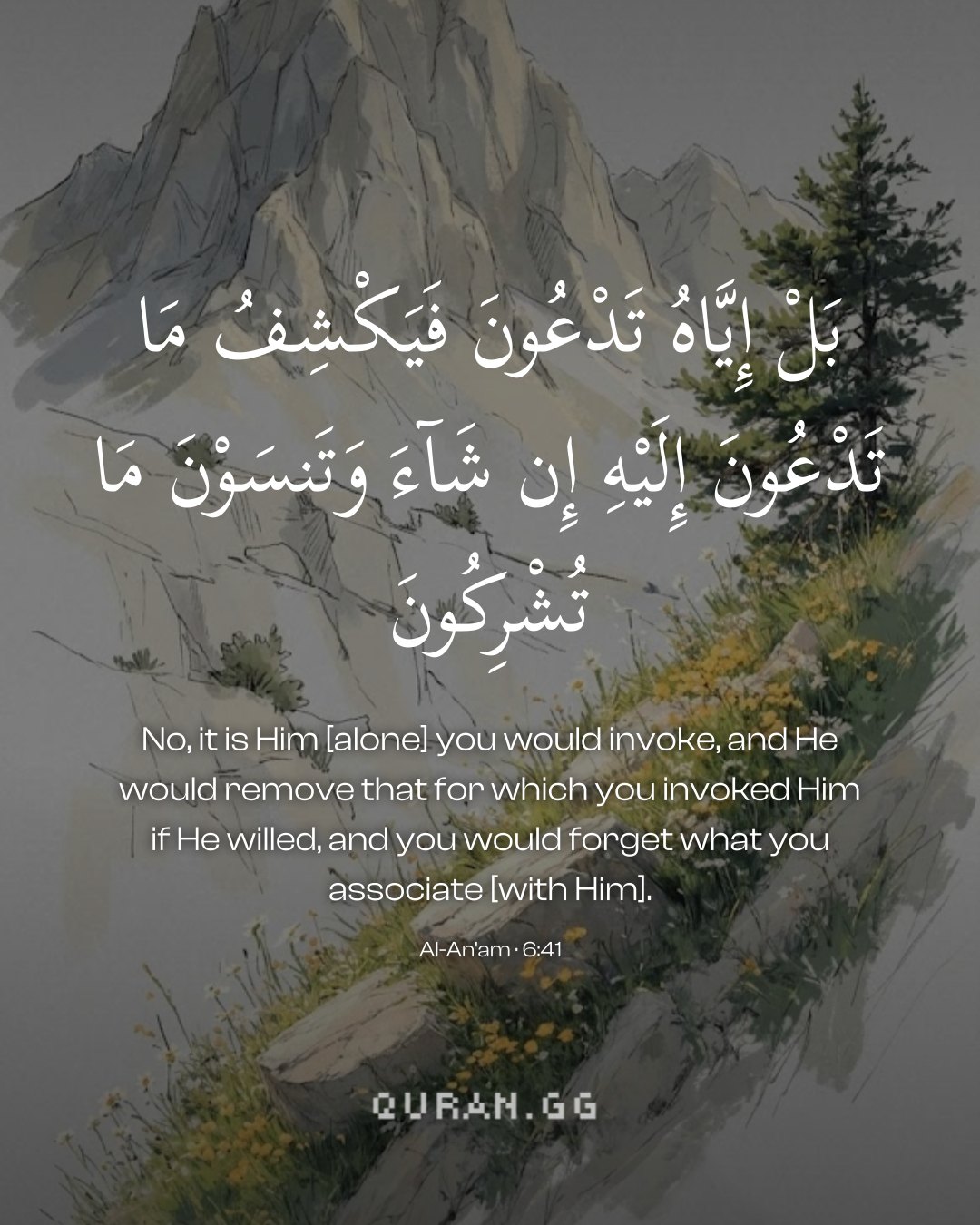
No, it is Him [alone] you would invoke, and He would remove that for which you invoked Him if He willed, and you would forget what you associate [with Him].
The Idolators Call On Allah Alone During Torment and Distress
Allah states that He does what He wills with His creatures and none can resist His decision or avert what He decrees for them. He is the One Who has no partners, Who accepts the supplication from whomever He wills. Allah said,
(Say: "Tell me if Allah's torment comes upon you, or the Hour comes upon you, would you then call upon any one other than Allah (Reply) if you are truthful!") This means, you -- disbelievers -- will not call other than Allah in this case, because you know that none except He is able to remove the affliction. Allah said,
The sixth verse (38): وَمَا مِن دَابَّةٍ (there is no creature moving …) tells us that, on the day of Qiyamah, animals will also be given life along with human beings. Following a narration of Sayyidna Abu Hurairah ؓ ، it has been reported by Ibn Jarir, Ibn Abi Hatim and Baihaqi that, on the day of Qiyamah, all animals, beasts and birds will also be given life once again. Such will be the measure of Divine justice that a horned animal which had hit the hornless one shall be subjected to retaliation, as would be the case with others too. And when all injustices have been vindicated, all of them would be commanded to become dust - and then, dust they shall become. This would be the time when the disbeliever will say: يَا لَيْتَنِي كُنتُ تُرَابًا [ 78:40] that is, ` would that I too were to become dust, and thus saved from the punishment of Hell!'.
History bears witness to the fact that a man starts invoking the name of God in crucial moments; even one who relied on beings other than God or did not believe in God’s existence at all. This is nature’s testament to God’s existence and His being the absolute authority. Under extraordinary circumstances, when the outward veils are removed and when man dismisses all superficial thoughts, he does not remember anything except God. In other words, on reaching the point of helplessness, every man admits the existence of God. But the Quran demands that man should follow a course of acceptance and obedience at a time when there is no apparent compulsion to do so. All animals other than man instinctively lead realistic lives. But what pushes man towards realism and the admission of the truth is the psychology of fear. In the world of animals all things are accomplished by instinct. The same role is played by fear of God (taqwa) in the world of human beings.
Uthmani text of the Madinah mushaf (King Fahd Complex). Translation: Saheeh International. Tafsir via Quran.com.