Allah's Compassion and Generosity, and His Power and Torment
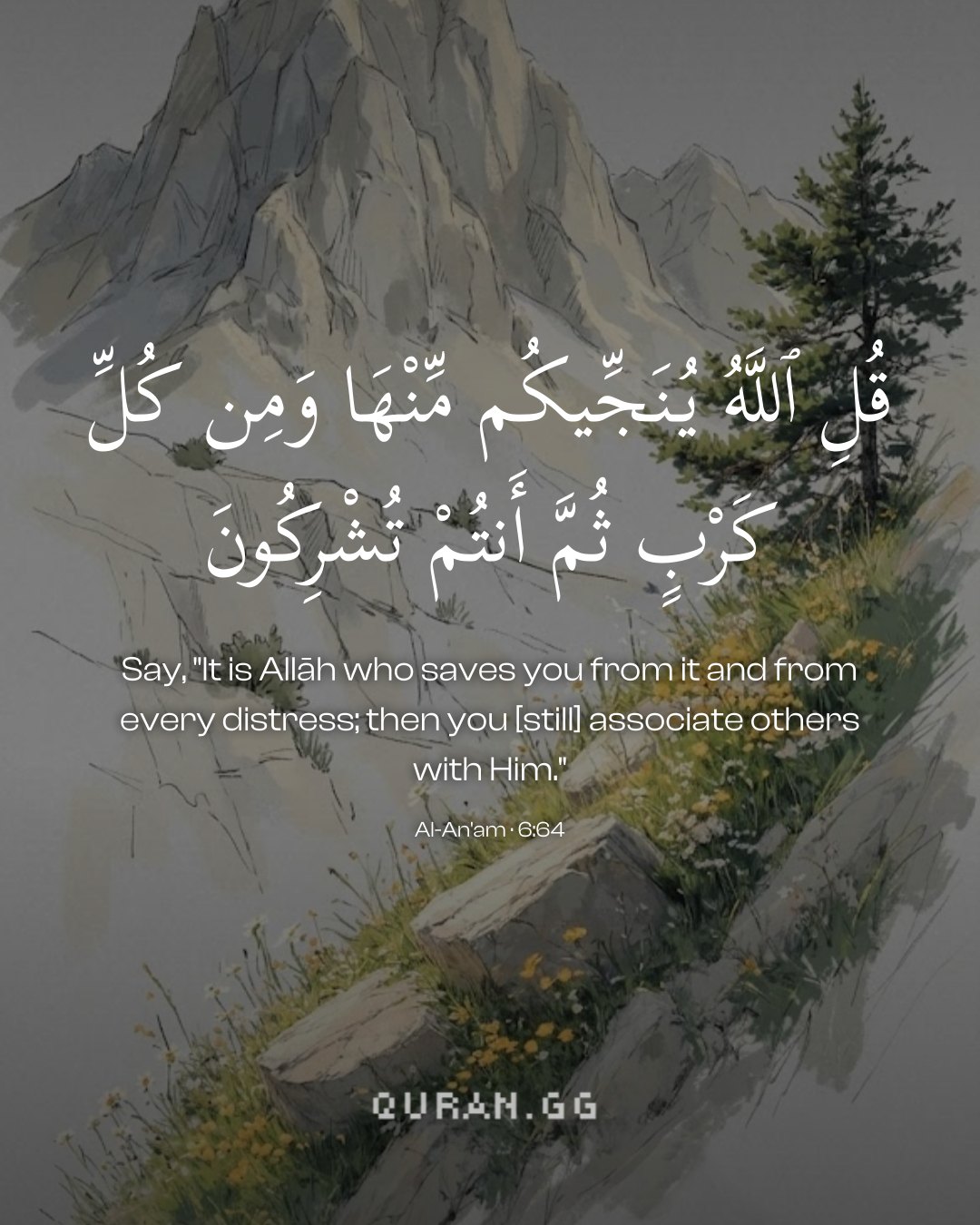
Allah mentions how He favors His servants, saving them during times of need, in the darkness of land and at sea, such as when storms strike. In such cases, they call on Allah alone, without partners, in supplication. In other Ayat, Allah said,
Some Manifestations of Divine Knowledge and Absolute Power
In previous verses, there was a description of the perfection of Divine Knowledge and Power, and of their unique expanse. Mentioned in the present verse, there are some manifestations of this very Knowledge and Power.
The word: ظُلُومَات (Zulumat) in the first verse (63) is the plural of ظُلمَہ (Zulmah) which means darkness [ and which does not have a plural form in English leaving the translator with no choice but to improvise in order to convey the Qur'anic plural which is necessary as ex-plained ]. Thus, the expression: ظُلُمَاتِ الْبَرِّ وَالْبَحْرِ in this verse means the many a darkness found on land and sea. Since darkness is of many kinds, such as, the darkness of night, the darkness of rain clouds, the darkness of dust storms and the darkness under the waves of the sea, it is to include all these kinds of darkness that the word, ظُلُمَاتِ Zulumat, has been used here.
No other living creature in this world faces so many troubles as human beings do. This is so, because man is intended to be subjected to adverse conditions so that all artificial, unreal thoughts are driven out of his mind, and he is able to see his own true nature. The fact is that whenever a man confronts any major trouble, he starts single-mindedly calling upon God. At that time, all the man-made veils are swept away from his mind. He comes to realise that in this world man is completely humble and helpless, and it is God alone who has all the power. But as soon as his troubles are eased, he reverts to his usual neglect and recklessness and becomes the same man as he was earlier.
Uthmani text of the Madinah mushaf (King Fahd Complex). Translation: Saheeh International. Tafsir via Quran.com.