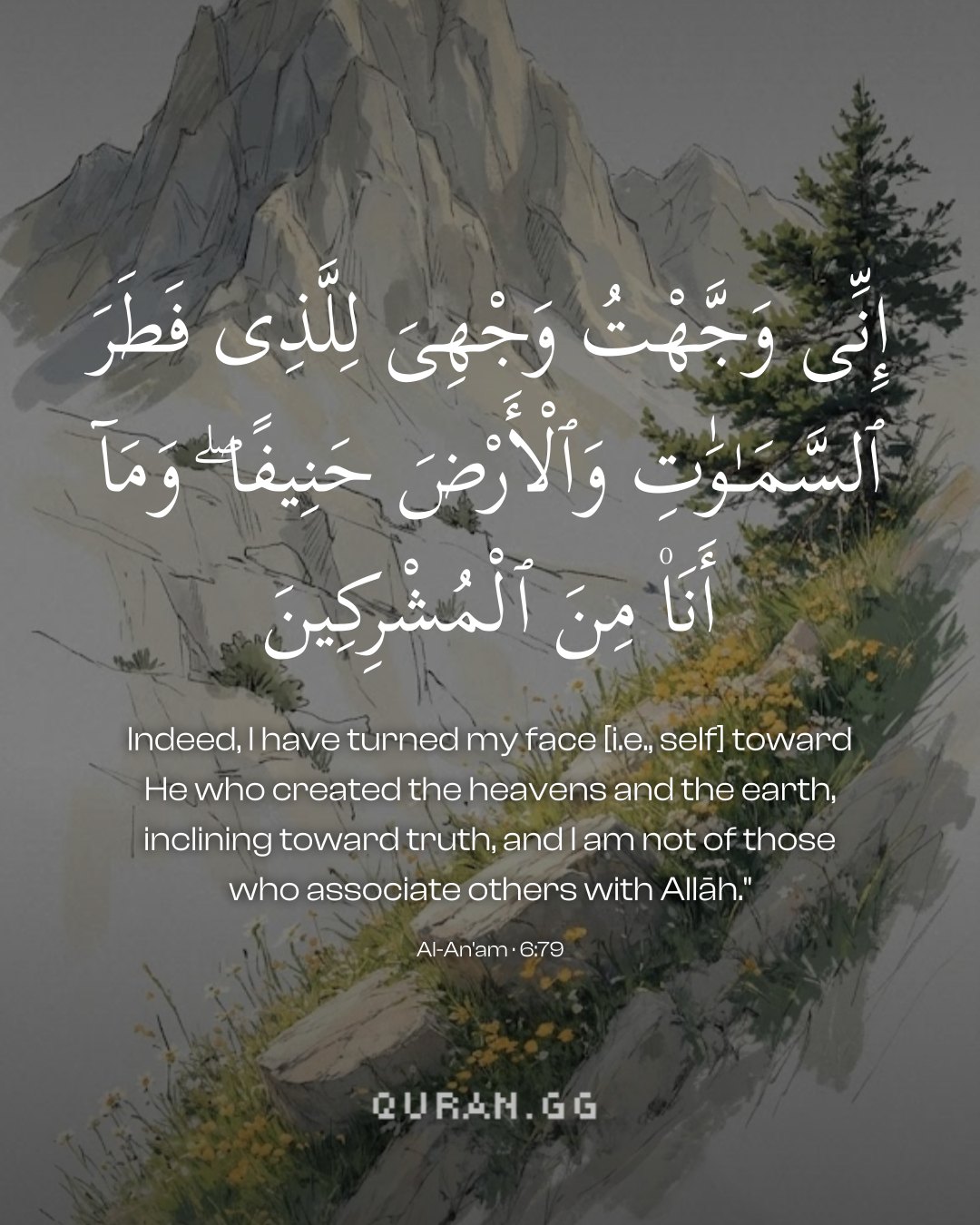
Indeed, I have turned my face [i.e., self] toward He who created the heavens and the earth, inclining toward truth, and I am not of those who associate others with Allāh."
(And (remember) when Ibrahim said to his father Azar: "Do you take idols as gods") meaning, do you worship an idol instead of Allah
إِنِّى أَرَاكَ وَقَوْمَكَ
(Verily, I see you and your people...) who follow your path,
فِى ضَلَـلٍ مُّبِينٍ
(in manifest error) wandering in confusion unaware of where to go. Therefore, you are in disarray and ignorance, and this fact is clear to all those who have sound reason. Allah also said,
Using Wisdom and Strategy in Tabligh and Da'wah is the Way of Prophets
Let us begin with verse 76 which opens with the words: رَأَىٰ كَوْكَبًا So, when the night enveloped him, he saw a star. Then, beaming at his people, he said: This is my Lord. The sense in which he said it was: Is it not, as you think and believe, my Lord and your Lord, the Rabb of both of us who nurtures, nourishes and sustains us? In a little while you will find out how real that is. Then, after some time, the star vanished. This gave Sayyidna Ibrahim (علیہ السلام) a good occasion to drive his argument home against his disbelieving people. He said: لَا أُحِبُّ الْآفِلِينَ (I do not like those who vanish). The word: آفِلِين (` afulin' ) is from: افول ('afulin) which means to set.
One night Abraham was looking up at the sky in search of signs of the one and only God. Soon, the planet Venus, whom his community was worshipping as God, appeared shining before him in all its brightness. A thought arose in his mind—not as a question, but as an expression of astonishment— ‘Is this the thing which could be my Lord? Is this the one we should worship?’ But then, he saw it setting, i.e. disappearing from his sight. He exclaimed over this and asked how a thing which shone momentarily and then disappeared could be treated as worthy of worship. This was an argument based on observation which testified to the truth of his own belief. He had the same experience with the sun and the moon. Everything shines for some time, leaves people wonderstruck and then vanishes. He presented these astronomical observations (which were for him a clear verification of the principle of the unity of God) before his community in his preaching as an argument, adopting the method which is known in philosophical terminology as ‘accusative logic’, that is, repeating the words of the addressee and then convincing him. This method has been used in the Quran at other places also, for example, in verse 97, chapter 20, entitled, Ta Ha. The signs of creation spread throughout the universe are not only a source of enhancement of Faith, but also provide strong arguments for the call for Truth.
Uthmani text of the Madinah mushaf (King Fahd Complex). Translation: Saheeh International. Tafsir via Quran.com.