Ibrahim Receives the News of Ishaq and Ya`qub During His Old Age
Allah states that after Ibrahim became old and he, and his wife, Sarah, lost hope of having children, He gave them Ishaq. The angels came to Ibrahim on their way to the people of Prophet Lut (to destroy them) and they delivered the good news of a child to Ibrahim and his wife. Ibrahim's wife was amazed at the news,
(She said (in astonishment): "Woe unto me! Shall I bear a child while I am an old woman, and here is my husband, an old man Verily! This is a strange thing!" They said: "Do you wonder at the decree of Allah The mercy of Allah and His blessings be on you, O the family of Ibrahim. Surely, He (Allah) is All-Praiseworthy, All-Glorious.") 11:72-73 The angels also gave them the good news that Ishaq will be a Prophet and that he will have offspring of his own. In another Ayah, Allah said;
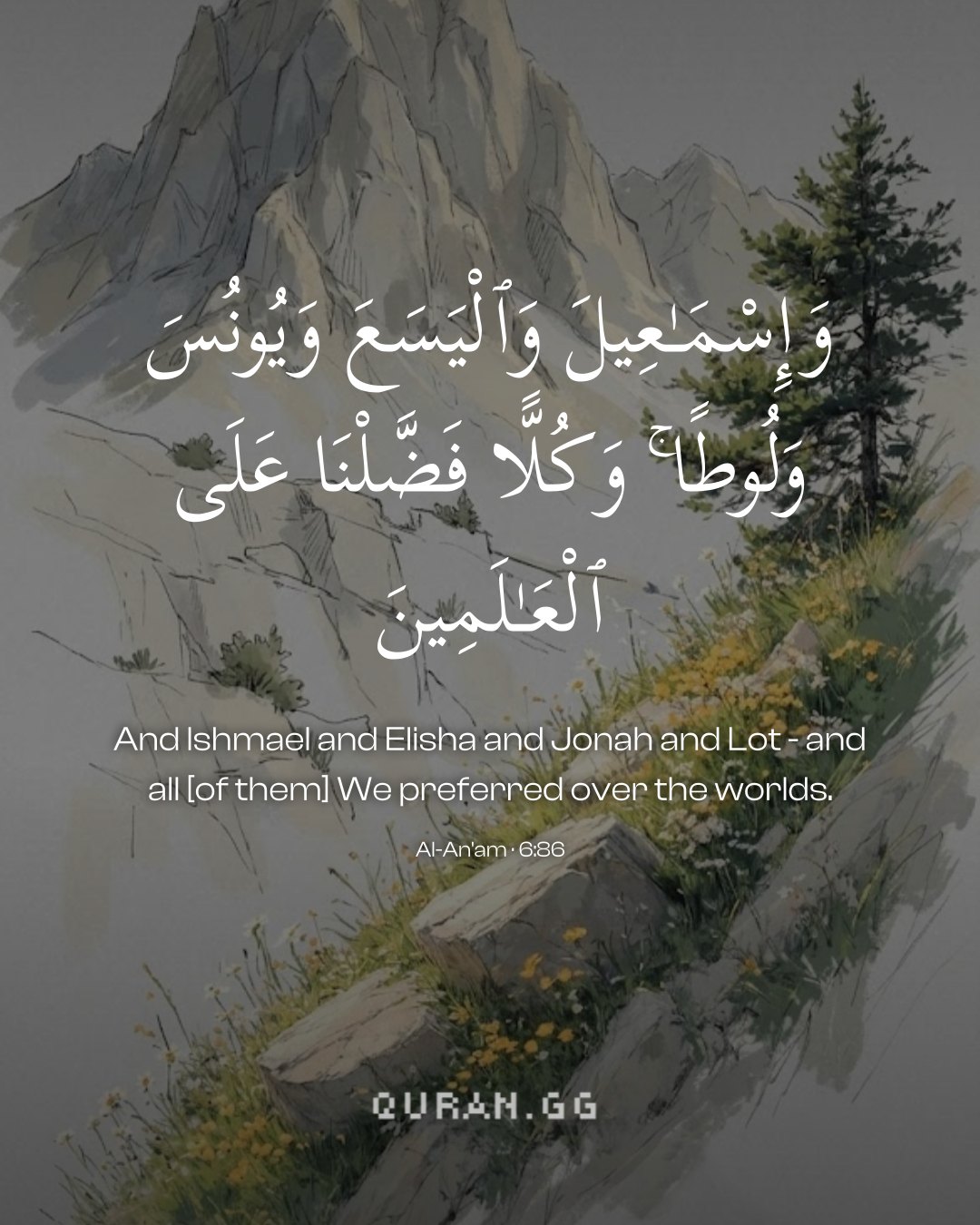
In the six verses (84-89) appearing after that, there is a list of seventeen blessed prophets, some of whom are the forefathers of Sayyidna Ibrahim (علیہ السلام) while most are his progeny, with some being his brothers or nephews. On the one hand, described in these verses is their being Divinely guided, righteous in conduct and firm on the straight path, along with the fact that Allah Ta` ala has chosen and blessed has been stressed them to serve His religion. On the other hand, it has been stressed that, in return for the sacrifice of Sayyidna Ibrahim (علیہ السلام) who had disassociated himself from his father, community and country in the way of Allah, was it not that, much before the reward of eternal bliss in the Hereafter, Allah Ta` ala bestowed on him right here in this world too a community better than his own, a country better than his own - and blessed him with the supreme distinction that all prophets and messengers sent into the world after him upto the end of time were from among his progeny? A branch that originated from Sayyidna Ishaq (علیہ السلام) had prophets who appeared among the Bani 1sra'il. The other branch which originated from Sayyidna 1sma'il (علیہ السلام) saw the coming of the foremost and the Last among prophets, Sayyidna Muhammad al-Mustafa ﷺ from among them. They all were the progeny of Sayyidna Ibrahim (علیہ السلام) . This phenomena also punishment tells us that, though honour and salvation or disgrace and punishment really depend on one's personal deeds, but having a prophet or man of Allah (waliy) among forefathers, or having observing ` Alims of Din and men and women of righteous conduct among children, is also a great blessing as this too brings its benefits.
Excellence, or superiority, is not anyone’s racial or national prerogative. It is a gift of God to only those individuals who keep themselves righteous according to God’s guidance, who avoid all sorts of polytheism (shirk) and who throw themselves, body and soul, into the task of ‘preaching (admonition) without remuneration.’ These are the people who make the Book of God their real guide. They identify themselves with the Book to such an extent that the divine mysteries reveal themselves to them; the result of which process is known as wisdom (hikmah). These are the people whom God picks out, then commissions some of them, whom He likes, with the task of conveying His message, as prophets during the age of prophethood, and thereafter as da‘is. God’s reward either to prophets or da‘i will be entirely on the basis of righteous action (ihsan).
Uthmani text of the Madinah mushaf (King Fahd Complex). Translation: Saheeh International. Tafsir via Quran.com.