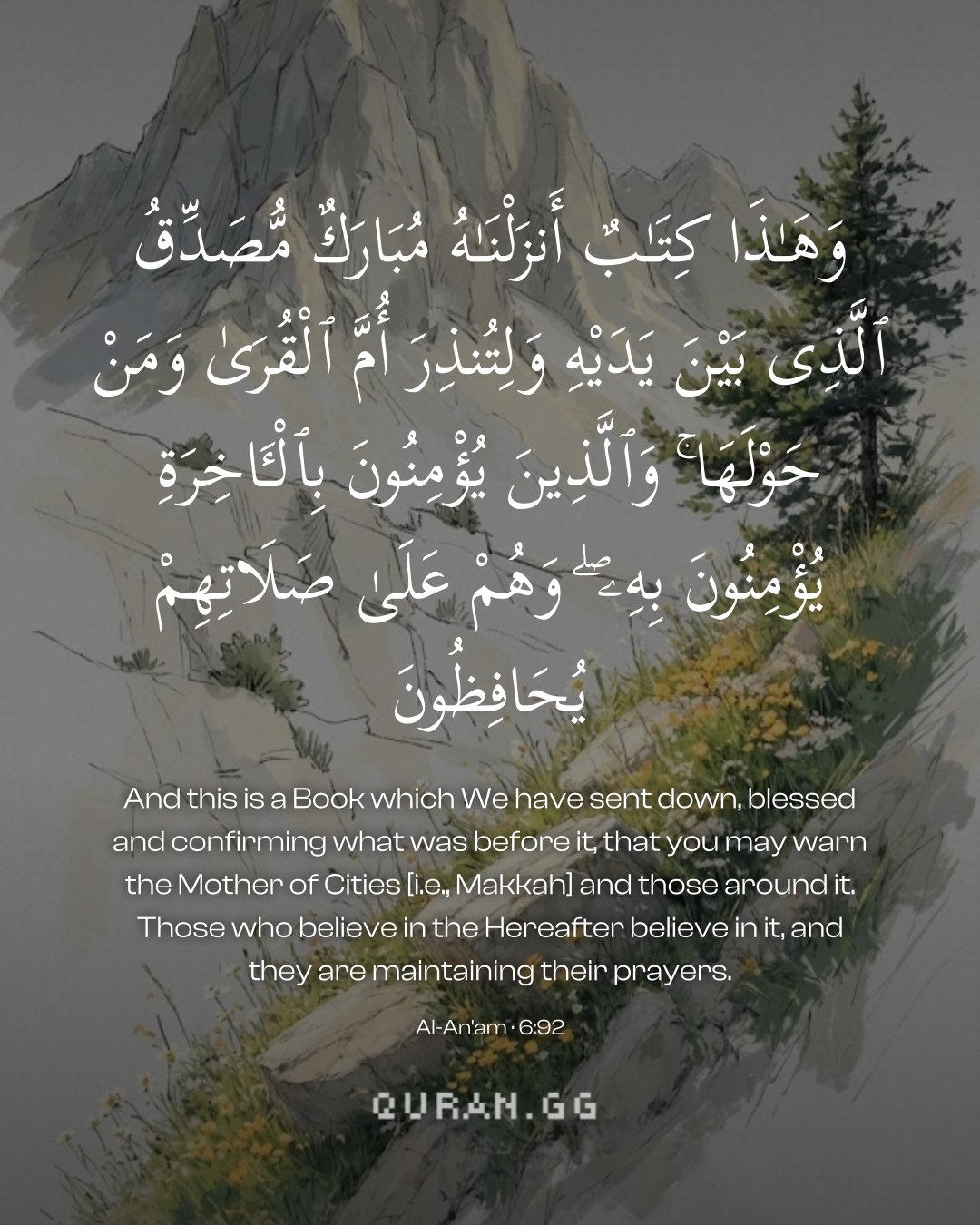
And this is a Book which We have sent down, blessed and confirming what was before it, that you may warn the Mother of Cities [i.e., Makkah] and those around it. Those who believe in the Hereafter believe in it, and they are maintaining their prayers.
The Messenger is but a Human to Whom the Book was Revealed by Inspiration
Allah says that those who rejected His Messengers did not give Allah due consideration. Ibn `Abbas, Mujahid and `Abdullah bin Kathir said that this Ayah was revealed about the Quraysh. It was also said that it was revealed about some Jews.
After having concluded the argument concerning Books revealed by Allah Ta` ala against deniers, it was said in the third verse (92): وَهَـٰذَا كِتَابٌ أَنزَلْنَاهُ مُبَارَكٌ مُّصَدِّقُ الَّذِي بَيْنَ يَدَيْهِ وَلِتُنذِرَ أُمَّ الْقُرَىٰ وَمَنْ حَوْلَهَا (And this is a blessed Book We have sent down confirming what has been before it, so that you may warn the town which is the mother of all towns, and those around it), that is, as it is that they too accept that the Torah was sent down by Allah Ta` ala, so it is that We have sent down this Qur'an too, and sufficient for them is the proof of its veracity that the Qur'an confirms what has been revealed in the Torah and the Injil. And that it was revealed after the Torah and Injil is because these two Books were sent for the Bani Isra'il while for their other branch of Bani Isma'il, known as Arabs living in Umm al-Qura, that is, Makkah and its environs, there has been no prophet or book of guidance until that time. Now this Qur'an has been sent for them particularly, and for the whole world generally. Makkah al-Mu'azzamah has been called Umm al-Qura by the Holy Qur'an. It means the root and foundation of all towns and habitations. The reason is that, according to historical nar-ratives, the land mass of the earth first began appearing from here. In addition to that, this is the Qiblah, and the central attraction of all acts of ` Ibadah for the whole world. (Mazhari) Said with: أُمَّ الْقُرَىٰ (Umm al-Qura) is: وَمَنْ حَوْلَهَا (and those around it). It means all environs of Makkah, which includes the whole world East, West, North and South of Makkah.
Towards the end of the verse, it was said: وَالَّذِينَ يُؤْمِنُونَ بِالْآخِرَةِ يُؤْمِنُونَ بِهِ ۖ وَهُمْ عَلَىٰ صَلَاتِهِمْ يُحَافِظُونَ. It means: Those who believe in the 'Akhirah (Hereafter) also believe in the Qur'an and are particularly careful about their prayers (Salah). This carries an admonition for the Jews and disbelievers against their common ailment whereby they would, with typical lack of concern, accept what they liked and reject what they did not, opening a front against it. This is an effect of that ailment - that they do not believe in 'Akhirah. Anyone who believes in 'Akhirah and in a Day of Judgment will definitely be moved by the fear of Allah which would help him or her reason it out, and once convinced, one would bypass constraints of ignorant customs and embrace what is the truth.
A little thought would reveal that the lack of concern for the 'Akhirah is the mother of all spiritual diseases. From here come Kufr and Shirk and sin and disobedience. If a believer in the 'Akhirah happens to have committed a mistake or sin, he does feel a pinch in his heart. Sooner or later, he repents and resolves to stay away from sin in the future. So, the fear of Allah 'and the concern for the 'Akhirah are, in all truth, channels which make human beings what they should be and which make them capable of staying away from crime and sin and disobedience by conscious choice. Therefore, no Surah (Chapter) of the Qur'an, perhaps no Ruku` (Section) either, is left without a reminder of this concern for the 'Akhirah:.
O Allah, make all our concerns a single concern - the concern for 'Akhirah.
Tazkirul Quran
Maulana Wahiduddin Khan
This brazen disregard for the truth developed in the Jews because they had disintegrated God’s Book page by page. They used to call attention to certain teachings of God, while there were others which they deliberately omitted to mention. For example, they used repeatedly to listen to and recite all verses relating to rewards, while omitting those verses which mentioned the deeds which merited rewards. They used to make special mention of those verses from which they could draw support for the petty details of their politics, while ignoring the verses in which instructions were given about quiet reformation. They used to elaborate upon those verses which gave them the opportunity to display their verbal hair-splitting talents, while cursorily passing over verses in which the eternal realities of religion were set forth. Frequent public airings were given to such verses as gave an indication of their superiority, while verses in which their responsibilities were mentioned used to be neglected. In those who disintegrate God’s Book ‘page by page’ in this way, a tendency to insolent bravado naturally develops. They indulge in frivolous and trivial discussions, then bicker, and make contradictory statements. One cannot expect real co-operation from them. If people do not do justice to God’s Book, how can they be just while dealing with human beings? The call of religion is actually a call to awaken people. The caller, however perfect he may be, can be effective and make an impact on the listener’s heart only when the listener has a fearing heart in his breast and considers the Hereafter a matter of the utmost gravity. If these elementary qualities are not found in the listener, then the giver of the call cannot offer him any benefit.
Uthmani text of the Madinah mushaf (King Fahd Complex). Translation: Saheeh International. Tafsir via Quran.com.