The Revelation of the Tawrah and the Qur'an
We have already noted that Allah often mentions Musa and Muhammad together -- may the peace and blessings of Allah be upon them both -- and He often mentions their Books together as well. He says:
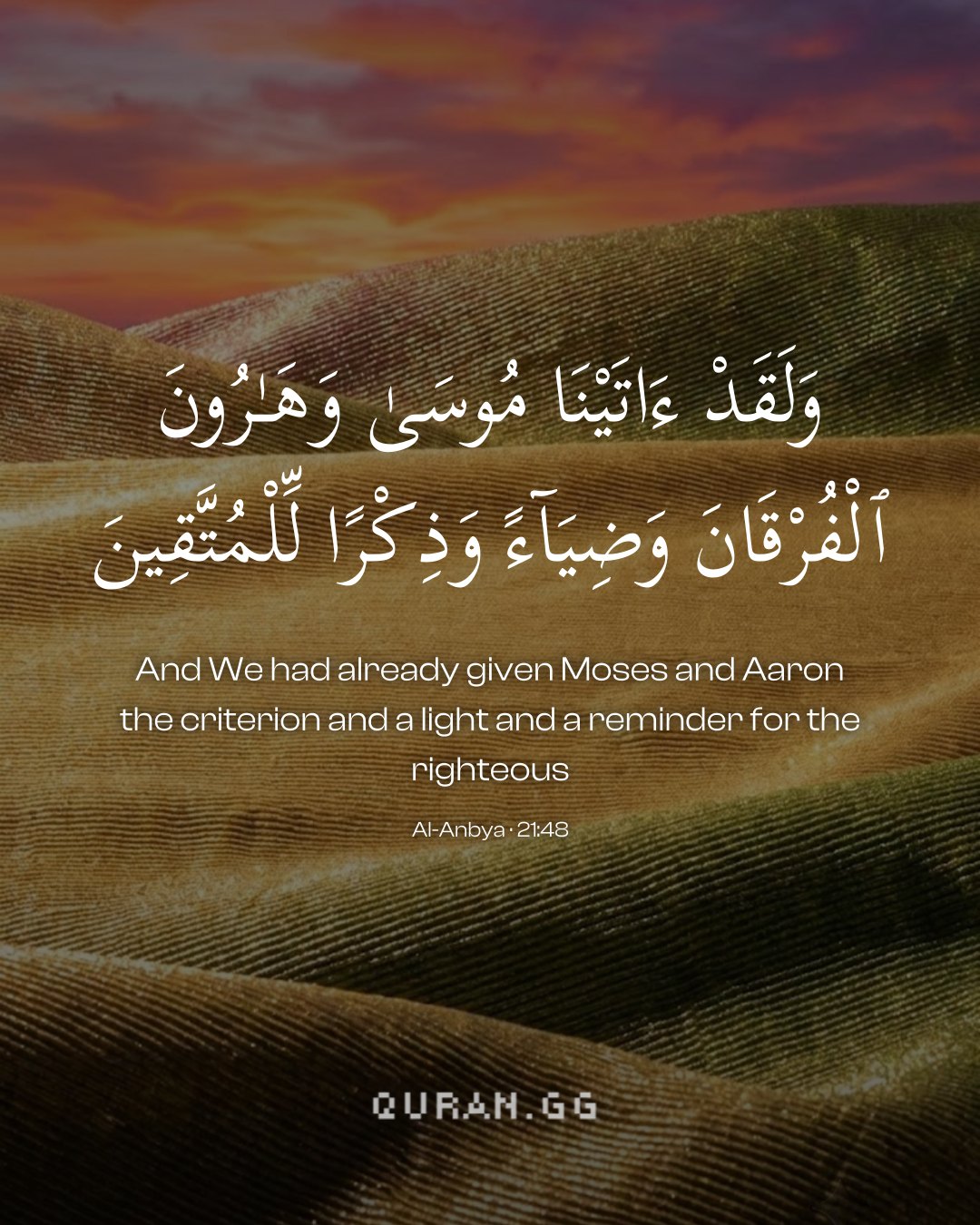
وَلَقَدْ ءَاتَيْنَا مُوسَى وَهَـرُونَ الْفُرْقَانَ
(And indeed We granted to Musa and Harun the criterion) Mujahid said, "This means the Scripture." Abu Salih said: "The Tawrah." Qatadah said: "The Tawrah, what it permits and it forbids, and how Allah differentiated between truth and falsehood." In conclusion, we may say that the heavenly Books included the distinction between truth and falsehood, guidance and misguidance, transgression and the right way, lawful and unlawful, and that which will fill the heart with light, guidance, fear of Allah and repentance. So Allah says:
الْفُرْقَانَ وَضِيَآءً وَذِكْراً لِّلْمُتَّقِينَ
(the criterion, and a shining light and a Reminder for those who have Taqwa.) meaning, a reminder and exhortation for them. Then He describes them as:
الَّذِينَ يَخْشَوْنَ رَبَّهُم بِالْغَيْبِ
(Those who fear their Lord in the unseen.) This is like the Ayah:
مَّنْ خَشِىَ الرَّحْمَـنَ بِالْغَيْبِ وَجَآءَ بِقَلْبٍ مُّنِيبٍ
(Who feared the Most Gracious in the unseen and came with a repenting heart. ) 50:33
إِنَّ الَّذِينَ يَخْشَوْنَ رَبَّهُم بِالْغَيْبِ لَهُم مَّغْفِرَةٌ وَأَجْرٌ كَبِيرٌ
(Verily, those who fear their Lord unseen, theirs will be forgiveness and a great reward.) 67:12 t
وَهُمْ مِّنَ السَّاعَةِ مُشْفِقُونَ
(and they are afraid of the Hour.) means, they fear it. Then Allah says:
وَهَـذَا ذِكْرٌ مُّبَارَكٌ أَنزَلْنَـهُ
(And this is a blessed Reminder which We have sent down;) means, the Magnificent Qur'an, which falsehood cannot approach, from before it or behind it, revealed by the All-Wise, Worthy of all praise.
أَفَأَنْتُمْ لَهُ مُنكِرُونَ
(will you then deny it) means, will you deny it when it is the utmost in clarity and truth
Commentary
الْفُرْقَانَ وَضِيَاءً وَذِكْرًا لِّلْمُتَّقِينَ (Criterion and light and an advice for the God-fearing - 21:48) The three attributes which belong to Torah are فُرْقَانَ (criterion) which differentiates between right and wrong second is 4 ' (light) which provides light and manifestation of truth to hearts, and the third is ذِکر (advice) which is a source of guidance for the people. Some explain فُرْقَانَ as help from God which was available to Sayyidna Musa (علیہ السلام) all times. It was manifest when he was raised in the Pharaoh's house, then at the time of his contest with the Egyptian magicians which resulted in the Pharaoh's discomfiture, and again when he was pursued by the Pharaoh and his army and Allah saved him by causing dry passageways to appear in the river and, after the Bani Isra'il had crossed over to the other side, by drowning the Pharaoh and his army. Even after this incident Allah's help was available to him at all times. Qurtubi has pointed out that whereas (ضِيَاءً light) and ذِکر (advice) are the attributes of Torah, o4 (criterion) is something else and not an attribute of Torah, because of the use of the conjunctive letter Wa.'o (و) after the word فُرْقَانَ (Allah knows best).
In the present world, a ‘balance (or scale)’ is a device for finding out the weight of an object. Therefore, God has used this known term to explain the events on Judgement Day. Where the scales of the world weigh material things, on the Day of Judgement, the scales of God will weigh intangible facts and show their ‘weights.’ That is, the scales of the world can measure the material aspect of things but the divine scales will be able to measure the inner value of our deeds. In this world, a man obtains things by paying for them. One who pays less receives less and one who pays more receives more. The same will be the position on the Day of Judgement. Things of high value will be available only on payment of their price which will be in terms of good deeds. Just as things are not available gratis in this world, similarly things will be available on the Day of Judgement only on making a suitable payment: the Quran is a book which indicates what the cost will be. According to the Quranic criterion, a believer will have to develop a spiritual personality in this world itself. This is the price which he has to pay if he wants to find an entry into the ideal world of Paradise.
Uthmani text of the Madinah mushaf (King Fahd Complex). Translation: Saheeh International. Tafsir via Quran.com.