Surah Al-Anbya Ayah 51 (21:51) — Meaning & Tafsir | Quran.GG

Surah Al-Anbya, Ayah 51

21:51 · Meaning and tafsir

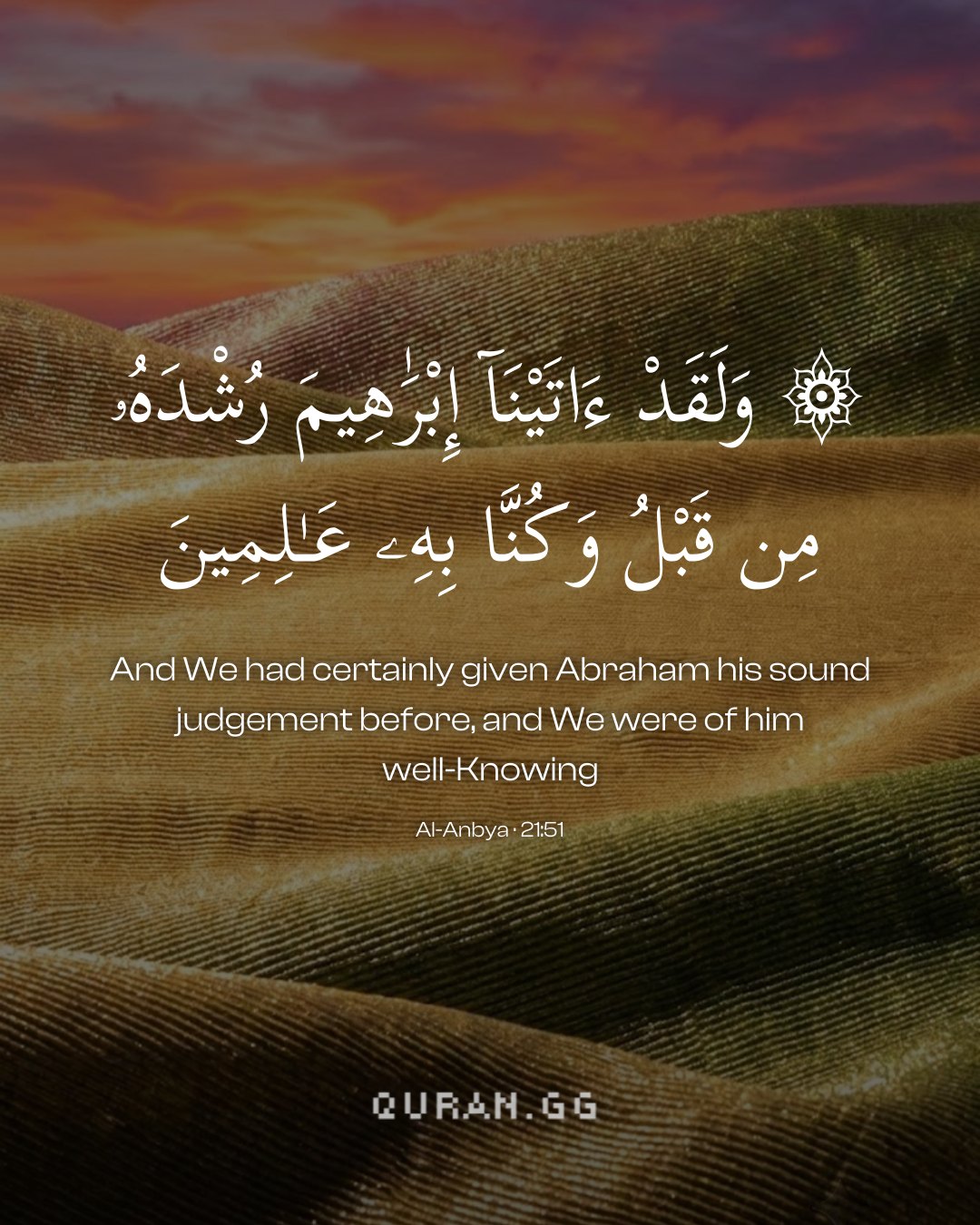
۞ وَلَقَدْ ءَاتَيْنَآ إِبْرَٰهِيمَ رُشْدَهُۥ مِن قَبْلُ وَكُنَّا بِهِۦ عَـٰلِمِينَ ٥١

And We had certainly given Abraham his sound judgement before, and We were of him well-Knowing

Surah Al-Anbya 21:51 in Arabic with its translation: “And We had certainly given Abraham his sound judgement before, and We were of him well-Knowing”

Make something with this ayah

Turn it into a video for Stories, Reels or TikTok, recited by the reciter you pick, or an image on a background you choose. Free, in your browser.

Download this image

Tafsir Ibn Kathir (abridged)

The Story of Ibrahim and his People

Allah tells us about His close Friend Ibrahim, peace be upon him, and how He bestowed upon him guidance aforetime, i.e., from an early age He inspired him with truth and evidence against his people, as Allah says elsewhere:

وَتِلْكَ حُجَّتُنَآ ءَاتَيْنَـهَآ إِبْرَهِيمَ عَلَى قَوْمِهِ

(And that was Our proof which We gave Ibrahim against his people) 6:83. The point here is that Allah is telling us that He gave guidance to Ibrahim aforetime, i.e., He had already guided him at an early age.

وَكُنَّا بِهِ عَـلِمِينَ

(and We were Well-Acquainted with him.) means, and he was worthy of that. Then Allah says:

إِذْ قَالَ لاًّبِيهِ وَقَوْمِهِ مَا هَـذِهِ التَّمَـثِيلُ الَّتِى أَنتُمْ لَهَا عَـكِفُونَ

(When he said to his father and his people: "What are these images, to which you are devoted") This is the guidance which he had been given during his youth: his denunciation of his people's worship of idols instead of Allah. Ibrahim said:

مَا هَـذِهِ التَّمَـثِيلُ الَّتِى أَنتُمْ لَهَا عَـكِفُونَ

("What are these images, to which you are devoted") meaning, which you worship with such devotion.

قَالُواْ وَجَدْنَآ ءَابَآءَنَا لَهَا عَـبِدِينَ

(They said: "We found our fathers worshipping them.") means, they had no other evidence apart from the misguided actions of their forefathers. Ibrahim said:

لَقَدْ كُنتُمْ أَنتُمْ وَءَابَآؤُكُمْ فِى ضَلَـلٍ مُّبِينٍ

(Indeed you and your fathers have been in manifest error.) meaning, Speaking to your fathers whose actions you cite as evidence would be the same as speaking to you. Both you and they are misguided and are not following any straight path.' When he called their intelligence into question, and said that their fathers were misguided and belittled their gods,

قَالُواْ أَجِئْتَنَا بِالْحَقِّ أَمْ أَنتَ مِنَ اللَّـعِبِينَ

(They said: "Have you brought us the Truth, or are you one of those who play about") They said: `These words that you are saying, are you speaking in jest or are you telling the truth For we have never heard such a thing before.'

قَالَ بَل رَّبُّكُمْ رَبُّ السَّمَـوَتِ وَالاٌّرْضِ الَّذِى فطَرَهُنَّ

(He said: "Nay, your Lord is the Lord of the heavens and the earth, Who created them...") meaning, your Lord, beside Whom there is no other god, is the One Who created the heavens and the earth and all that they contain; He is the One Who initiated their creation; He is the Creator of all things.

وَأَنَاْ عَلَى ذلِكُمْ مِّنَ الشَّـهِدِينَ

(and to that I am one of the witnesses. ) means, and I bear witness that there is no God other than Him and no Lord except Him.

Ma'arif al-Qur'an

Commentary

الْفُرْ‌قَانَ وَضِيَاءً وَذِكْرً‌ا لِّلْمُتَّقِينَ (Criterion and light and an advice for the God-fearing - 21:48) The three attributes which belong to Torah are فُرْ‌قَانَ (criterion) which differentiates between right and wrong second is 4 ' (light) which provides light and manifestation of truth to hearts, and the third is ذِکر (advice) which is a source of guidance for the people. Some explain فُرْ‌قَانَ as help from God which was available to Sayyidna Musa (علیہ السلام) all times. It was manifest when he was raised in the Pharaoh's house, then at the time of his contest with the Egyptian magicians which resulted in the Pharaoh's discomfiture, and again when he was pursued by the Pharaoh and his army and Allah saved him by causing dry passageways to appear in the river and, after the Bani Isra'il had crossed over to the other side, by drowning the Pharaoh and his army. Even after this incident Allah's help was available to him at all times. Qurtubi has pointed out that whereas (ضِيَاءً light) and ذِکر (advice) are the attributes of Torah, o4 (criterion) is something else and not an attribute of Torah, because of the use of the conjunctive letter Wa.'o (و) after the word فُرْ‌قَانَ (Allah knows best).

Tazkirul Quran

The criterion or discernment (al-furqan), light and reminder or remembrance (dhikr), which were given to Moses, were the same things which all the prophets received from God. Al-furqan means that ideological standard which enables a man to distinguish between Truth and falsehood. Light means divine guidance which pulls a man out of the darkness of the wrong path and puts him on to the straight path. Dhikr means remembrance, i.e. the highlighting of the latent educative aspect of things, so that they do not figure simply as things, but as treasure chests of knowledge for the recognition and realisation of God and His Divine guidance. In this way God has arranged for the guidance of man. But, it is possible for God’s Guide Book to provide guidance in the real sense only when a man is anxious about his fate in the Hereafter, and this anxiety makes him so serious that he attaches more importance to Truth and righteousness than to all other things.

Uthmani text of the Madinah mushaf (King Fahd Complex). Translation: Saheeh International. Tafsir via Quran.com.