Surah Al-Anbya Ayah 89 (21:89) — Meaning & Tafsir | Quran.GG

Surah Al-Anbya, Ayah 89

21:89 · Meaning and tafsir

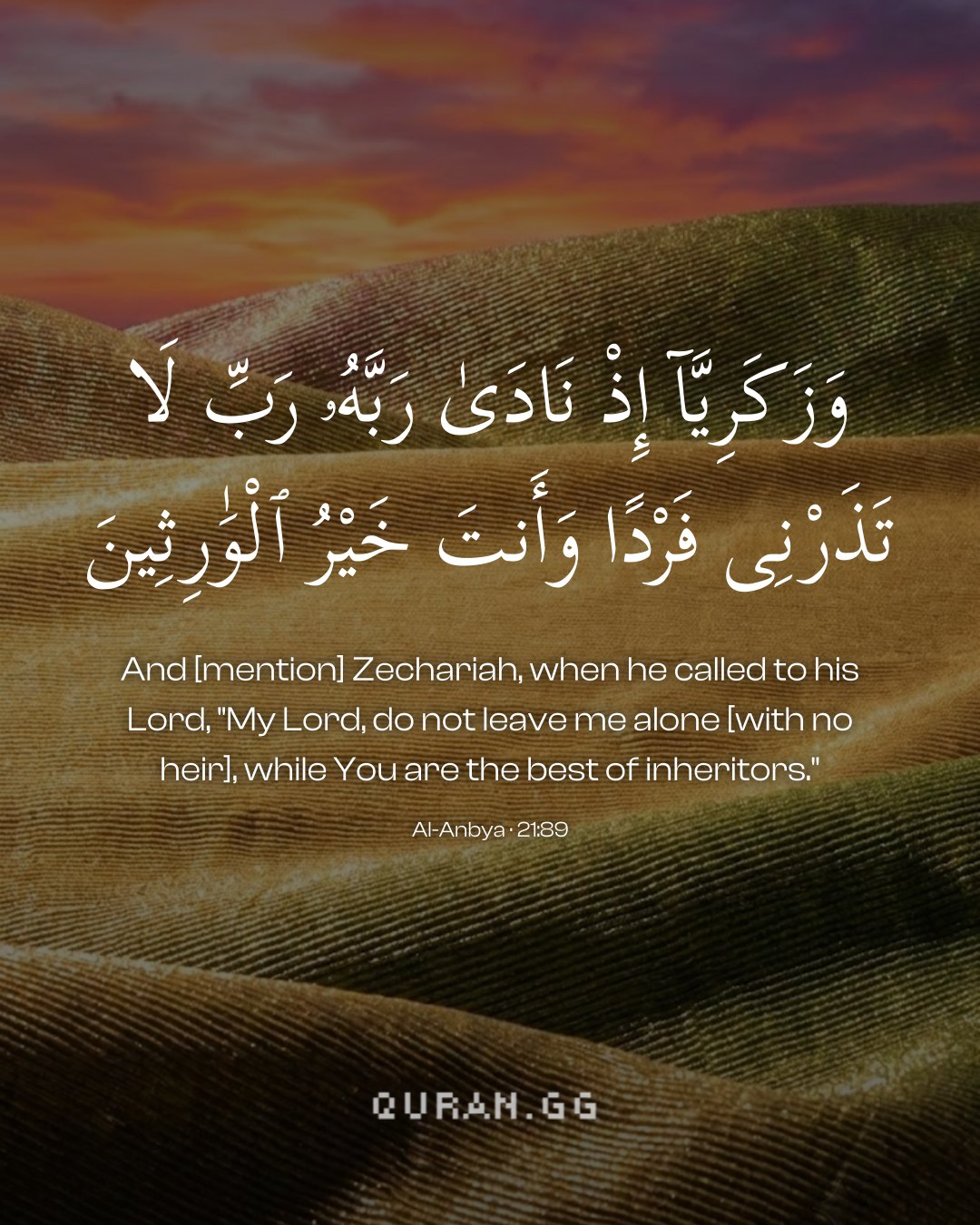
وَزَكَرِيَّآ إِذْ نَادَىٰ رَبَّهُۥ رَبِّ لَا تَذَرْنِى فَرْدًا وَأَنتَ خَيْرُ ٱلْوَٰرِثِينَ ٨٩

And [mention] Zechariah, when he called to his Lord, "My Lord, do not leave me alone [with no heir], while You are the best of inheritors."

Surah Al-Anbya 21:89 in Arabic with its translation: “And [mention] Zechariah, when he called to his Lord, "My Lord, do not leave me alone [with no heir], while…”

Make something with this ayah

Turn it into a video for Stories, Reels or TikTok, recited by the reciter you pick, or an image on a background you choose. Free, in your browser.

Download this image

Tafsir Ibn Kathir (abridged)

Zakariyya and Yahya

Allah tells us of His servant Zakariyya, who asked Allah to grant him a son who would be a Prophet after him. The story has already been given in detail at the beginning of Surah Maryam and also in Surah `Imran. Here an abbreviated version is given.

إِذْ نَادَى رَبَّهُ

(when he cried to his Lord) means, in secret, hiding it from his people.

رَبِّ لاَ تَذَرْنِى فَرْداً

(O My Lord! Leave me not single,) means, with no child and no heir to stand among the people after me.

وَأَنتَ خَيْرُ الْوَرِثِينَ

(though You are the Best of the inheritors.) This is a supplication and form of praise befitting the topic. Allah says:

فَاسْتَجَبْنَا لَهُ وَوَهَبْنَا لَهُ يَحْيَى وَأَصْلَحْنَا لَهُ زَوْجَهُ

(So We answered his call, and We bestowed upon him Yahya, and cured his wife for him.) Ibn `Abbas, Mujahid and Sa`id bin Jubayr said: "She was barren and never had a child, then she gave birth."

إِنَّهُمْ كَانُواْ يُسَارِعُونَ فِى الْخَيْرَتِ

(Verily, they used to hasten on to do good deeds,) means, acts of worship and acts of obedience towards Allah.

وَيَدْعُونَنَا رَغَباً وَرَهَباً

(and they used to call on Us with hope and fear,) Ath-Thawri said, "Hoping for that (reward) which is with Us and fearing that (punishment) which is with Us."

وَكَانُواْ لَنَا خـشِعِينَ

(and they were Khashi`in before Us.) `Ali bin Abi Talhah reported from Ibn `Abbas that this means, sincerely believing in that which was revealed by Allah. Mujahid said: "Truly believing." Abu Al-`Aliyah said: "Fearing." Abu Sinan said: "Khushu` means the fear which should never leave our hearts." It was also reported from Mujahid that the Khashi`in are those who are humble." Al-Hasan, Qatadah and Ad-Dahhak said, "The Khashi`in are those who humble themselves before Allah." All of these suggestions are close in meaning.

Ma'arif al-Qur'an

Commentary

Sayyidna Zakariyya (علیہ السلام) wished for a son and heir for which he prayed to Allah. But at the same time he made it clear that Allah is the best heir no matter if he had a son or not وَأَنتَ خَيْرُ‌ الْوَارِ‌ثِينَ. You are the best of inheritors - 21:89). This was the manifestation of the prophetic respect in that the main concern of the prophets should always be toward Allah Ta’ ala, and even if someone else came into focus, their attention should not deviate from the main objective.

Tazkirul Quran

Jonah (Yunus) was sent as a prophet to Nineveh, an ancient city of Iraq. At that time, Nineveh’s population was just over one hundred thousand. For a long time, he invited the community to accept the unity of God and the Hereafter, but they were not ready to do so. Now, if any community remains adamant about their denial of a prophet, even after having had the divine message conveyed to them to the fullest possible extent, then God’s way is to ask the prophet to leave the town and thereafter the community is subjected to punishment (in the shape of some disaster). But Jonah himself felt that the time had come for him to go, and he went away, leaving his community without waiting for God’s command to do so. He left the city and, reaching the sea coast, he boarded a boat. After setting sail, the boat started sinking. People thought that some slave who had fled from his master was on the boat. According to an old tradition, the solution to this problem was to discover the slave and cast him out. When lots were drawn, the name of Jonah came up and he was thrown overboard. At that moment a big fish (probably a sperm whale) appeared and swallowed him. The fish kept him in its stomach, then at God’s command, ejected him and cast him up on the coast. There he recovered his health and returned to his community. A prophet had to face this fate simply because he left his dawah mission before its completion. Then one can imagine the fate of those successors of the prophet who have been neglectful and completely unmindful of the task of spreading God’s word.

Uthmani text of the Madinah mushaf (King Fahd Complex). Translation: Saheeh International. Tafsir via Quran.com.