Muslims invoke Allah for Help, Allah sends the Angels to help Them
Al-Bukhari wrote in the book of battles (in his Sahih) under "Chapter; Allah's statement,
إِذْ تَسْتَغِيثُونَ رَبَّكُمْ فَاسْتَجَابَ لَكُمْ
((Remember) when you sought help of your Lord and He answered you) until,
فَإِنَّ اللَّهَ شَدِيدُ الْعِقَابِ
(then verily, Allah is severe in punishment)" that Ibn Mas`ud said, "I was a witness to something that Al-Miqdad bin Al-Aswad did, that I would like more than almost anything else to have been the one who did it. Al-Miqdad came to the Prophet while he was invoking Allah against the idolators and proclaimed, `We will not say as the people of Musa said, "So go you and your Lord and fight you two."
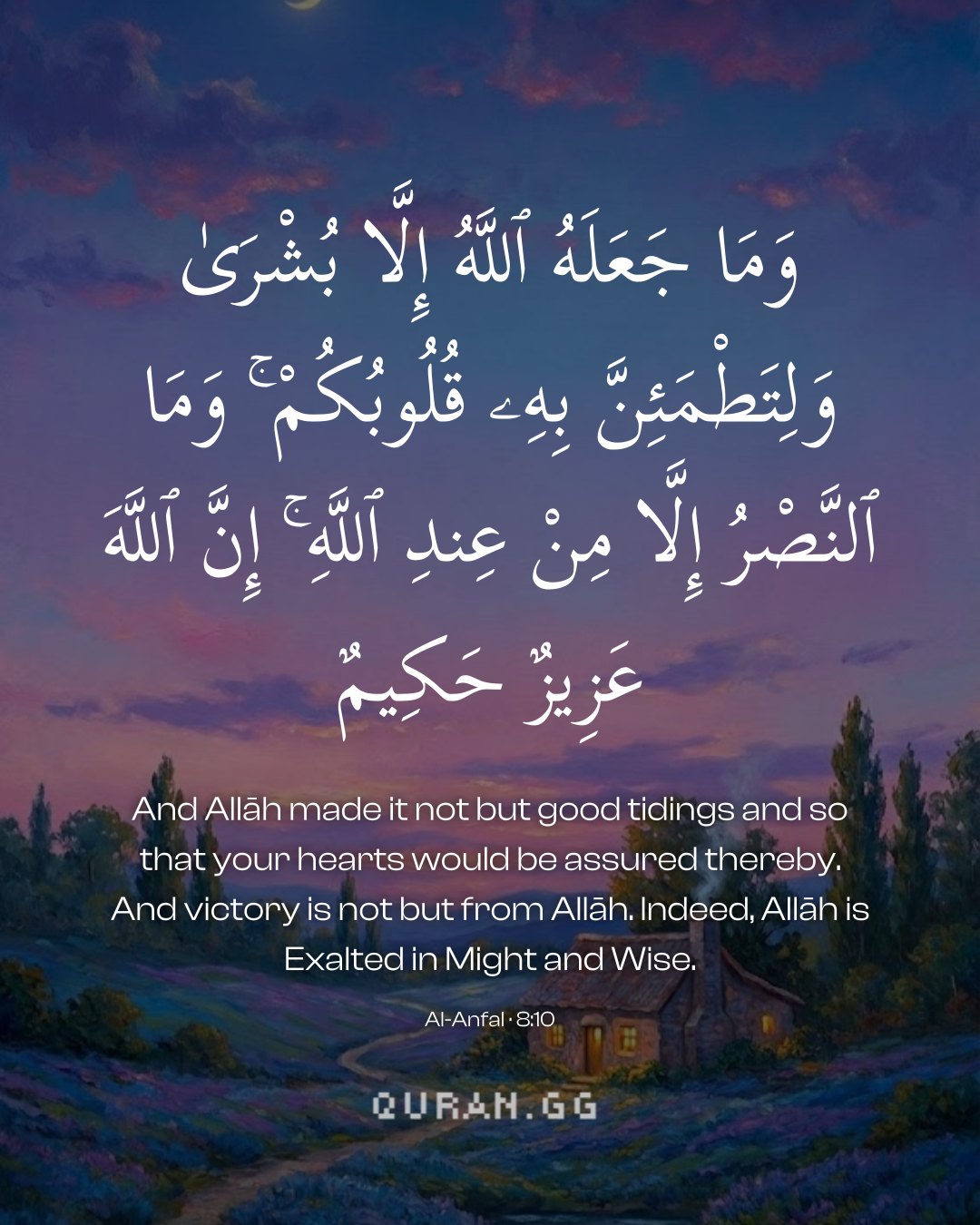
Continue reading the tafsir of ayahs 9–10 The fourth verse (10) restates this aspect explicitly by saying: وَمَا جَعَلَهُ اللَّـهُ إِلَّا بُشْرَىٰ وَلِتَطْمَئِنَّ بِهِ قُلُوبُكُمْ. It means: 'Allah has done it only to give you glad tidings and so that your hearts might be at rest thereby.'
The number of angels sent to support Muslims in the battle of Badr has been given as one thousand at this place, while in Surah 'Al-` Imran (3:124) the number mentioned is three thousand and five thousand. The reason for this lies in three different promises made under different circumstances. The first promise was that of one thousand angels, the reason for which was the prayer of the Holy Prophet ﷺ and the supporting plaint of common Muslims with him. The second promise of three thousand angels which appears first in Surah 'Al-` Imran was made at a time when Muslims heard about the additional forces coming to join the Quraysh army. It has been reported in Ruh al-Ma'ani as based on a narration of Al-Sha'bi from Ibn Abi Shaybah, Ibn al-Mundhir and others that on the day of the battle of Badr when Muslims heard that Kurz ibn Jabir Muharibi was coming with additional armed support for the disbelievers, they were disturbed and agitated. Thereupon, the verse of 'Al-` Imran: أَلَن يَكْفِيَكُمْ أَن يُمِدَّكُمْ رَبُّكُم بِثَلَاثَةِ آلَافٍ مِّنَ الْمَلَائِكَةِ مُنزَلِينَ : "Shall it not suffice you that your Lord should help you with three thousand of the angels sent down (for you)?" - 3:124) was revealed and referred to wherein is the promise of sending a force of three thousand angels from the heavens in order to support believers.
As for the third promise of five thousand, it was made subject to the condition that should the enemy launch a sudden offensive, a supporting force of five thousand angels will be sent down. That promise appears in the verse which follows verse 124 of Surah 'Al-` Imran (3) cited immediately above. Given here are the words in which it has been mentioned:
بَلَىٰ ۚ إِن تَصْبِرُوا وَتَتَّقُوا وَيَأْتُوكُم مِّن فَوْرِهِمْ هَـٰذَا يُمْدِدْكُمْ رَبُّكُم بِخَمْسَةِ آلَافٍ مِّنَ الْمَلَائِكَةِ مُسَوِّمِينَ ﴿125﴾
"Why not? If you stay patient and fear Allah and they come upon you even in this heat of theirs, your Lord will reinforce you with five thousand of the angels having distinct marks" (3:125).
Some Commentators have said that this promise had three conditions: (1) Fortitude, (2) Taqwa or fear of Allah and (3) Sudden and all-out attack by the opposing forces. Out of these, the first two conditions were already fulfilled by the noble Companions ؓ for no departure from these was witnessed in this battlefield from the beginning to the end.
But, what did not take place was the third condition of a sudden attack. Therefore, things did not reach the point where the army of five thousand angels was to be inducted.
So, this matter remained revolving between one and three thousand which also lends to the probability that the figure of three thousand may mean the one thousand sent earlier to which an additional force of two thousand was added and made to be three thousand - and it is also probable that these three thousand were in addition to the first one thousand.
At this stage, it is also interesting to note that the promise of sending three groups of angels in these three verses (8:9; 3:124; 3:125) mentions a quality particular to each group. In the present verse, verse 9 of Surah Al-Anfal, where the promise is for one thousand, the word used to describe the quality of these angels is مُرْدِفِينَ (murdifin: translated here as 'one following the other' ). Perhaps, the indication already given within the text is that there are others too coming behind these angels. Then, in the first verse of Surah 'Al-` Imran (3:124) quoted above, the quality of the angels has been given as: مُنزَلِينَ (munzalin : translated as 'sent down [ for you ] ' ). The sense is that these angels will be made to descend from the heavens. In this, there is a hint towards the special arrangement made in this connection - that the angels already present on the earth will not be employed for this mission, instead of which, it will be by special appointment and dispatch that these angels will be sent down from the heavens to fulfill the assignment they have been sent to carry out. After that, we have the second verse (3:125) of Surah 'Al-` Imran where the figure of five thousand has been mentioned. There, the quality of the angels has been stated to be: مُسَوِّمِينَ (musawwimin: translated as 'having distinct marks' ) that is, they shall be appearing in a particular dress and distinctive signs and marks. This is corroborated by Hadith narrations which report that the headgear of angels that descended during the battle of Badr was white and that of the angels who were sent down to help believers in the battle of Hunayn was red.
Finally, towards the end of the verse (10), it was said: وَمَا النَّصْرُ إِلَّا مِنْ عِندِ اللَّـهِ ۚ إِنَّ اللَّـهَ عَزِيزٌ حَكِيمٌ (And the help is from none but Allah. Surely, Allah is Mighty, Wise). Here, Muslims have been warned that all help, whatever and from wherever it may be, open or secret, is from Allah Ta` ala alone and issues forth through His power and control only. The help and support of angels is also subject to nothing but His command. Therefore, all believers must look up to none but the most pristine Being of Allah who is One and with Whom there is no partner or associate - because, He is the possessor of Power and Wisdom at its greatest.
In Sha‘ban, (2 A.H.) the eighth month of the Islamic calendar, it came to be known that a commercial caravan of the Quraysh, carrying goods worth about fifty thousand guineas, was returning from Syria to Makkah. It was on a route which passed close by Madinah. It was feared that the Muslims might attack this caravan of their enemies. So, the chief of the caravan, Abu Sufyan ibn Harb, sent word to the people of Makkah that they should rush to him with aid, otherwise the Muslims would capture the caravan. This news created a lot of fervour in Makkah. So, a troop of 950 horsemen (600 of them fully armoured) set out from Makkah for Madinah. The Prophet was also receiving all the news. Now the Muslims of Madinah were in between two groups—one was the caravan returning from Syria, and the other was the army advancing from Makkah to Madinah. One section of the Muslims had the idea that they should advance towards the caravan. Since this caravan had only 40 guards, it could be overcome and its goods captured. But God’s plan was different. In fact, God wanted to crush the strength of those who deny the truth rather than permit the Muslims to make some material gain. God, therefore, created special conditions and caused all the chiefs of the opponents to set out from Makkah and reach Badr, a place 20 miles from Madinah, so that they should finally perish forever after clashing with the Muslims. When the Prophet informed the Muslims of God’s plan, they all agreed and proceeded towards Badr. Their strength was only 313 and they were ill-equipped. But God gave them special aid, and they routed the army of the Quraysh. Seventy of their chiefs were killed and seventy were taken prisoner. The battlefield of Badr became the scene of Islam’s victory over the deniers of the Truth. Whenever it happens that there is material benefit on the one hand and religious benefit on the other, this division itself proves that God’s will and pleasure centre upon religious benefit and not upon material benefit.The target of Islamic effort is never the attainment of economic advantages. The purpose of Islamic struggle is always to break the strength of falsehood, either by ideological superiority or, through material power as dictated by the circumstances.
Continue reading the tafsir of ayahs 8–10 Uthmani text of the Madinah mushaf (King Fahd Complex). Translation: Saheeh International. Tafsir via Quran.com.