Allah's Signs displayed during Badr, And throwing Sand in the Eyes of the Disbelievers
Allah states that He creates the actions that the servants perform and that whatever good actions they take, it is He Who should be praised for them, for He directed and helped them perform these actions. Allah said,
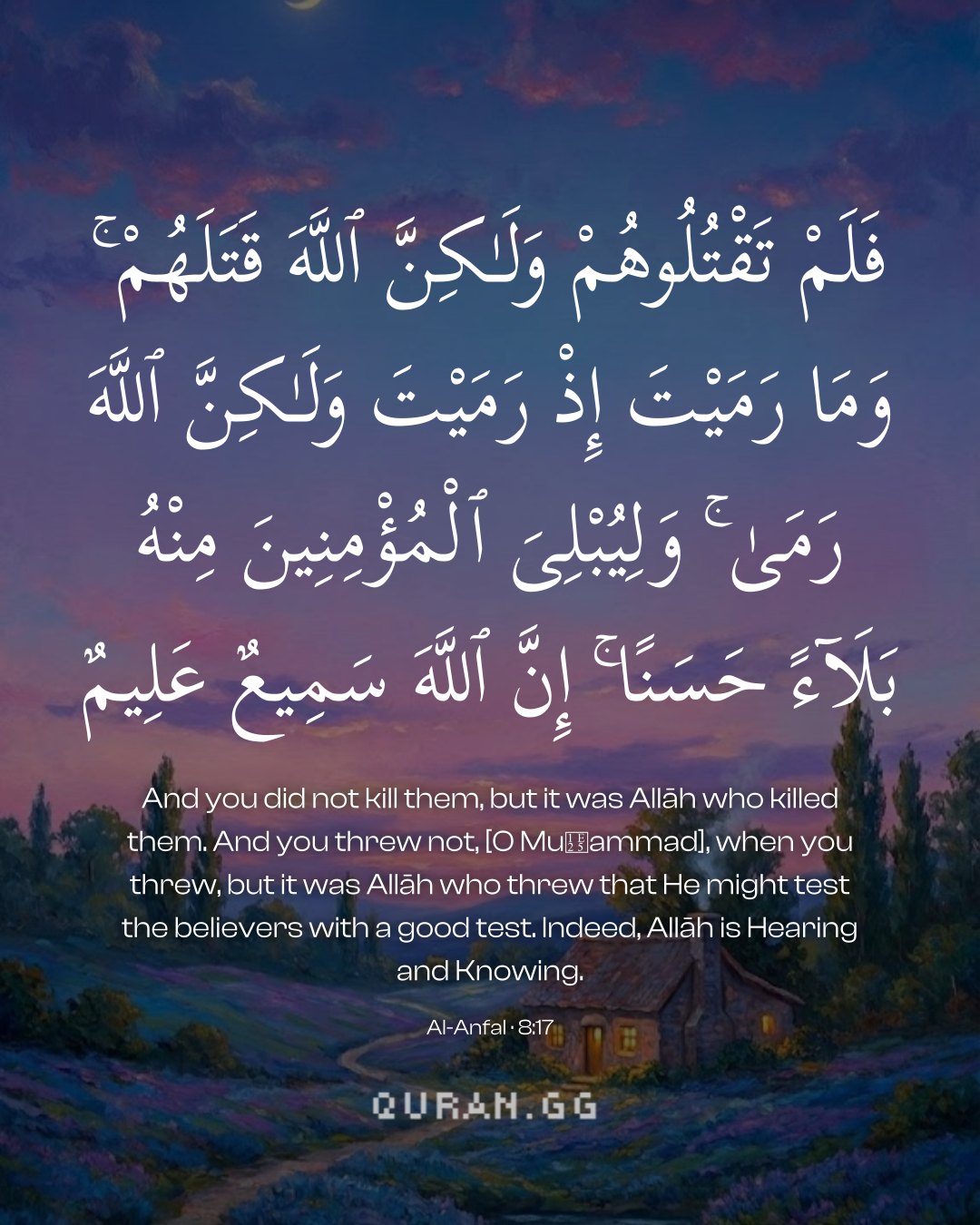
فَلَمْ تَقْتُلُوهُمْ وَلَـكِنَّ اللَّهَ قَتَلَهُمْ
(You killed them not, but Allah killed them.) meaning, it is not because of your power and strength that you killed the pagans, who were many while you were few. Rather, it is He Who gave you victory over them, just as He said in another Ayah,
وَلَقَدْ نَصَرَكُمُ اللَّهُ بِبَدْرٍ وَأَنتُمْ أَذِلَّةٌ
(And Allah has already made you victorious at Badr, when you were a weak little force.) 3:123, and,
لَقَدْ نَصَرَكُمُ اللَّهُ فِى مَوَاطِنَ كَثِيرَةٍ وَيَوْمَ حُنَيْنٍ إِذْ أَعْجَبَتْكُمْ كَثْرَتُكُمْ فَلَمْ تُغْنِ عَنكُمْ شَيْئاً وَضَاقَتْ عَلَيْكُمُ الأَرْضُ بِمَا رَحُبَتْ ثُمَّ وَلَّيْتُم مُّدْبِرِينَ
(Truly, Allah has given you victory on many battlefields, and on the day of Hunayn when you rejoiced at your great number, but it availed you naught and the earth, vast as it is, was straitened for you, then you turned back in flight.) 9:25
Allah, the Exalted and Ever High, states that victory does not depend on numbers or collecting weapons and shields. Rather, victory is from Him, Exalted He is.
كَم مِّن فِئَةٍ قَلِيلَةٍ غَلَبَتْ فِئَةٍ كَثِيرَةً بِإِذْنِ اللَّهِ وَاللَّهُ مَعَ الصَّـبِرِينَ
(How often has a small group overcome a mighty host by Allah's leave" And Allah is with the patient.) 2:249
Allah then mentioned the handful of sand that His Prophet threw at the disbelievers during the day of Badr, when he went out of his bunker. While in the bunker, the Prophet invoked Allah humbly and expressing his neediness before Allah. He then threw a handful of sand at the disbelievers and said,
«شَاهَتِ الْوُجُوه»
(Humiliated be their faces.) He then commanded his Companions to start fighting with sincerity and they did. Allah made this handful of sand enter the eyes of the idolators, each one of them were struck by some of it and it distracted them making each of them busy. Allah said,
وَمَا رَمَيْتَ إِذْ رَمَيْتَ وَلَـكِنَّ اللَّهَ رَمَى
(And you threw not when you did throw, but Allah threw.)
Therefore, it is Allah Who made the sand reach their eyes and busied them with it, not you (O Muhammad) .
Muhammad bin Ishaq said that Muhammad bin Ja`far bin Az-Zubayr narrated to him that `Urwah bin Az-Zubayr said about Allah's statement,
وَلِيُبْلِىَ الْمُؤْمِنِينَ مِنْهُ بَلاَءً حَسَنًا
(that He might test the believers by a fair trial from Him. ) "So that the believers know Allah's favor for them by giving them victory over their enemy, even though their enemy was numerous, while they were few. They should thus know His right and express gratitude for His favor on them." Similar was said by Ibn Jarir. It is stated in a Hadith,
«وَكُلَّ بَلَاءٍ حَسَنٍ أَبْلَانَا»
(Every trail (from Allah) is a favor for us.)
Allah said next,
إِنَّ اللَّهَ سَمِيعٌ عَلِيمٌ
(Verily, Allah is All-Hearer, All-Knower.)
Allah hears the supplication and knows those who deserve help and triumph. Allah said,
ذلِكُمْ وَأَنَّ اللَّهَ مُوهِنُ كَيْدِ الْكَـفِرِينَ
(This (is the fact) and surely Allah weakens the deceitful plots of the disbelievers.) This is more good news, aside from the victory that the believers gained. Allah informed them that He will weaken the plots of the disbelievers in the future, degrade them and make everything they have perish and be destroyed, all praise and thanks are due to Allah.
Ma'arif al-Qur'an
Mufti Muhammad Shafi
This great victory was achieved by Muslims in the background which was initially full of dismay and hopelessness. So, when they returned from the battlefield, they started talking about it. The Companions ؓ got busy relating their deeds on the battlefield. Revealed thereupon was this verse: فَلَمْ تَقْتُلُوهُمْ وَلَـٰكِنَّ اللَّـهَ قَتَلَهُمْ (So, you did not kill them, but Allah killed them -17) through which they were instructed not to wax proud over their effort and deed, for that which happened there was not simply the outcome of their personal effort and deed. In fact, it was purely and simply the fruit of the help and support given by Allah Ta` ala - and the enemies killed at their hands were not really killed by them, rather, they were killed by Allah Ta` ala.
Similarly, addressing the Holy Prophet ﷺ , it was said: وَمَا رَمَيْتَ إِذْ رَمَيْتَ وَلَـٰكِنَّ اللَّـهَ رَمَىٰ (And you did not throw when you threw, but Allah did throw). It means that the specific outcome of the act of throwing, whereby it would reach the eyes of every fighting man in the enemy force and frighten them all, was not the direct effect of 'his' throwing. It was, in fact, the perfect power of Allah Ta’ ala which generated the format of this situation. To quote Rumi for a chic poetic explanation:
ما رمیت اذ رمیت گفت حق کا رما برکارھا دارد سبق
'And you did not throw when you did,' said Allah,
'Our Act precedes all other acts.'
Certainly valuable for Muslims - more valuable than their victory in Jihad - was this instruction which disengaged their minds from means and tied it up with the master-provider of all means, and through it, saved them from falling into the trap of pride and arrogance which generally intoxicates victorious nations. After that it was said that victory and defeat are subservient to the command of Allah and that His support is with those who are obedient: وَلِيُبْلِيَ الْمُؤْمِنِينَ مِنْهُ بَلَاءً حَسَنًا (so that He may bless the believers with a good favour). It means that Allah blessed the believers with this great victory in order to give them the best of return for their obedience and struggle. The literal meaning of the word: بَلَاءً (bala' ) is test or trial. As for the test taken by Allah Ta` ala, it sometimes comes when someone is put to distress or hardship - and there are occasions when this is done by giving someone comfort and wealth. Here, the name of hasan حَسَن (good) bala' (trial) has been given to a test which is taken by giving comfort, wealth, support and victory to find out if people who are so blessed take it to be a favour from Allah and are grateful for it, or take it to be the outcome of their personal excellence, become proud and arrogant and undo what they did - because, there is no room for pride from anyone before Allah Ta` ala.
When the clash between believers and those who deny the truth reaches the battlefield, it is a moment of reckoning for both the parties. If at that critical moment a believing individual or group, turns tail and flees from the battlefield, it amounts to committing the worst kind of crime. Such people consider it more important to save themselves rather than to defend the Truth. They do this when what is at stake is the life of that Truth which they have admitted as the greatest Truth and which they have embraced in all good faith. On such critical occasions, even a minor defection can cause a major debacle. One person’s or one group’s flight from the battlefield lowers the morale of the whole army. One person’s running away can finally turn into a mass stampede. However, the exception to this is when a soldier or an army unit retreats for some strategic purpose, perhaps to leave one front and join another. Retreat is undoubtedly an unpardonable crime, but when carried out on strategic grounds, it is legitimate. The aforesaid commandment originally relates to battle. However, other similar cases may also come within its purview. For example, a missionary may call people to engage in the peaceful and constructive propagation of Islam, but after some time, when he sees that his call is not very popular, he may lose patience and, abandoning the constructive approach, may rush towards that type of Islam through which fame and status among the general public can very soon become a reality. Running away from the battlefield occurs consciously and with intention. But ‘running away’ from the struggle going on outside the battlefield often takes place at the unconscious level. Man happens to be result-loving by nature. He likes to be admired for his work. He wants his work to be accepted and recognised. Such a temperament gradually removes him from the tasks from which an immediate result does not seem to follow. Barely conscious of the factors working within him, he is attracted towards such things as apparently give him the hope of immediate honour and success. Every deviation of this type is an example of what has been described in the above-mentioned verse as ‘running away from the battlefield.’
Continue reading the tafsir of ayahs 16–18 Uthmani text of the Madinah mushaf (King Fahd Complex). Translation: Saheeh International. Tafsir via Quran.com.