The Quraysh claimed They can produce Something similar to the Qur'an
Allah describes the disbelief, transgression, rebellion, as well as misguided statements that the pagans of Quraysh used to utter when they heard Allah's Ayat being recited to them,
قَدْ سَمِعْنَا لَوْ نَشَآءُ لَقُلْنَا مِثْلَ هَـذَآ
("We have heard (the Qur'an); if we wish we can say the like of this.")
They boasted with their words, but not with their actions. They were challenged several times to bring even one chapter like the Qur'an, and they had no way to meet this challenge. They only boasted in order to deceive themselves and those who followed their falsehood. It was said that An-Nadr bin Al-Harith, may Allah curse him, was the one who said this, according to Sa`id bin Jubayr, As-Suddi, Ibn Jurayj and others. An-Nadr visited Persia and learned the stories of some Persian kings, such as Rustum and Isphandiyar. When he went back to Makkah, He found that the Prophet was sent from Allah and reciting the Qur'an to the people. Whenever the Prophet would leave an audience in which An-Nadr was sitting, An-Nadr began narrating to them the stories that he learned in Persia, proclaiming afterwards, "Who, by Allah, has better tales to narrate, I or Muhammad" When Allah allowed the Muslims to capture An-Nadr in Badr, the Messenger of Allah ﷺ commanded that his head be cut off before him, and that was done, all thanks are due to Allah. The meaning of,
Continue reading the tafsir of ayahs 31–33Ma'arif al-Qur'an
Mufti Muhammad Shafi
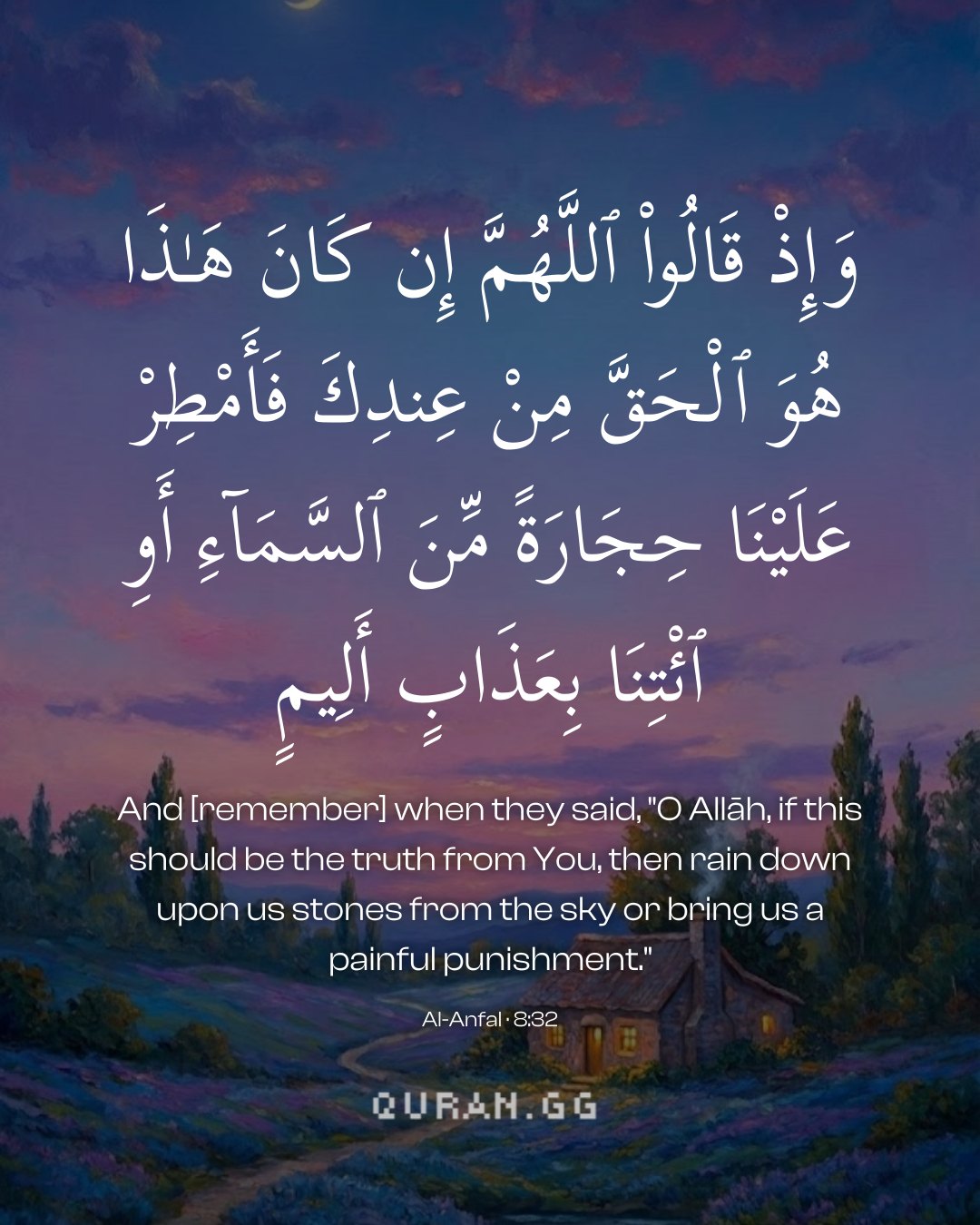
اللَّـهُمَّ إِن كَانَ هَـٰذَا هُوَ الْحَقَّ مِنْ عِندِكَ فَأَمْطِرْ عَلَيْنَا حِجَارَةً مِّنَ السَّمَاءِ أَوِ ائْتِنَا بِعَذَابٍ أَلِيمٍ
O Allah, if this be indeed the truth [ revealed ] from You, then, rain down upon us stones from the heavens, or bring upon us a painful punishment - 32.
Literally, ‘We can also produce such a discourse. If we speak untruths why do stones not rain down upon us?’ All such talk arises from haughtiness. When a man finds himself in a safe position in this world; when he observes that he has lost nothing by denying the Truth or by ignoring it, a certain false self-confidence is created in him. He thinks that whatever he has been doing is perfectly right. This feeling makes him utter such words as are not uttered by anyone in normal circumstances. This daring on the part of such people can manifest itself only because of God’s law of respite. God certainly punishes the guilty, but He follows the principle of seizing a man only when the work of clarifying to him Truth and falsehood has been fully performed. Before the completion of this task, nobody is struck down. Furthermore, if during the process of the missionary call, even one or two people at a time are influenced and start reforming themselves, God withholds His retribution so that all those who wish to respond positively to the call of truth may have the time and opportunity to do so.
Uthmani text of the Madinah mushaf (King Fahd Complex). Translation: Saheeh International. Tafsir via Quran.com.