Qualities of the Faithful and Truthful Believers
`Ali bin Abi Talhah reported that Ibn `Abbas said about the Ayah,
إِنَّمَا الْمُؤْمِنُونَ الَّذِينَ إِذَا ذُكِرَ اللَّهُ وَجِلَتْ قُلُوبُهُمْ
(The believers are only those who, when Allah is mentioned, feel a fear in their hearts)
"None of Allah's remembrance enters the hearts of the hypocrites upon performing what He has ordained. They neither believe in any of Allah's Ayat nor trust (in Allah) nor pray if they are alone nor pay the Zakah due on their wealth. Allah stated that they are not believers. He then described the believers by saying,
إِنَّمَا الْمُؤْمِنُونَ الَّذِينَ إِذَا ذُكِرَ اللَّهُ وَجِلَتْ قُلُوبُهُمْ
Continue reading the tafsir of ayahs 2–4Ma'arif al-Qur'an
Mufti Muhammad Shafi
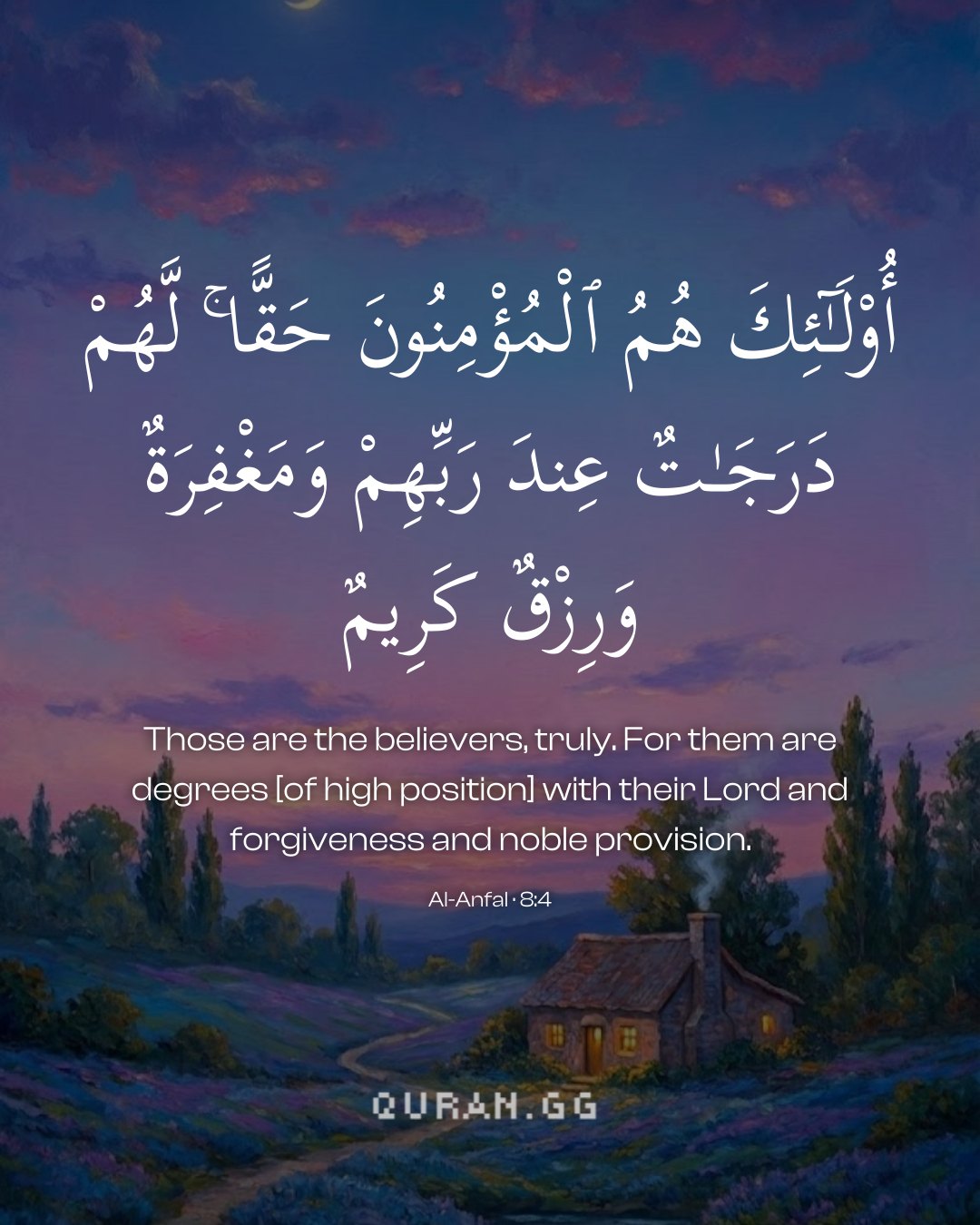
After describing these five virtues of the model believer, it was said: أُولَـٰئِكَ هُمُ الْمُؤْمِنُونَ حَقًّا Those are the believers in reality) - that is, they are the same, outwardly and inwardly, they say what is there in their heart, otherwise, there are those who say: اَشھَدُ اَنَّ لا إله إلا اللہ و اَشھَدُ اَنَّ مُحَمَّدَ رَّسُولُ اَلله (I testify that there is no god worthy of worship but Allah and I testify that Muhammad is the Messenger of Allah) which is only verbal as far as it goes. Their hearts do not throb with belief in the Oneness of Allah, nor do they have the passion for obedience to His prophet. What they do contradicts what they say. There is a hint in the verse which points out that every truth has its reality and unless you get to that reality, you cannot arrive at the truth.
Someone asked the famous Hasan al-Basri (رح) : '0 Abu Said, are you a believer?' He said: 'Brother, there are two kinds of 'Iman (faith). If you are asking whether or not I am a believer in Allah Ta` ala and His angels, Books and Messengers, and in Paradise and Hell, and in the accounting and retribution of the Last Day, then, my answer is: Of course, I am a believer. And if you are asking whether or not I am the perfect believer mentioned in the verses of Surah Al-Anfal, then, I just do not know whether or not I am one of those. The verses of Surah Al-Anfal referred to here are the same verses the discussion of which is before you right now.
After having described the attributes and marks of true believers in the verses cited above, it was said: لَّهُمْ دَرَجَاتٌ عِندَ رَبِّهِمْ وَمَغْفِرَةٌ وَرِزْقٌ كَرِيمٌ (For them there are high ranks with their Lord, and forgiveness, and dignified provision).
Promised here are three things: (1) high ranks, (2) forgiveness and (3) dignified provision.
According to Tafsir Al-Bahr Al-Muhit, the attributes of true Muslims mentioned in the previous verses are of three kinds: (1) Those which relate to one's heart, the inward human dimension, such as, belief in Allah, fear of Allah and trust in Allah. (2) Those which relate to physical deeds, such as, Salah etc., and (3) Those which relate to one's wealth, such as, spending in the way of Allah.
Counter-poised against these three kinds, three rewards have been mentioned. High ranks have been set against inward and spiritual attributes; forgiveness has been placed against deeds which are related to outward human physique, like Salah and Sawm. Salah, as in Hadith, becomes the Kaffarah (expiation) of sins. Finally, 'dignified provision' has been set against spending in the way of Allah, that is, one would get what is much better and much more than what one has spent in the mortal life.
Uthmani text of the Madinah mushaf (King Fahd Complex). Translation: Saheeh International. Tafsir via Quran.com.