Surah Al-Anfal Ayah 61 (8:61) — Meaning & Tafsir | Quran.GG

Surah Al-Anfal, Ayah 61

8:61 · Meaning and tafsir

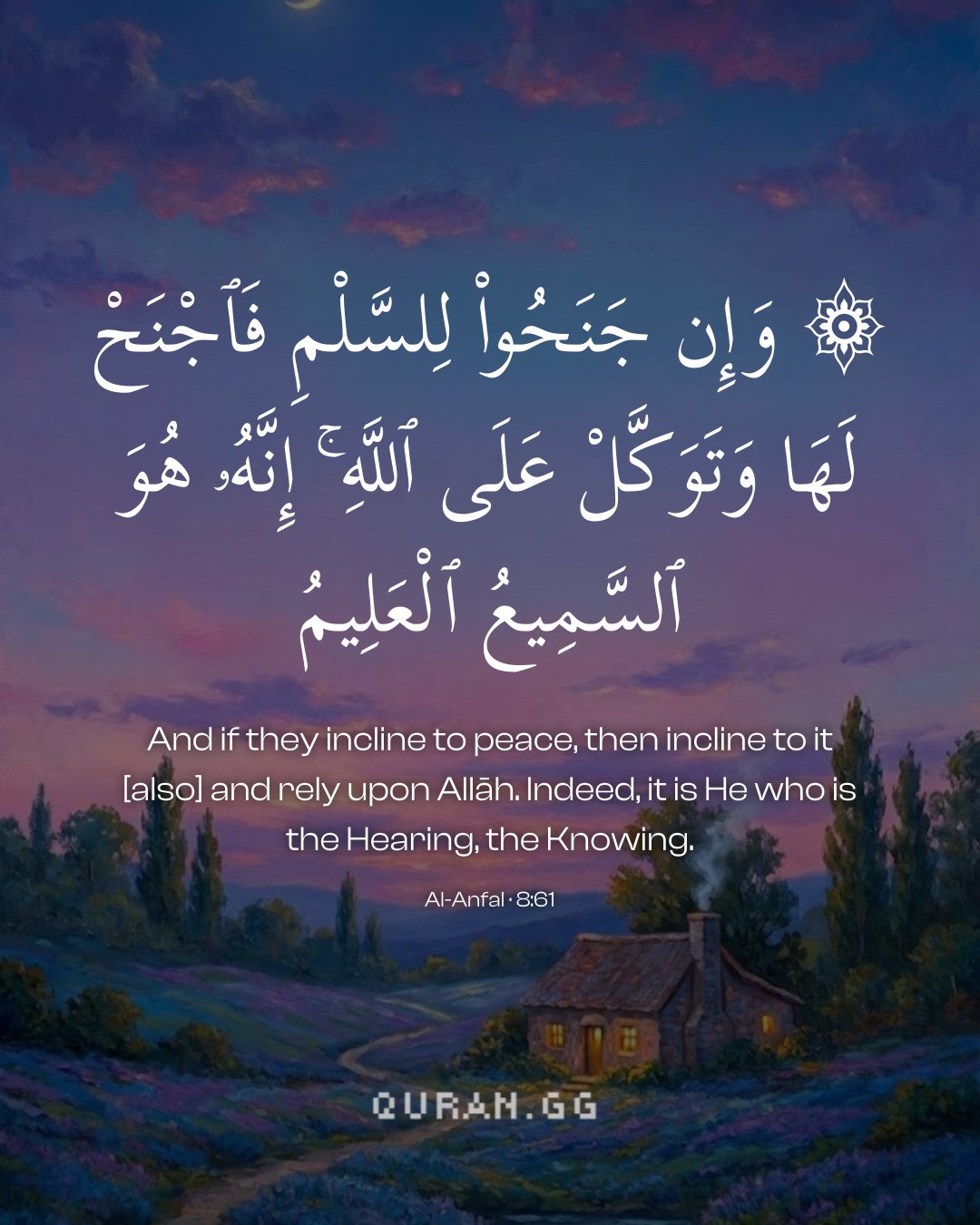
۞ وَإِن جَنَحُوا۟ لِلسَّلْمِ فَٱجْنَحْ لَهَا وَتَوَكَّلْ عَلَى ٱللَّهِ ۚ إِنَّهُۥ هُوَ ٱلسَّمِيعُ ٱلْعَلِيمُ ٦١

And if they incline to peace, then incline to it [also] and rely upon Allāh. Indeed, it is He who is the Hearing, the Knowing.

Surah Al-Anfal 8:61 in Arabic with its translation: “And if they incline to peace, then incline to it [also] and rely upon Allāh. Indeed, it is He who is the…”

Make something with this ayah

Turn it into a video for Stories, Reels or TikTok, recited by the reciter you pick, or an image on a background you choose. Free, in your browser.

Download this image

Tafsir Ibn Kathir (abridged)

The Command to Facilitate Peace when the Enemy seeks a Peaceful Resolution

Allah says, if you fear betrayal from a clan of people, then sever the peace treaty with them, so that you both are on equal terms. If they continue being hostile and opposing you, then fight them,

وَإِن جَنَحُواْ

(But if they incline), and seek,

لِلسَّلْمِ

(to peace), if they resort to reconciliation, and seek a treaty of non-hostility,

فَاجْنَحْ لَهَا

(you also incline to it), and accept offers of peace from them. This is why when the pagans inclined to peace in the year of Hudaybiyah and sought cessation of hostilities for nine years, between them and the Messenger of Allah he accepted this from them, as well as, accepting other terms of peace they brought forth. `Abdullah bin Al-Imam Ahmad recorded that `Ali bin Abi Talib said that the Messenger of Allah said,

«إِنَّهُ سَيَكُونُ بَعْدِي اخْتِلَافٌ أَوْ أَمْرٌ فَإِنِ اسْتَطَعْتَ أَنْ يَكُونَ السِّلْمَ فَافْعَل»

(There will be disputes after me, so if you have a way to end them in peace, then do so.)

Allah said next,

وَتَوَكَّلْ عَلَى اللَّهِ

(and trust in Allah. ) Allah says, conduct a peace treaty with those who incline to peace, and trust in Allah. Verily, Allah will suffice for you and aid you even if they resort to peace as a trick, so that they gather and reorganize their forces,

فَإِنَّ حَسْبَكَ اللَّهُ

(then verily, Allah is All-Sufficient for you).

Reminding the Believers of Allah's Favor of uniting Them

Allah mentioned His favor on the Prophet , in that He aided him with believers, the Muhajirin and the Ansar,

هُوَ الَّذِى أَيَّدَكَ بِنَصْرِهِ وَبِالْمُؤْمِنِينَوَأَلَّفَ بَيْنَ قُلُوبِهِمْ

(He it is Who has supported you with His help and with the believers. And He has united their hearts.)

The Ayah says, `it is Allah who gathered the believers' hearts, believing, obeying, aiding and supporting you -- O Muhammad,'

لَوْ أَنفَقْتَ مَا فِى الاٌّرْضِ جَمِيعاً مَّآ أَلَّفْتَ بَيْنَ قُلُوبِهِمْ

(If you had spent all that is in the earth, you could not have united their hearts.) because of the enmity and hatred that existed between them. Before Islam, there were many wars between the Ansar tribes of Aws and Khazraj, and there were many causes to stir unrest between them. However, Allah ended all that evil with the light of faith,

وَاذْكُرُواْ نِعْمَةَ اللَّهِ عَلَيْكُمْ إِذْ كُنتُم أَعْدَآءً فَأَلَّفَ بَيْنَ قُلُوبِكُمْ فَأَصْبَحْتُم بِنِعْمَتِهِ إِخْوَاناً وَكُنتُمْ عَلَى شَفَا حُفْرَةٍ مِّنَ النَّارِ فَأَنقَذَكُمْ مِّنْهَا كَذلِكَ يُبَيِّنُ اللَّهُ لَكُمْ ءَايَـتِهِ لَعَلَّكُمْ تَهْتَدُونَ

(And remember Allah's favor on you, for you were enemies one to another, but He united your hearts, so that, by His grace, you became brethren, and you were on the brink of a pit of Fire, and He saved you from it. Thus Allah makes His Ayat clear to you, that you may be guided.) 3:103

In the Two Sahihs, it is recorded that when the Messenger of Allah ﷺ gave a speech to the Ansar about the division of war booty collected in the battle of Hunayn, he said to them,

«يَا مَعْشَرَ الْأَنْصَارِ أَلَمْ أَجِدْكُمْ ضُلَّالًا فَهَدَاكُمُ اللهُ بِي، وَعَالَةً فَأَغْنَاكُمُ اللهُ بِي، وَكُنْتُمْ مُتَفَرِّقِينَ فَأَلَّفَكُمُ اللهُ بِي»

(O Ansar! Did I not find you misguided and Allah guided you by me, poor and Allah enriched you by me, and divided and Allah united you by me) Every question the Prophet asked them, they said, "Truly, the favor is from Allah and His Messenger." Allah said,

وَلَـكِنَّ اللَّهَ أَلَّفَ بَيْنَهُمْ إِنَّهُ عَزِيزٌ حَكِيمٌ

(But Allah has united them. Certainly He is All-Mighty, All-Wise.)

He is the Most Formidable, and the hopes of those who have trust in Him, never end unanswered; Allah is All-Wise in all of His decisions and actions.

Ma'arif al-Qur'an

The third verse (61) takes up injunctions of peace and aspects related to it. It was said: وَإِن جَنَحُوا لِلسَّلْمِ فَاجْنَحْ لَهَا (And if they tilt towards peace, you tilt towards it). The word: سَلم (salm) with fatha (′)on sin (س), or: سِلم (silm with kasrah ( ِ ) on sin (س) are both used in the sense of peace. The meaning of the verse - as fairly evident from the translation - is that should the disbelievers incline towards peace on some occasion, you too should incline towards it. At this point, it should be borne in mind that the imperative form has been used here to carry the sense of choice. Thus, the intended sense is that at a time when disbelievers are inclined towards peace, the Holy Prophet ﷺ also has the choice of making peace, if he feels peace is in the best interest of Muslims.

And the restriction of: إِن جَنَحُوا (if they tilt) tells us that peace can be made only when the desire to have peace comes from the disbelievers - because, should Muslims themselves start proposing peace without their desire to have it, then, this would be taken as a sign of their weakness.

However, should there arise a situation in which Muslims are totally encircled and find no way out except a peace for security deal, then, initiating a peace proposal is also permissible as ruled by Muslim jurists and as proved through hints given in the directives of the Holy Qur'an and Sunnah نُصُوص (nusus).

And since the proposal of peace initiated by the enemy does have the probability that they might use it as a strategy of deceit, make them negligent and then make a surprise attack, therefore, at the end of the verse, the instruction given to the Holy Prophet ﷺ was: وَتَوَكَّلْ عَلَى اللَّـهِ ۚ إِنَّهُ هُوَ السَّمِيعُ الْعَلِيمُ (and place your trust in Allah. Surely, He is the All-Hearing, All-Knowing - 61). It means that Allah Ta` ala hears what they say and also knows the intentions and designs concealed in their hearts. He is sufficient to help you, therefore, do not base your decisions to do things on such probabilities which cannot be proved. The safest policy was to entrust all such apprehensions and scruples with Allah.

Tazkirul Quran

The Jews of Madinah had already become guilty by rejecting the prophethood of the Prophet Muhammad. The gravity of their guilt was further increased by their breaking of the pledge. After the emigration to Madinah, there had been a written agreement between the Prophet and the Jews of Madinah that both the sides would be neutral in matters relating to each other. But the Jews started conspiring against him, secretly joining hands and collaborating with his enemies. This was breach of trust in addition to the rejection of truth. Punishment awaits such people in the Hereafter. And in this world they will be discouraged from creating further mischief. If the Muslims have a treaty with a community, but they want to cancel it for fear of its being breached by that community, it is necessary that they should first inform those co-signatories, so that it is known in advance that the treaty no longer exists between them. The position is different when there is not merely the fear of a beach of trust but there has been a clear contravention of the treaty. In such a case it is permissable to start retaliatory action without informing the other party. The campaign of Makkah is an example of this type. The Quraysh had unilaterally contravened the Hudaibiyah treaty by joining the Banu Bakr’s aggression against an ally of the Prophet Muhammad, namely, the Banu Khuza‘a. So the Prophet quietly proceeded against the Quraysh without giving them advance information.

Uthmani text of the Madinah mushaf (King Fahd Complex). Translation: Saheeh International. Tafsir via Quran.com.