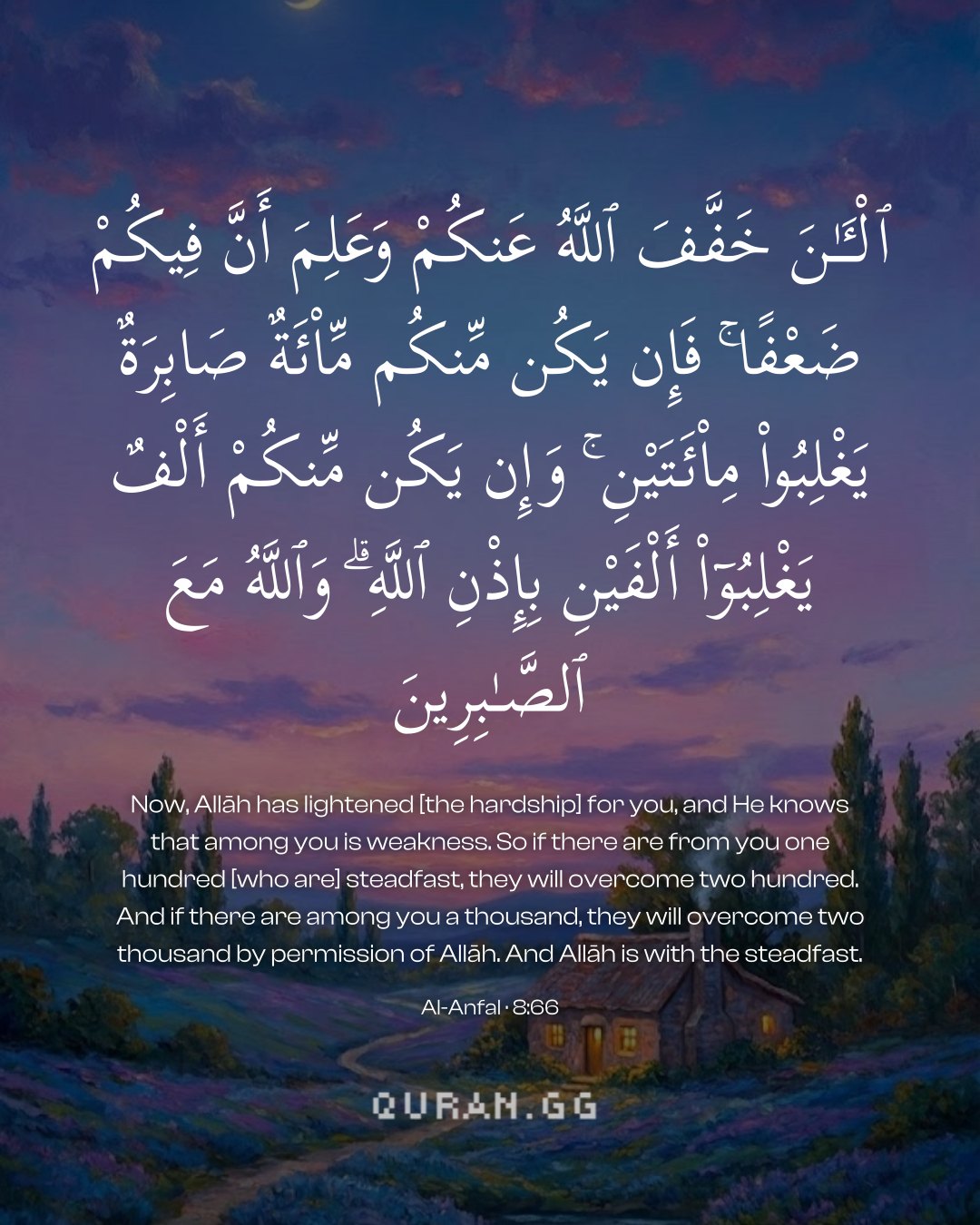
Now, Allāh has lightened [the hardship] for you, and He knows that among you is weakness. So if there are from you one hundred [who are] steadfast, they will overcome two hundred. And if there are among you a thousand, they will overcome two thousand by permission of Allāh. And Allāh is with the steadfast.
Encouraging Believers to fight in Jihad; the Good News that a Few Muslims can overcome a Superior Enemy Force
Allah encourages His Prophet and the believers to fight and struggle against the enemy, and wage war against their forces. Allah affirms that He will suffice, aid, support, and help the believers against their enemies, even if their enemies are numerous and have sufficient supplies, while the believers are few. Allah said,
(O Prophet! Urge the believers to fight), encouraged and called them to fight. The Messenger of Allah ﷺ used to encourage the Companions to fight when they faced the enemy. On the day of Badr when the idolators came with their forces and supplies, he said to his Companions,
Now Allah has made it easy on you and He knew that there is weakness in you. So, if there are one hundred among you, who are patient, they will overcome two hundred - 8:66.
Here too, the purpose is to order that it is not permissible for one hundred Muslims to avoid fighting against two hundred disbelievers. It will be recalled that, in the first verse (65), the avoidance of one Muslim to fight against ten was declared to be forbidden. Here, in this verse (66), the avoidance of one against two was all that remained forbidden. And this is the last and final injunction which is operative forever and shall continue as such.
Here too, the command does not appear in the usual style of a command. Instead, the manner used is that of glad tidings which indicates that asking one Muslim to go out and stand firm against two disbelievers was, God forbid, no injustice or coercion. To be honest, Allah Ta` ala has Himself placed in a Muslim person - because of his 'Iman or Faith - a special power that one of them turns out to be equal to two.
But, at both places, the glad tidings about this support and victory has been made subject to the condition that these Muslims should be observers of patience and fortitude. It is obvious that standing steadfast while endangering one's dear life in fighting and killing on a battlefield is a feat which can be performed only by a person whose 'Iman is perfect - because, perfect 'Iman generates enthusiasm for surrendering one's life in the way of Allah and this enthusiasm multiplies his combat strength a lot more.
Towards the end of the verse, it was in the manner of a general principle that it was stated: وَاللَّـهُ مَعَ الصَّابِرِينَ (And Allah is with the patient - 66). Included here, there are those who remain steadfast in the battlefield as well as those who keep following the usual injunctions of the Shari’ ah strictly. The promise of Divine company stands good for all of them and in this state of His being with one and all of them lies the real secret of their victory - because, whoever has the good fortune of having the company of the Absolute Master simply cannot be moved away from the station of duty by anyone, not even by the whole world in unison.
Tazkirul Quran
Maulana Wahiduddin KhanOn ayahs 66–68
The reason for a lesser number of believers overcoming a large number of those who deny the truth has been explained by saying that the believers possessed fiqh, while those who deny the truth were devoid of it. The literal meaning of fiqh is understanding. This means the insight and wisdom which a man acquires as a result of faith. Faith in God is like the lighting of a lamp in a dark room. The lamp lights up the room in a such way that everything in it is seen clearly. Similarly, faith blesses man with a divine consciousness, after which he starts seeing all realities in their original shape. As a result of faith, man understands the reality of life and death. He comes to know that the most important thing is not the life of this world but the life of the Hereafter. This makes him fearless. He looks at death as if it is a door through which he may enter Paradise. A believer is God-fearing and he is anxious about the Hereafter. Such a temperament purifies him of all types of negative feelings. He rises above obstinacy, hatred, prejudice, revenge and haughtiness. The case of those who deny the truth is just the opposite. One who denies the truth acts emotionally, while the believer acts realistically. One who denies the truth carries out his dealings with narrow-mindedness, while the believer displays broad-mindedness.
Uthmani text of the Madinah mushaf (King Fahd Complex). Translation: Saheeh International. Tafsir via Quran.com.