Imam Ahmad recorded that Anas said, "The Prophet asked the people for their opinion about the prisoners of war of Badr, saying,
«إِنَّ اللهَ قَدْ أَمْكَنَكُمْ مِنْهُم»
(Allah has made you prevail above them.) `Umar bin Al-Khattab stood up and said, `O Allah's Messenger! Cut off their necks,' but the Prophet turned away from him. The Messenger of Allah ﷺ again asked,
«يَاأَيُّهَا النَّاسُ إِنَّ اللهَ قَدْ أَمْكَنَكُمْ مِنْهُمْ وَإِنَّمَا هُمْ إِخْوَانُكُمْ بِالْأَمْس»
(O people! Allah has made you prevail over them, and only yesterday, they were your brothers.) `Umar again stood up and said, `O Allah's Messenger! Cut off their necks.' The Prophet ignored him and asked the same question again and he repeated the same answer. Abu Bakr As-Siddiq stood up and said, `O Allah's Messenger! I think you should pardon them and set them free in return for ransom.' Thereupon the grief on the face of Allah's Messenger ﷺ vanished. He pardoned them and accepted ransom for their release. Allah, the Exalted and Most Honored, revealed this verse,
Continue reading the tafsir of ayahs 67–69Ma'arif al-Qur'an
Mufti Muhammad Shafi
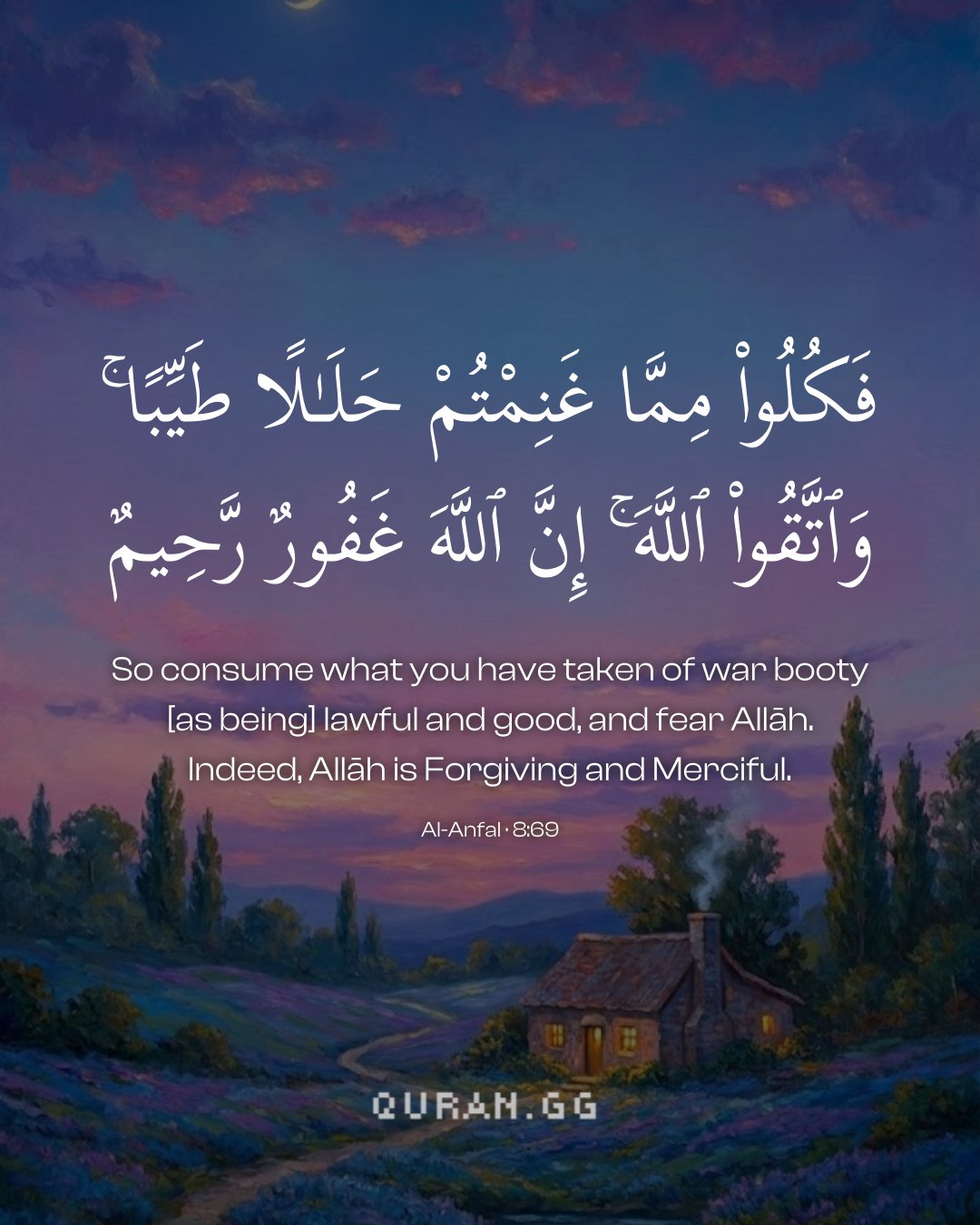
Ruling 1: In the verse under discussion, admonition came upon releasing prisoners against ransom or collecting spoils, warning of Divine punishment was given, then came forgiveness. But, what remained still not clear was the future course Muslims would be required to take in such matters. Therefore, in the next verse (69), the matter relating to spoils was made all too clear by saying: فَكُلُوا مِمَّا غَنِمْتُمْ (So, eat of the spoils you have got), that is, it has been made lawful for you in the future. But, even now, there remains a doubt to the effect that the injunction making spoils lawful had come at the present stage, however, spoils which had been collected in error before the coming of this injunction may contain some element of undesirability in it. Therefore, by saying: حَلَالًا طَيِّبًا (lawful and pure - 69) soon after it, even this doubt was removed. It means: Though, taking the initiative in collecting spoils, before the revelation of Divine guideline, was not correct - but now that the injunction making spoils lawful has been revealed, all that has been collected earlier is also lawful without any shade of repugnance or reprehensibility (karahah) in it.
Ruling 2: At this point, worth notice and retention is a principle of Islamic jurisprudence: When some impermissible initiative is regularized through a standing verse, no effect of the previous initiative remains operative therein. The property becomes lawful and pure - as it happened here. But, there is a corresponding instance relevant to what has been stated above. Take a case in which there was an injunction already revealed, but its revelation did not seem to affect the initiators of an action, based on which they went on to contravene it. It was later on that they found out that the particular deed of theirs was contrary to such and such injunction of the Qur'an and Sunnah. Then, in such a situation, after the coming of the injunction, that property does not remain lawful - even though the previous error is forgiven. (Nuru 'l-Anwar, Mulla Jiwan) However, in the present verse, spoils have, no doubt, been declared to be lawful and pure, but the restriction imposed at the end of the verse was: وَاتَّقُوا اللَّـهَ ۚ إِنَّ اللَّـهَ غَفُورٌ رَّحِيمٌ (and fear Allah. Surely, Allah is Most-Forgiving, Very-Merciful - 69). The hint given here is that, though spoils have been made lawful, but that too has been made lawful under a particular law. Taking against that law or taking more than due shall not still be permissible.
There were two matters in question here: (1) Spoils (2) Release of prisoners against ransom. The first problem was resolved clearly by the present verse, but the other matter was yet to be cleared. Regarding this, the following verse of Surah Muhammad was revealed:
فَإِذَا لَقِيتُمُ الَّذِينَ كَفَرُوا فَضَرْبَ الرِّقَابِ حَتَّىٰ إِذَا أَثْخَنتُمُوهُمْ فَشُدُّوا الْوَثَاقَ فَإِمَّا مَنًّا بَعْدُ وَإِمَّا فِدَاءً حَتَّىٰ تَضَعَ الْحَرْبُ أَوْزَارَهَا
So, when you confront those who disbelieve at war, then keep beheading them until when you have had a thorough blood-shed to break their power, then shackle them tight. After that, either free them as favour without any return or release them against ransom - until the war lays down its arms - 47:4)
Sayyidna ` Abdullah ibn ` Abbas ؓ says: Divine admonition came upon releasing prisoners against ransom in the battle of Badr. This was the first Jihad of Islam. That was a time when the might and power of disbelievers was yet to break apart. It was by chance that they had run into trouble. Finally, when Islam and Muslims went on to achieve total ascendency, Allah Ta` ala abrogated the earlier injunction and revealed the verse of the Surah Muhammad quoted above in which the Holy Prophet ﷺ and Muslims have been given four options about prisoners. These are:
ان شاء واقتلوھم وان شاء وا استعبدوھم وان شاء وا افادوھم وان شاء وا اعتقوھم۔
If they wish, they can kill them all; or if they wish, they can put them in bondage; or if they wish, they can release them against ransom; or if they wish, they can (just) free them (without taking any ransom). (Mazhari)
There is a consensus of the entire Muslim Ummah on the first two of the four options mentioned above that the Amir of Muslims has the dual right of killing the prisoners and holding them in bondage, but there is a difference of opinion among Muslim jurists about setting them free without compensation or releasing them against it.
The position taken by Imam Malik, Shafi` i, Ahmad. ibn Hanbal, Thawri, Ishaq, and Hasan al-Basri and 'Ata' from among the Tabi` in, is that both these forms are permissible for the Amir of Muslims - that he may release the prisoners against compensation, or set them free without compensation, or exchange them for Muslim prisoners.
But Imam Abu- Hanifah, Abu Yusuf, Muhammad, Awza` i, and Qatadah, Dahhak, Suddiyy and Ibn Jurayj say that setting them free is just not permissible without compensation. Even releasing them against ransom is not permissible in the well-known creed of Imam Abu Hanifah. However, it appears in a report of al-Siyar al-Kabir that, should Muslims be in need of financial support, they can release prisoners against ransom. However, releasing them in exchange for Muslim prisoners is permissible with Imam Abu Hanifah and the two Jurists, Imams Abu Yusuf and Muhammad. (As evident from the two reports from them - Mazhari).
Those who have permitted release against ransom or without ransom, they - as said by Sayyidna Ibn ` Abbas ؓ - regard the verse of Surah Muhammad to be the abrogator (nasikh) of the verse of Surah Al-Anfal and take the later as abrogated (mansukh). According to Hanafi jurists, what stands abrogated (mansukh) is the verse of Surah Muhammad, while the verses of Surah Al-Anfal: فَشَرِّدْ بِهِم مَّنْ خَلْفَهُمْ (make them an example, for those behind them -57) and Surah Al-Taubah: فَاقْتُلُوا الْمُشْرِكِينَ حَيْثُ وَجَدتُّمُوهُمْ (kill the Mushriks wherever you find them -9:5) are its abrogator (nasikh). Therefore, according to them, it is not permissible to release the prisoners, whether against ransom or without it. (Mazhari)
But, a careful deliberation into the respective words of the verses of Su-rah Al-Anfal and Surah Muhammad leaves us with the impression that none of these two can be called the abrogator or the abrogated. In fact, they are two injunctions for two different situations.
It can be seen that the pivotal injunction of breaking the power of disbelievers (اَثخان فی العرض) has been taken up in the verse of Surah Al-Anfal, then, the option of releasing prisoners without compensation or against it (in the form of: من وفداء) has been given in Surah Muhammad too, but the main objective has already been stated in the former - that of' ithkhan fi 'l-ard'. Thus, it means that once the power facade of the disbelievers has been broken through a thorough blood-shed, Muslims have the option of releasing prisoners against ransom, or setting them free without any ransom.
The report of al-Siyar al-Kabir from Imam Abu Hanifah (رح) could also be intended to establish that both kinds of injunctions can be given keeping in view the conditions and needs Muslims are faced with. 1.
1. Some more detail about the war-prisoners will appear in the commentary of Surah Muhammad insha-allah. (Editor)
Uthmani text of the Madinah mushaf (King Fahd Complex). Translation: Saheeh International. Tafsir via Quran.com.