(I have come to know that some people from Bani Hashim and others were forced to accompany the pagans, although they had no desire to fight us. Therefore, whoever meets any of them (Bani Hashim), do not kill him. Whoever meets Abu Al-Bukhtari bin Hisham, should not kill him. Whoever meets Al-`Abbas bin `Abdul-Muttalib, let him not kill him, for he was forced to come (with the pagan army).) Abu Hudhayfah bin `Utbah said, "Shall we kill our fathers, children, brothers and tribesmen (from Quraysh), and leave Al-`Abbas By Allah! If I meet him, I will kill him with the sword." When this reached the Messenger of Allah ﷺ, he said to `Umar bin Al-Khattab,
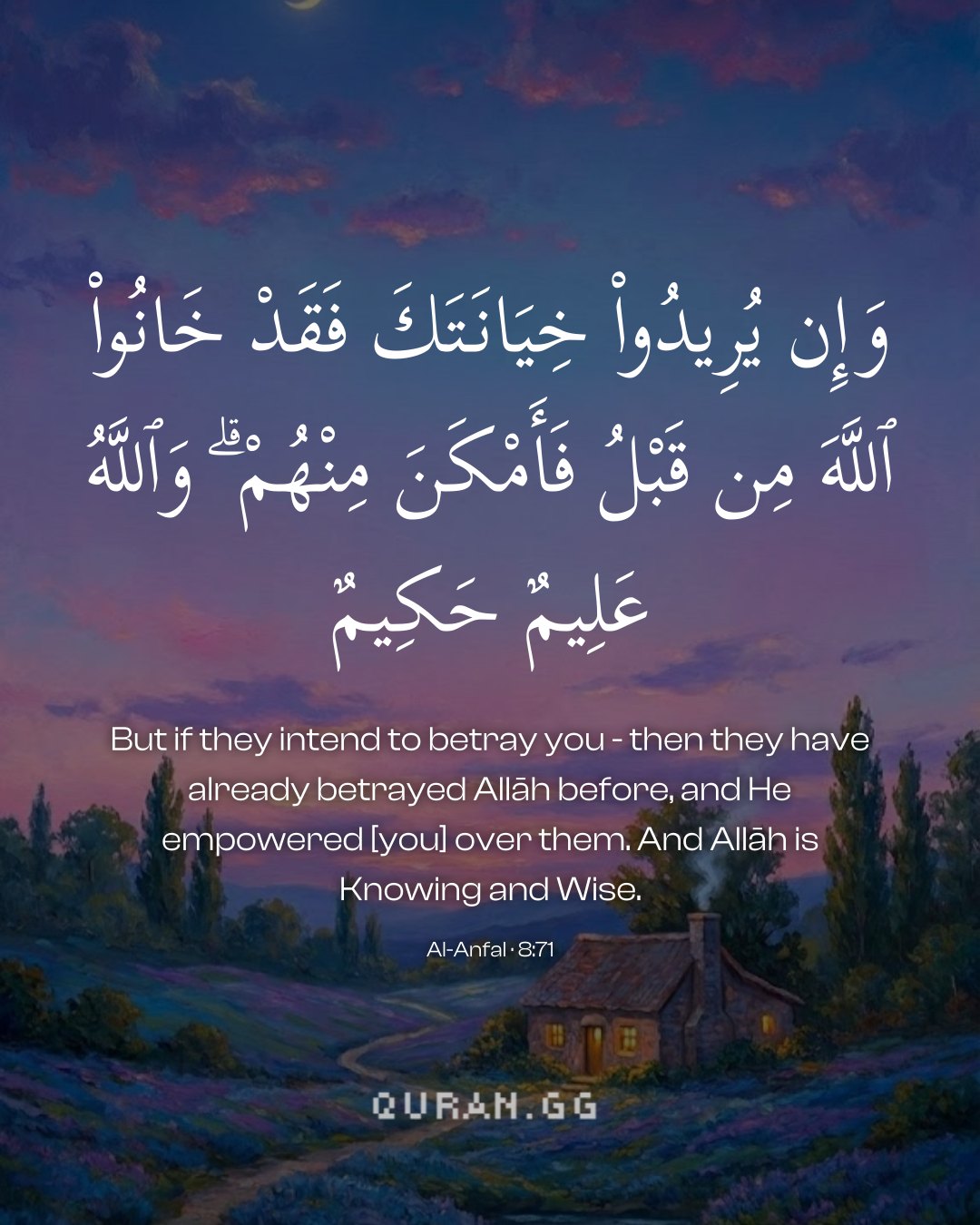
About some prisoners of the battle of Badr who had become Muslims, there remained a doubt that they, once back in Makkah, may turn away from Islam and start hurting them thereafter. In the next verse (71), Allah Ta` ala has removed this apprehension by saying: وَإِن يُرِيدُوا خِيَانَتَكَ فَقَدْ خَانُوا اللَّـهَ مِن قَبْلُ فَأَمْكَنَ مِنْهُمْ ۗ وَاللَّـهُ عَلِيمٌ حَكِيمٌ ﴿71﴾ (And if they intend to commit treachery against you, then, they have already committed treachery against Allah, so Allah has given [ you ] power over them. And Allah is All-Knowing, Wise). It means that should these people decide to commit a breach of trust with you, it will not bring any hurt or loss to you. They were the same people who had already committed a breach of trust with Allah. They had admitted of Allah being the Lord of all the worlds at the time of the original Covenant, then they became hostile to it. But, this breach of trust turned out to be fatal for none but them when, finally, they were disgraced and detained. As for Allah Ta` ala, He is the knower of secrets hidden in hearts, and He is the possessor of great wisdom. If these people start opposing you even now, there is nowhere they can go, certainly not anywhere outside the range of the power and control of Allah Ta` ala. Inevitably, He shall seize them as before. To sum up, it can be said that, in verse 70, the da'wah of Islam was given to the released prisoners in the mode of persuasion - while in verse 71, it was in the mode of warning that they were told that success in their worldly life and in their life to come depends on Islam and 'Iman.
Upto this point, the text was dealing with injunctions relating to fighting and killing disbelievers, taking them prisoners, setting them free and carrying on peace negotiations with them. In verses which follow right upto the end of the Surah itself, a particular related chapter has been taken up alongwith some details of its injunctions. They are the injunctions of Hijrah (Emigration) - because, situations can arise during a confrontation with disbelievers wherein neither the Muslims have the power to launch an attack against them and kill them off, nor are they willing to go for peace. In such a state of weakness, the only course through which Islam and Muslims can be salvaged is Hijrah (Emigration) which means that Muslims should leave that city or country and go to stay in some other land where acting freely in accordance with Islamic injunctions is possible.
Tazkirul Quran
Maulana Wahiduddin KhanOn ayahs 71–72
Releasing the prisoners at the battle of Badr was a strategic error. But, for the prisoners themselves, this amounted to giving them a new lease of life. This meant that the people who had become liable to be killed due to their opposition of the Truth, were given a further opportunity to re-think the Islamic call and their improper behaviour towards it. This respite opened up for them the door of self-rectification.Now one consequence of this event could have been that the flames of revenge flared up in the hearts of the prisoners due to the defeat they had suffered; they could have become eager to avenge the ignominy and loss they had suffered on the payment of ransom. In this case, they would have repeated the same wrong action as a result of which they had become liable to be seized upon by God. They would have expended their energy in opposing Islam, the result of which action would have been destruction in the world and punishment in the Hereafter. The second possibility was that they could have thought over the extraordinary happenings on the battlefield of Badr, i.e. why did it happen that, in spite of having inferior and fewer armaments, the Muslims were clearly victorious? This clearly indicated that God was in favour of the religion of the Muslims and disfavoured that of the Quraysh. If this second line of thinking developed, it would make them change their previous behaviour and adopt the religion which they had not earlier been able to adopt and in this way become eligible for God’s reward in this world and also in the Hereafter.History shows that there were a number of individuals among the Quraysh in whose hearts this question had arisen and sooner or later they joined Islam. ‘Abbas ibn ‘Abdul Muttalib had embraced Islam when he was a prisoner. Some others also joined the Islamic circle later. These people lowered themselves in the eyes of their own prejudiced group, but they honoured themselves in the eyes of God. They suffered worldly harm, but became possessors of the benefit of the Hereafter. On the release of the prisoners, the Muslims had the suspicion that the latter, instead of being grateful for the Muslims’ magnamity, would engage in conspiracies, adopt destructive ways and create impediments in the way of Islam. But the Quran did not give importance to these suspicions, because a movement launched for the cause of pure Truth is not an ordinary movement. It is a Divine affair. God Himself is behind it; and nobody has the power to fight God.
Uthmani text of the Madinah mushaf (King Fahd Complex). Translation: Saheeh International. Tafsir via Quran.com.