Surah Al-Anfal Ayah 74 (8:74) — Meaning & Tafsir | Quran.GG

Surah Al-Anfal, Ayah 74

8:74 · Meaning and tafsir

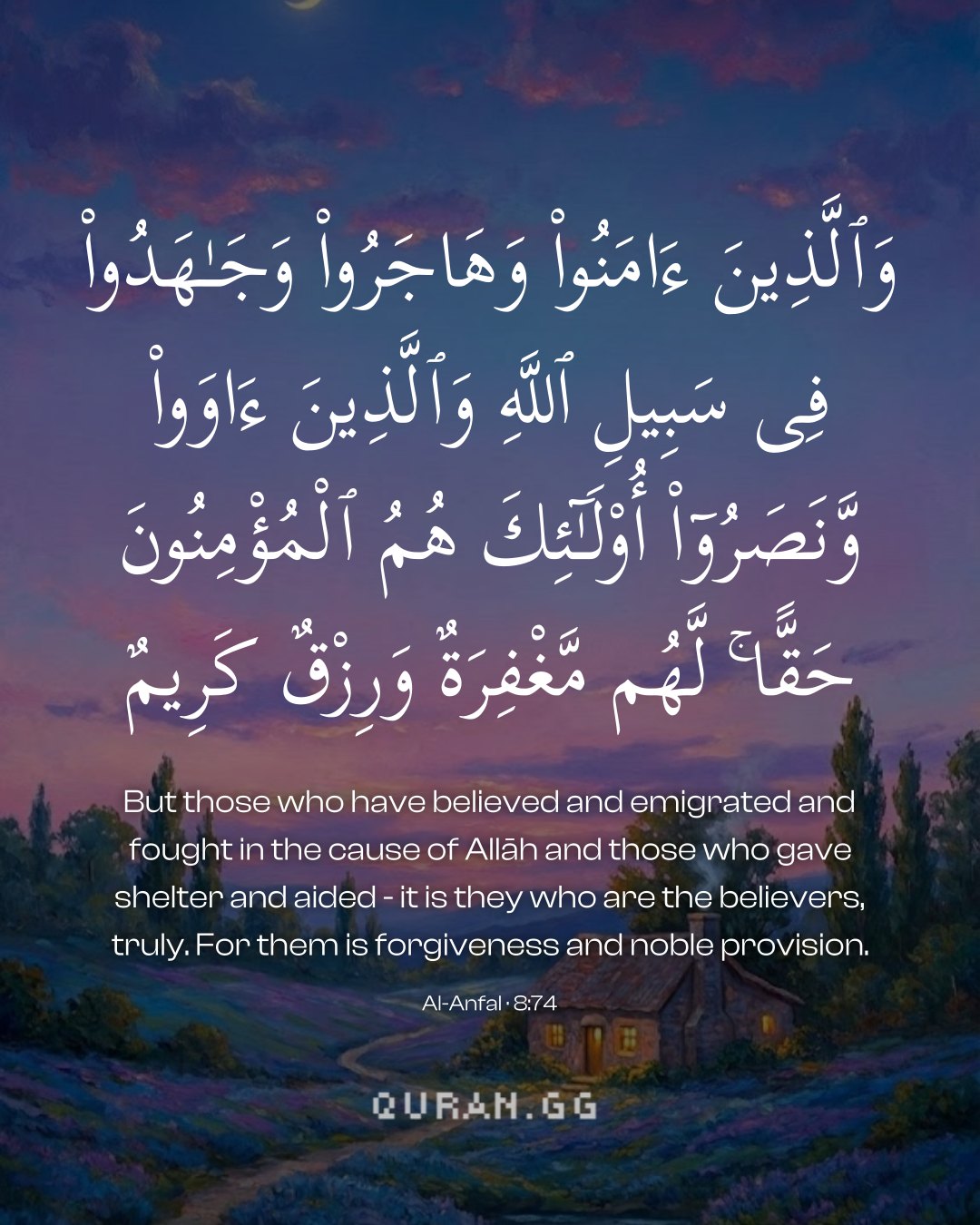
وَٱلَّذِينَ ءَامَنُوا۟ وَهَاجَرُوا۟ وَجَـٰهَدُوا۟ فِى سَبِيلِ ٱللَّهِ وَٱلَّذِينَ ءَاوَوا۟ وَّنَصَرُوٓا۟ أُو۟لَـٰٓئِكَ هُمُ ٱلْمُؤْمِنُونَ حَقًّا ۚ لَّهُم مَّغْفِرَةٌ وَرِزْقٌ كَرِيمٌ ٧٤

But those who have believed and emigrated and fought in the cause of Allāh and those who gave shelter and aided - it is they who are the believers, truly. For them is forgiveness and noble provision.

Surah Al-Anfal 8:74 in Arabic with its translation: “But those who have believed and emigrated and fought in the cause of Allāh and those who gave shelter and…”

Make something with this ayah

Turn it into a video for Stories, Reels or TikTok, recited by the reciter you pick, or an image on a background you choose. Free, in your browser.

Download this image

Tafsir Ibn Kathir (abridged)

Believers in Truth

After Allah affirmed the ruling of loyalty and protection between the believers in this life, He then mentioned their destination in the Hereafter. Allah also affirmed the faith of the believers, just as mentioned in the beginning of this Surah, and that He will reward them with forgiveness and by erasing their sins, if they have any. He also promised them honorable provisions that are abundant, pure, everlasting and eternal; provisions that never end or run out, nor will they ever cause boredom, for they are delightful and come in great varieties. Allah then mentioned that those who follow the path of the believers in faith and performing good deeds, will be with them in the Hereafter. Just as Allah said,

وَالسَّـبِقُونَ الاٌّوَّلُونَ

(And the foremost to embrace Islam...) 9:100, until the end of the Ayah. He also said,

وَالَّذِينَ جَآءُوا مِن بَعْدِهِمْ

(And those who came after them ...) 59:10.

A Hadith that is in the Two Sahihs, which is Mutawatir and has several authentic chains of narrations, mentions that the Messenger of Allah ﷺ said,

«الْمَرْءُ مَعَ مَنْ أَحَب»

(One will be in the company of those whom he loves.) Another Hadith states,

«مَنْ أَحَبَّ قَوْمًا فَهُوَ مِنْهُم»

(He who loves a people is one of them), and in another narration, he said,

«حُشِرَ مَعَهُم»

(...will be gathered with them (on the Day of Resurrection).)

Inheritance is for Designated Degrees of Relatives

Allah said,

وَأُوْلُواْ الأَرْحَامِ بَعْضُهُمْ أَوْلَى بِبَعْضٍ فِي كِتَـبِ اللَّهِ

(But kindred by blood are nearer to one another (regarding inheritance) in the decree ordained by Allah), meaning, in Allah's decision. This Ayah encompasses all relatives, not only the degrees of relative who do not have a fixed, designated share in the inheritance, as some people claim and use this Ayah to argue. According to Ibn `Abbas, Mujahid, `Ikrimah, Al-Hasan, Qatadah and several others, this Ayah abrogated inheriting from those with whom one had ties of treaties or brotherhood, as was the case in the beginning of Islam. So it applies to all relatives, and as for those who do not inherit, then this is supported by the Hadith,

«إِنَّ اللهَ قَدْ أَعْطَى كُلَّ ذِي حَقَ حَقَّهُ فَلَا وَصِيَّةٍ لِوَارِث»

(Indeed Allah had alloted every right to the one who deserves it, so there may be no will for an heir.)

Therefore, this Ayah also includes those who have a fixed share of inheritance. Allah knows best.

This is the end of the Tafsir of Surat Al-Anfal, all praise and thanks are for Allah, in Him we trust, and He is sufficient for us, what an excellent supporter He is.

Ma'arif al-Qur'an

Mentioned in the third verse (74) are words of praise for the Sahabah who emigrated from Makkah and for the Ansar of Madinah who helped them, as well as the attestation to their being true Muslims and the promise of forgiveness and respectable provision made to them. When it was said: أُولَـٰئِكَ هُمُ الْمُؤْمِنُونَ حَقًّا (those are the believers in truth), the hint given was in the direction that those who did not migrate were though Muslims, but their Islam was neither perfect, nor certain - because there existed the probability that they may really be hypocrites professing Islam only outwardly. After that, it was said: لَّهُم مَّغْفِرَ‌ةٌ (For them there is forgiveness) - as it has been explained in sound (Sahih) Ahadith: اَلاِسلَامُ یَھدِمُ مَا کَانَ قَبلَہ (Islam demolishes what was before it) and: والھِجرَۃُ تَھدِمُ مَا کَانَ قَبلَھَا (Hijrah razes what was before it). In short, this means that the act of becoming a Muslim goes on to demolish the entire edifice of past sins. Similarly, the making of Hijrah razes all past sins.

Tazkirul Quran

Generally when a man helps another, it is because that other person belongs to his family or group or class. But after the hijrah (migration to Madinah) the Islamic society formed in Madinah was such that those who were householders gave their houses to people with whom their relation was based only on religion. The people who left their hearths and homes and migrated to Madinah had done all this for the sake of God and the Hereafter, and those who allowed these strangers to share their money and property also did so, in order that God should be pleased with them and send them to paradise in the Hereafter. This was a society in which relations of family or race were not important as compared to faith. People used to help each other, not for worldly benefit, but for the sake of the Hereafter. They used to give to each other without expecting any return from the receiver, but only expecting a reward from God. That society is truly Islamic where relations are established not on the basis of family relations or the prejudices of groupism, but on the basis of Truth; where the people are the supporters and helpers of each other for the sole reason that they are brothers in religion and not because some worldly consideration is linked with them.

Uthmani text of the Madinah mushaf (King Fahd Complex). Translation: Saheeh International. Tafsir via Quran.com.