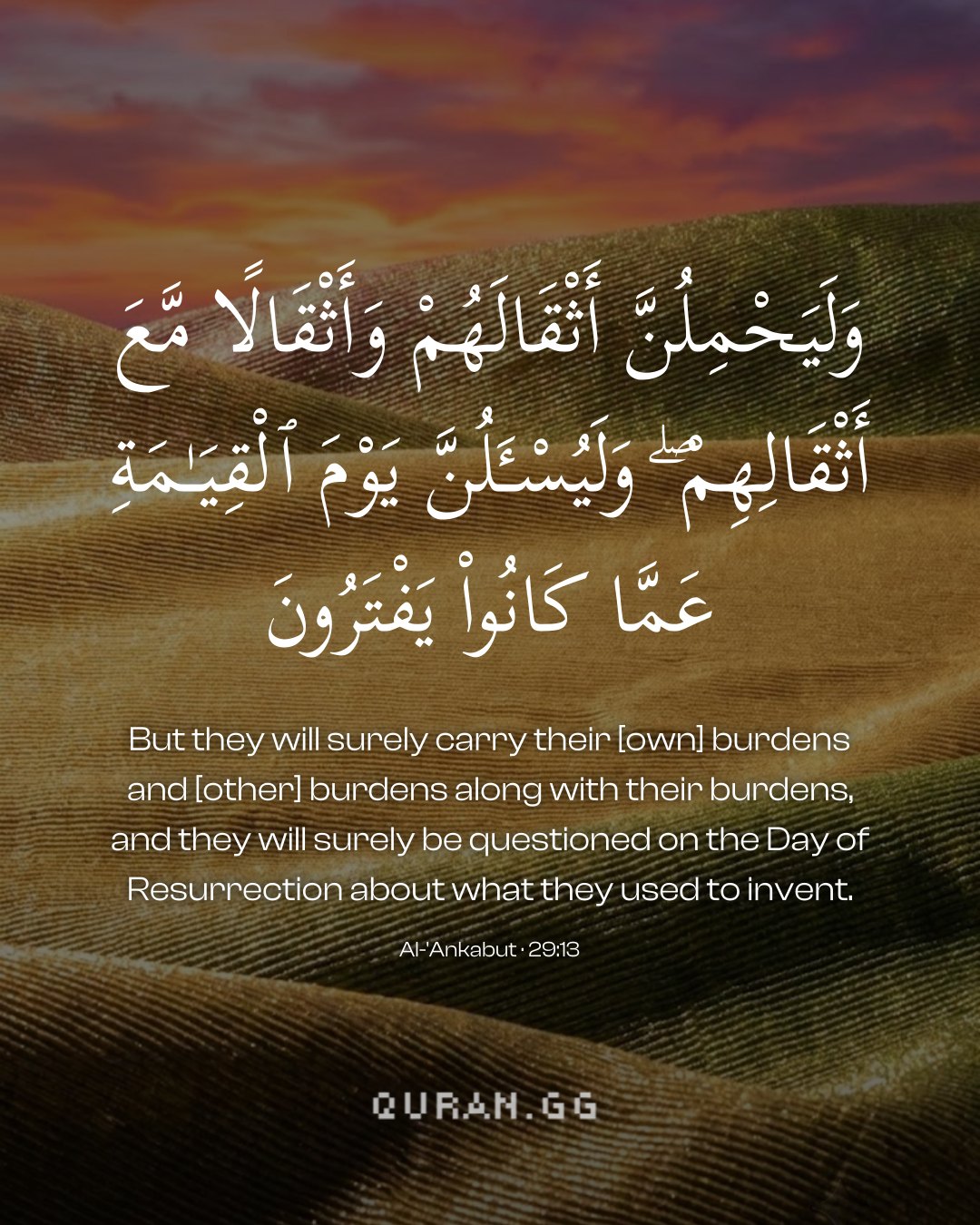
But they will surely carry their [own] burdens and [other] burdens along with their burdens, and they will surely be questioned on the Day of Resurrection about what they used to invent.
The Arrogant Claim of the Disbelievers that They would carry theSins of Others if They would return to Disbelief
Allah tells us that the disbelievers of Quraysh said to those who believed and followed the truth: leave your religion, come back to our religion, and follow our way;
وَلْنَحْمِلْ خَطَـيَـكُمْ
(and let us bear your sins.) meaning, `if there is any sin on you, we will bear it and it will be our responsibility'. It is like a person saying: "Do this, and your sin will be on my shoulders." Allah says, proving this to be a lie:
(Never will they bear anything of their sins. Surely, they are liars.) in their claim that they will bear the sins of others, for no person will bear the sins of another. Allah says:
وَقَالَ الَّذِينَ كَفَرُوا (And those who disbelieve say - 29:12). The infidels had tried all sorts of devices to mislead the Muslims and to hinder the progress of their faith. Sometimes they tried to get hold of Muslims by show of power and wealth, and at others by trying to put doubts in their minds. This verse mentions one such move made by them. They asked Muslims not to leave their ancestral religion in fear of torments in the Hereafter, because no such thing was going to happen at the first place, but even the belief of the Muslims about the Hereafter would come true, they (the infidels) were willing to undertake that they themselves would bear all the torments in the Hereafter on behalf of the Muslims, and the Muslims would not suffer at all.
Inventing a lie, or iftira, consists of saying something of one’s own concoction and then attributing it to God. All manner of wrongful innovations in religion, or bid‘ah, and wrong interpretations are included in this definition. One of the forms of iftira is prominent people among the deniers of God asking the less enlightened to follow their path and reassuring them that they will be responsible if the latter are questioned before God. But God has not given this kind of right to anybody. Therefore, to make such a statement amounts to uttering a falsehood in the name of God. Human beings say many things for the sake of saying them. But if they were to understand the consequences of their words, they would not utter them. When such people who have spoken idly see the horror of the Day of Judgement, their condition will be entirely different from what it seems to be in today’s world.
Uthmani text of the Madinah mushaf (King Fahd Complex). Translation: Saheeh International. Tafsir via Quran.com.