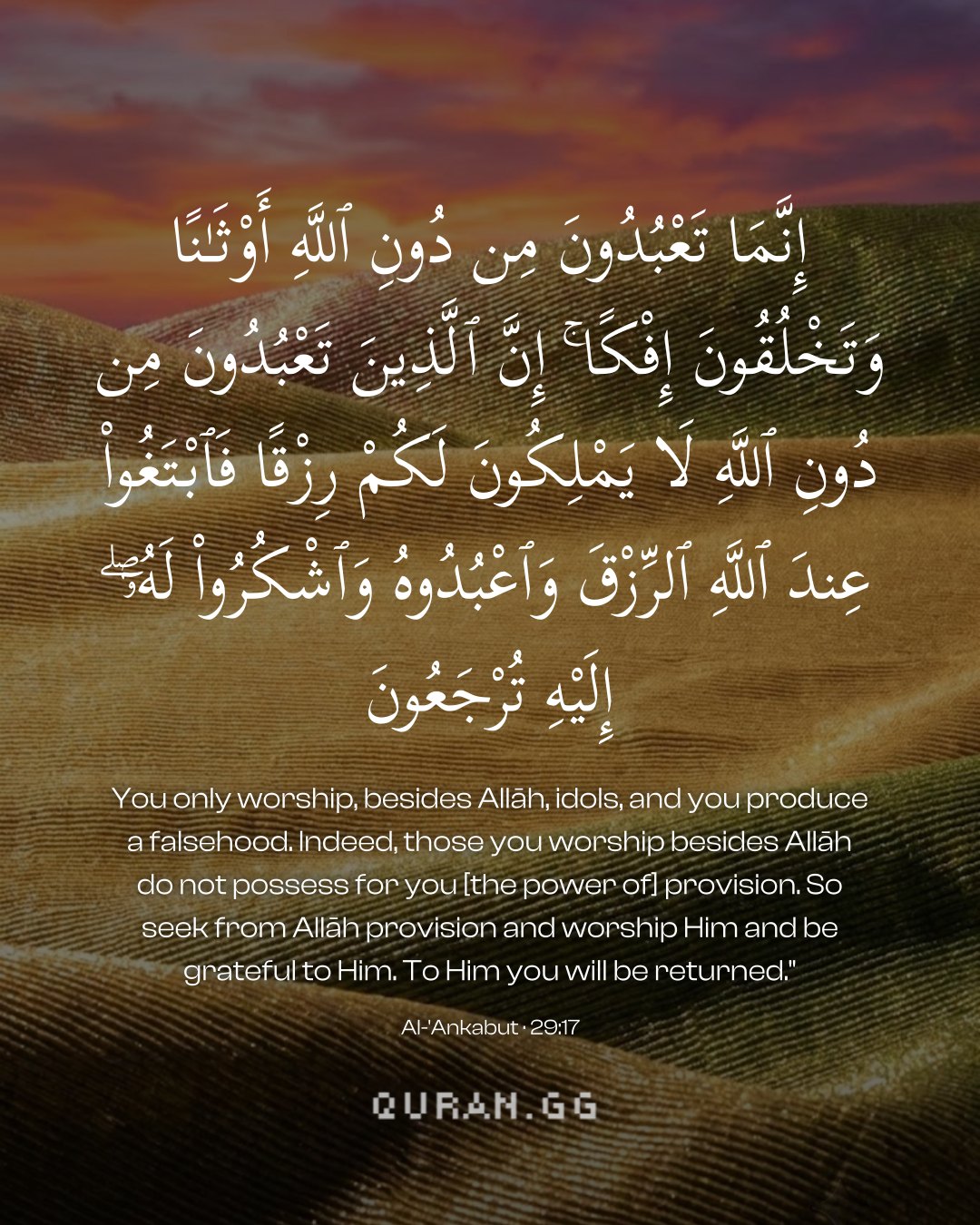
You only worship, besides Allāh, idols, and you produce a falsehood. Indeed, those you worship besides Allāh do not possess for you [the power of] provision. So seek from Allāh provision and worship Him and be grateful to Him. To Him you will be returned."
Allah tells us how His servant, Messenger and close friend Ibrahim, the Imam of the monotheists, called his people to worship Allah alone, with no partner or associate, to fear Him alone, to seek provision from Him alone, with no partner or associate, to give thanks to Him alone, for He is the One to Whom thanks should be given for the blessings which none can bestow but He. Ibrahim said to his people:
اعْبُدُواْ اللَّهَ وَاتَّقُوهُ
(Worship Allah, and have Taqwa of Him,) meaning worship Him and fear Him Alone, with all sincerity.
ذَلِكُمْ خَيْرٌ لَّكُمْ إِن كُنتُمْ تَعْلَمُونَ
(that is better for you if you know.) if you do that you will attain good in this world and the next, and you will prevent evil from yourselves in this world and the Hereafter. Then Allah states that the idols which they worshipped were not able to do any harm or any good, and tells them, "You made up names for them and called them gods, but they are created beings just like you." This interpretation was reported by Al-`Awfi from Ibn `Abbas. It was also the view of Mujahid and As-Suddi. Al-Walibi reported from Ibn `Abbas: "You invent falsehood, means, you carve idols," which do not have the power to provide for you.
It was described in the previous verses that infidels keep on their opposition and afflictions on Muslims as a routine. In the above verses the Holy Prophet ﷺ was consoled by relating some incidents of earlier people that this practice of harassment of believers by the infidels is going on for long. But they never lost hope due to such harassments. Therefore, you too should not care about the troubles afflicted by the infidels, and should keep on performing firmly your prophetic obligations.
Among the earlier prophets, the story of Sayyidna Nuh (علیہ السلام) was related first. It was so because he was the very first prophet who had to confront with the infidelity and association of others with Allah Ta’ ala. Secondly, any other prophet did not experience the extent of harassment he had to put up with from his own people. It was because he had the exclusive honour from Allah Ta’ ala of having very long life. His life span of nine hundred and fifty years (950) years as quoted by the Holy Qur'an is true without any element of doubt. However, in certain narrations it is mentioned that this relates to the period of his preaching and teaching, and there are additional periods of his life before this and after the deluge. وَاللہُ أعلَم
Noah lived for nine hundred and fifty years. Even before he was given prophethood, he was a righteous person and followed the Shariah or religious code of Adam. After receiving prophethood, he became a regular missionary of God and issued warnings to his people. But, even after he had put in efforts for hundreds of years, his people rejected him. In the end, the whole community, barring a few reformed individuals, was destroyed in a terrible flood. There is a high mountain known as Ararat in the mountain ranges of Eastern Anatolia on the border between Russia and Turkey. Its height is more than five thousand metres. The pilots of planes flying over this mountain say that they have seen a boat-like object on the snow-clad peak. So, constant efforts are being made to reach this boat. Scholars hold the view that this is that very boat known in religious traditions as Noah’s Ark. If this information is correct, it means that Almighty God has preserved Noah’s Ark till today, to serve as a sign to show that, in order to save themselves from a storm which will destroy them all, human beings required the special protection of a prophet’s boat. Nothing else could save them from His wrath.
Uthmani text of the Madinah mushaf (King Fahd Complex). Translation: Saheeh International. Tafsir via Quran.com.