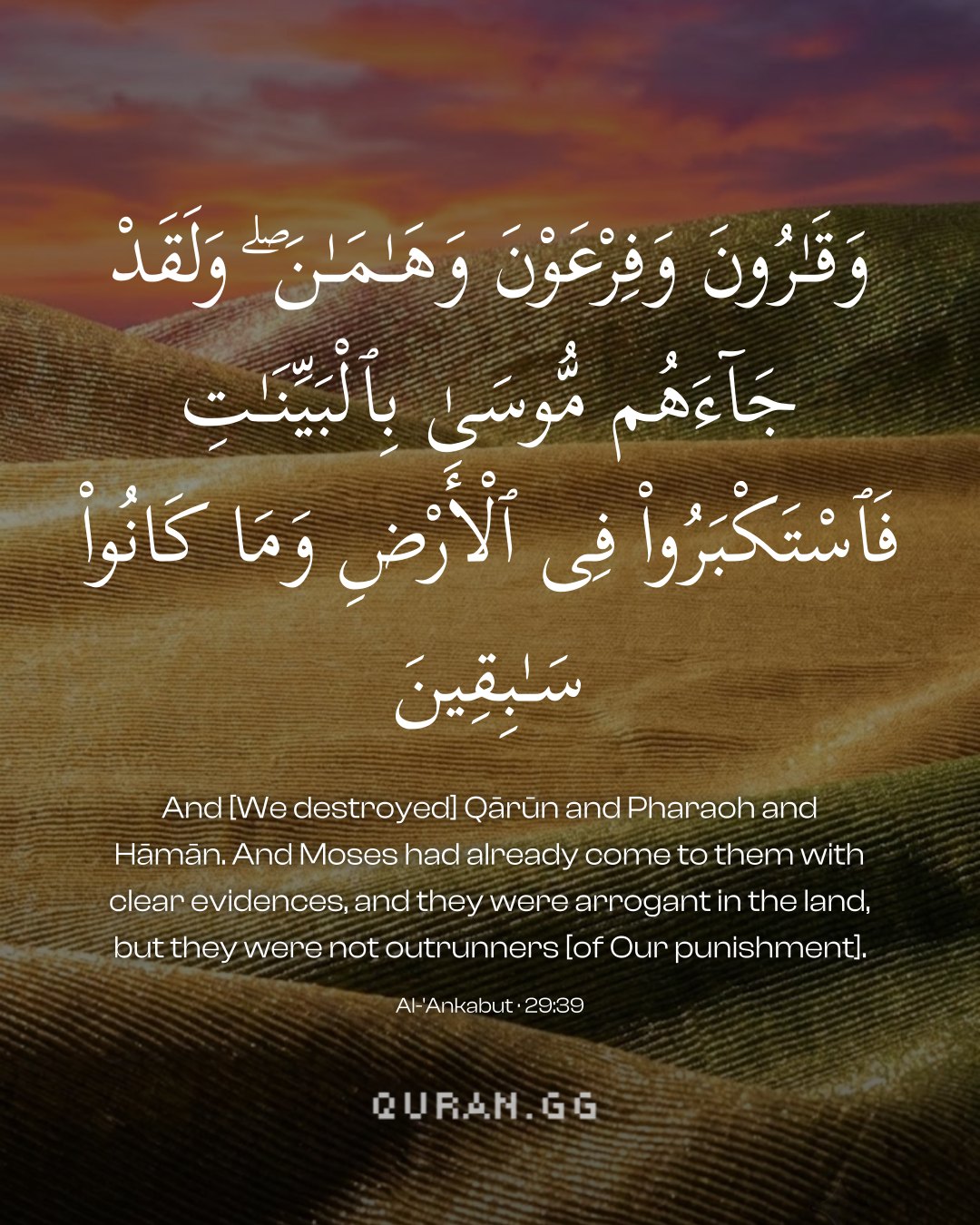
And [We destroyed] Qārūn and Pharaoh and Hāmān. And Moses had already come to them with clear evidences, and they were arrogant in the land, but they were not outrunners [of Our punishment].
The Destruction of Nations Who rejected Their Messengers
Allah tells us about these nations who disbelieved in their Messengers, and how He destroyed them and sent various kinds of punishments and vengeance upon them. `Ad, the people of Hud, peace be upon him, used to live in the Ahqaf (curved sand-hills), near Hadramawt, in the Yemen. Thamud, the people of Salih, lived in Al-Hijr, near Wadi Al-Qura. The Arabs used to know their dwelling place very well, and they often used to pass by it. Qarun was the owner of great wealth and had the keys to immense treasures. Fir`awn, the king of Egypt at the time of Musa, and his minister Haman were two Coptics who disbelieved in Allah and His Messenger, peace be upon him.
The stories of the earlier people, that are mentioned in these verses briefly, have been related in detail in the previous Surahs. For instance, the story of Shu'aib and those of ` Ad and Thamud have been related in Surahs Al-A` raf and Hud, and the incidents of Qarun, Haman, and the Pharaoh have just passed in Surah Al- Qasas.
وَكَانُوا مُسْتَبْصِرِينَ (They were people of insight - 29:38). This word is derived from Istibsar, which means sight; and Mustabsir is used for observer. The meaning of this sentence is that those who insisted on infidelity and shirk (associating partner with Allah) and got themselves involved in perdition and Allah's wrath were no fools or insane. They were very clever having insight, but their intelligence and sagacity was confined to mundane considerations. They did not realize that there would be a day of reckoning for all good and bad actions, when there would be complete justice, because the cruel and the oppressors move about in this world without hindrance, but those oppressed and afflicted are compelled to endure injustice. The day this injustice will finish and justice will be the order of the day is called the Hereafter. They are at a loss to comprehend this bit.
God’s retribution was likewise meted out to the ‘Ad and the Thamud. They were very shrewd in their worldly affairs, but they proved most foolish in the matter of the Hereafter. They learned the secret of carving houses out of rocky mountain sides, but not the secret of shaping their lives under the guidance of their prophet. The reason for this was what is known as false glorification of deeds, or taz’in. Satan misled them into thinking that building up their worldly position was the genuine aim of life, and that if worldly success were achieved, nothing would pose any problem after that. But this deception was of no avail to them and neither will such fraudulence be of any avail to anybody at any time. In ancient times the ‘Ad people inhabited the area of southern Arabia, which is now known as Yemen, Ahqaf and Hadramouth. Similarly, the Thamud people inhabited the areas located in the northern part of Hijaz stretching from Rabegh to Aquaba and from Madinah and Khyber to Tyma and Tabuk.
Uthmani text of the Madinah mushaf (King Fahd Complex). Translation: Saheeh International. Tafsir via Quran.com.