Evidence for the Fact that the Qur'an was revealed from Allah
Ibn Jarir said: "Allah says, `just as We revealed the Books to the Messengers who came before you, O Muhammad, so We have also revealed this Book to you."' What he said is good and fits the context. Allah's saying:
فَالَّذِينَ ءَاتَيْنَـهُمُ الْكِتَـبَ يُؤْمِنُونَ بِهِ
(and those whom We gave the Scripture believe therein) means, those knowledgable rabbis and scholars among them who learned it and recited it properly, such as `Abdullah bin Salam, Salman Al-Farisi and others like them.
وَمِنْ هَـؤُلاءِ مَن يُؤْمِنُ بِهِ
(as also believe therein some of these) meaning, the Quraysh Arabs and others.
وَمَا يَجْحَدُ بِـايَـتِنَآ إِلاَّ الْكَـفِرونَ
Continue reading the tafsir of ayahs 47–49 The status of the narrations of the People of the Book quoted by the commentators in their commentaries is also the same. The object of their reproduction in the commentaries is meant to highlight their historical position. They cannot be used for determining what is permitted (halal) and what is not permitted حَرَام (haram).
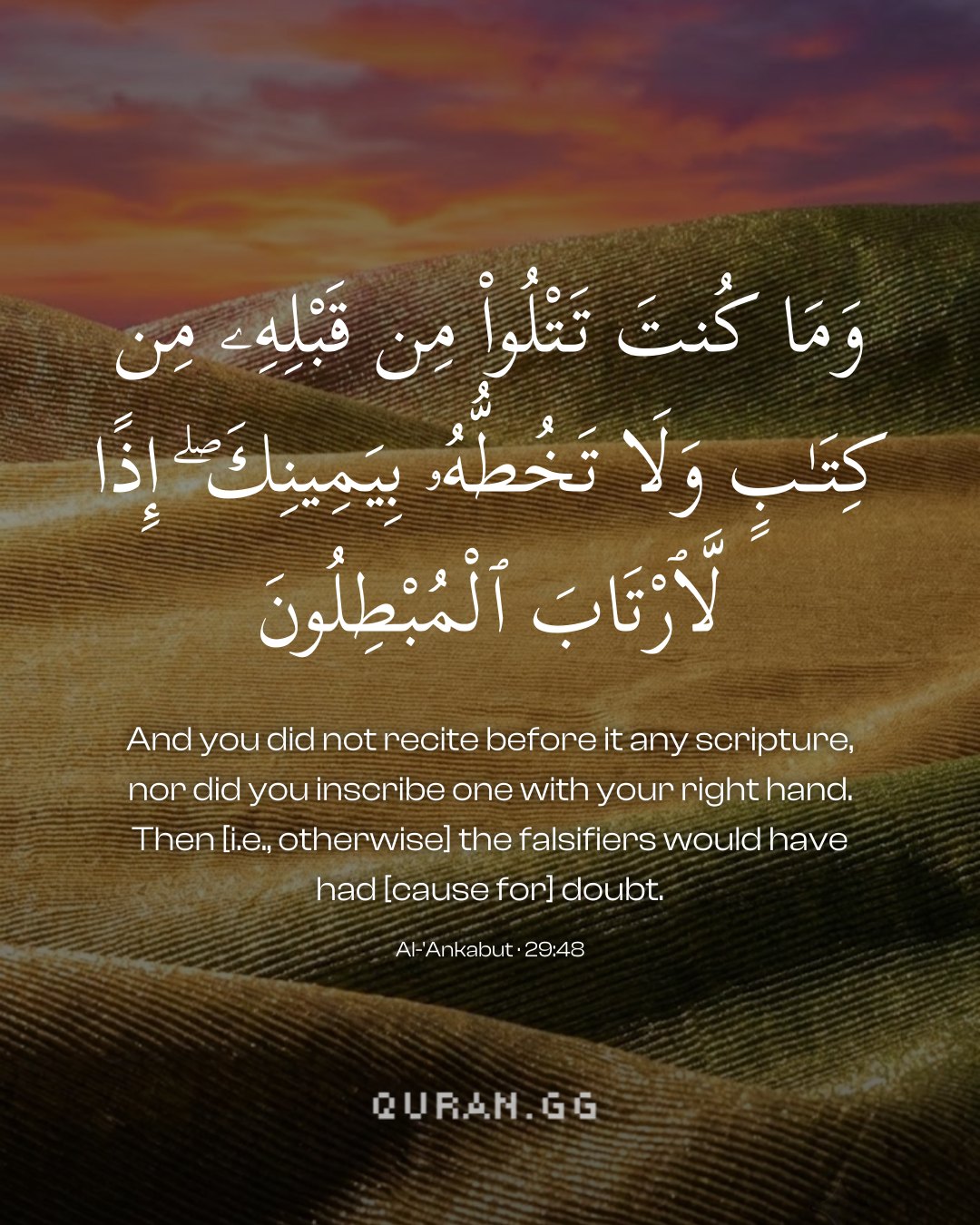
مَا كُنتَ تَتْلُو مِن قَبْلِهِ مِن كِتَابٍ وَلَا تَخُطُّهُ بِيَمِينِكَ إِذًا لَّارْتَابَ الْمُبْطِلُونَ (And you have never been reciting any book before this, nor have you been writing it with your right hand, had it been so, the people of falsehood would have raised doubts. - 29:48). That is Before the revelation of the Qur'an you could neither read nor write, rather you were unlettered (اُمِّی). If it was not so, and you were literate, then there could have been a possibility of doubt for the infidels to put the blame that you were repeating what you had read in, the earlier books, Torah and Injil, and it was not a new revelation sent down on you by way of prophethood.'
It was a great honour and miracle for the Holy Prophet ﷺ to be unlettered
Allah Ta’ ala had demonstrated so many evident and clear miracles to prove the prophethood of the Holy Prophet ﷺ ، and it was one of those miracles that He made him unlettered. Neither he could read anything nor could he write at all. Forty years of his life were spent in this fashion before the eyes of the people of Makkah. He did not have any acquaintance with the People of the Book wherefrom he could have learnt anything. In fact, there were no People of the Book living in Makkah. Suddenly, at the age of forty years, such a speech started flowing from his mouth that was a miracle not only in its theme and meaning, but also in the pinnacle of its eloquence.
Some scholars have tried to prove that he was unlettered in the beginning, but later Allah Ta’ ala taught him how to read and write. In support of their contention they quote a hadith regarding the incident of Hudaibiyah, which says that when the agreement between the Holy Prophet ﷺ and the infidels of Makkah was being written, it was started by the Muslims with the words, مِن مُحَمَّدِ عبد اللہ وَ رسَوُلِہٖ - (From Muhammad, the slave of Allah and His messenger). On this the disbelievers of Makkah objected that his being the messenger of Allah was the real bone of contention, and if they had accepted him as a messenger of Allah, there would not have been any dispute among them. Therefore, they would not accept the words ` and His messenger' along with his name. Sayyidna Ali ؓ had written this agreement, so, the Holy Prophet ﷺ asked him to erase it, to which he declined out of respect and reverence for him. Then the Holy Prophet ﷺ took the paper in his own hand, and after erasing the words ` His messenger' wrote مِن مُحَمَّدِ بن عَبدَاللہِ (From Muhammad, the son of ` Abdullah).
In this narration, the act of writing has been attributed to the Holy Prophet ﷺ which led some people to think that he knew how to write. But the correct position is that the act of writing was attributed to him in the narration as a colloquial expression. It is a fairly common idiom spoken quite widely that if someone gets something written by an ascribe, the writing is attributed to the former, even though he has not written it himself. The other possibility is that Allah Ta’ ala made him write this bit miraculously on this occasion. Also, by writing just a few words, one cannot be called a literate, but would still remain an unlettered. Furthermore, it would not be an honour for him to be labeled as literate, rather the honour is in him being an unlettered.
Rather than become entangled in unnecessary discussions and bickering, it is best if the preacher (da‘i) greets his antagonists formally and then avoids them. But, to those who are sincere and serious, he should try to explain and clarify the Truth. Furthermore, the preacher’s words should be full of wisdom—a wisdom made manifest in the way he takes into account the mental make-up of the addressee. He should present his message in a way which appeals to the addressee, so that his mind is addressed. The message should consist of sound advice and should not be argumentative.
Uthmani text of the Madinah mushaf (King Fahd Complex). Translation: Saheeh International. Tafsir via Quran.com.