Advice to migrate and the Promise of Provision and a Goodly Reward
Allah commands His believing servants to migrate from a land in which they are not able to establish Islam, to the spacious earth of Allah where they can do so, by declaring Allah to be One and worshipping Him as He has commanded. Allah says:
(O My servants who believe! Certainly, spacious is My earth. Therefore worship Me.) When things became too difficult for the believers in Makkah who were in a weak position and were oppressed, they left and migrated to Ethiopia, where they were able to practice their religion. The Muslims found Ethiopia the best place for guest; where Ashamah, the Negus or king, may Allah have mercy on him, gave them refuge, helped them, supported them, and honored them in his land. Later, the Messenger of Allah ﷺ and his remaining Companions migrated to Al-Madinah, formerly known as Yathrib, may Allah protect it. Then Allah says:
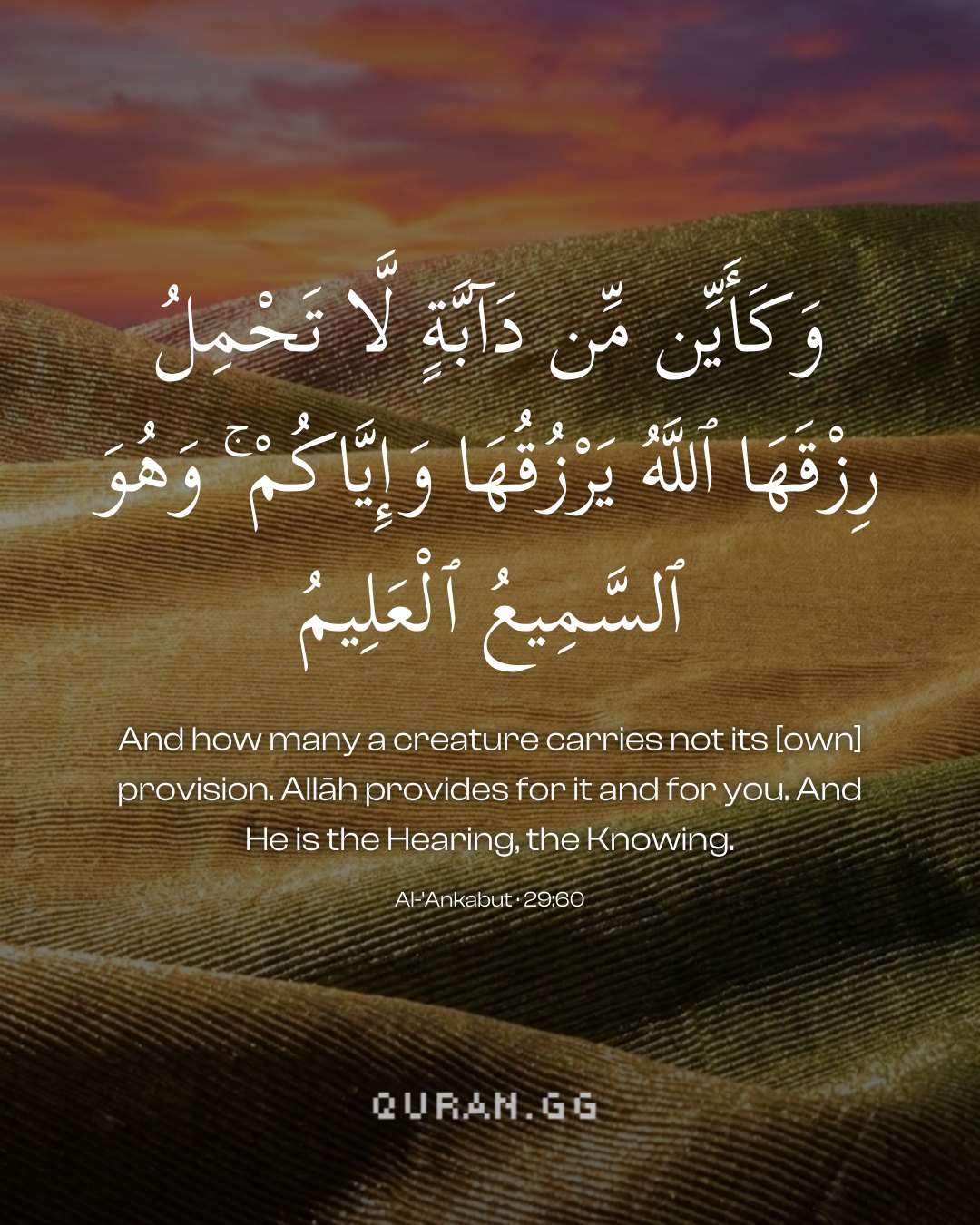
وَكَأَيِّن مِّن دَابَّةٍ لَّا تَحْمِلُ رِزْقَهَا اللَّـهُ يَرْزُقُهَا وَإِيَّاكُمْ (And how many an animal there is that does not carry its provision. Allah gives provision to it as well as to you, - 29:60), that is, ` You should ponder over the fact that there are innumerable animals on earth who do not collect and store their sustenance, nor do they worry about its collection. But Allah Ta’ ala provides them their sustenance daily by His grace'. This applies to almost all animals, except a few. For instance, ants and rats are two such animals that store their food. Ants do not come out of their holes in winter; hence store the food during the summer season. Among the birds crow is the only one that collects food in its nest, but then forgets it. Thus, all the countless animals living on earth are those who neither collect their food for the next day, nor do they have means to do so. It is stated in a hadith that all the birds set off from their nests at dawn in a state of hunger, and return in the evening satiated. They all get their sustenance daily from the bounty of Allah Ta’ ala, and the practice goes on throughout their lifetime.
Tazkirul Quran
Maulana Wahiduddin KhanOn ayahs 60–62
Sometimes a change is necessary in the mode of performing a task. This may require a change in the sphere of influence, in the way that the Hudaybiyah Pact shifted the scene of action from the battlefield to the field of missionary work. But more often, it requires a major step, like migration, for example, the migration of the Prophet from Makkah to Madinah. In these verses the faithful living in Makkah were told that if the people of Makkah were harassing them, they should leave Makkah, migrate to some other place, and carry on God’s worship there. This shows that the exercise of patience and trust means being steadfast in prayer and not persisting in clashing with enemies. Had it been God’s will that they should engage in hostilities under any circumstances, then the instructions would have been to continue fighting with their opponents and not in any event to move away.
Uthmani text of the Madinah mushaf (King Fahd Complex). Translation: Saheeh International. Tafsir via Quran.com.