(That is some of the news of the towns which We relate unto you; of them, some are standing, and some have been reaped. We wronged them not, but they wronged themselves.) 11:100-101 Allah said
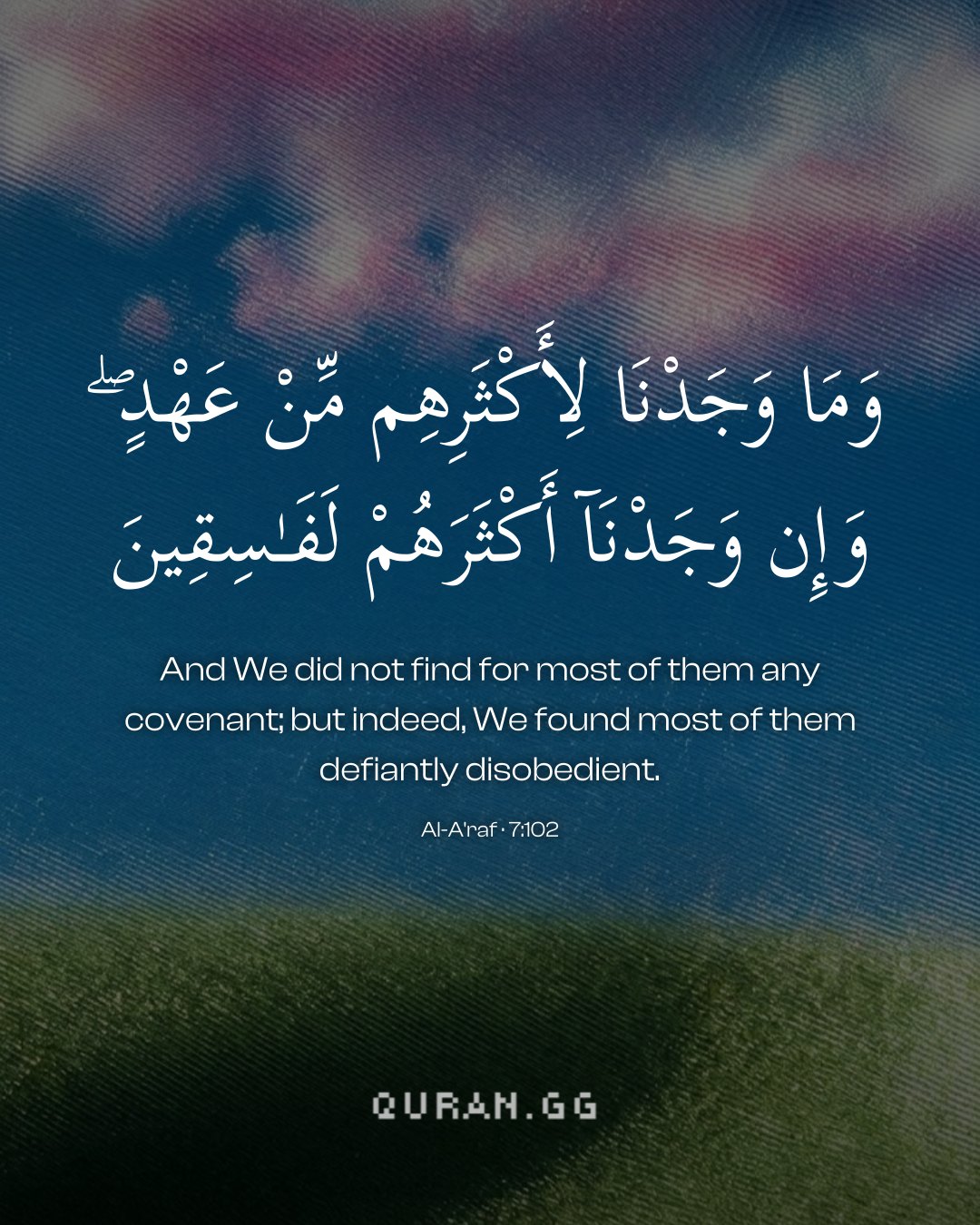
The verse 102 has said, "And We did not find with most of them any covenant (unbroken)." The Companion ` Abdullah ibn Abbas ؓ has said that the covenant referred to in this verse is the Covenant called . That is, the covenant that Allah made with the spirits of all the creatures before creating them, when Allah said to them: أَلَسْتُ بِرَبِّكُمْ ''Am I not your Lord?" All the human spirits entered into a covenant by answering" Yes" to the question. Most of the people forgot this covenant after they came to earth, and got involved in worshipping false gods instead of worshipping Allah. The verse, therefore, has said that Allah did not find most of the people true to this covenant. (Tafsir Kabir)
The respected companion ` Abdullah ibn Masud ؓ عنہما has said that the covenant referred to in this verse is the covenant of 'Iman' the Faith as has been indicated in the Holy Qur'an in these words إِلَّا مَنِ اتَّخَذَ عِندَ الرَّحْمَـٰنِ عَهْدًا "Except the one who entered into a covenant with Rahman (Allah), the covenant in this verse signifies the covenant of Faith. The verse, therefore, implies that most of the people deviated from their covenant with Allah. We usually note that nearly every individual when he finds himself trapped in some distress, no matter how sinful he is, turns to Allah and often makes a promise in words or in his heart that he will be faithful to Allah and obey Him and avoid disobedience if he is relieved from this calamity. But when they are out of the mess, they indulge in their mundane desires having no regard for their covenant with Allah.
The Holy Qur'an has made mention of many of such people. It may be noted that the verse has made exception by saying 'most of them' and not 'all of them'. It is because there are people who are so perverted that even in their distress they do not turn to Allah, and they do not think of making any promise with Allah, while there are others who fulfill their promise and stay obedient to Him. At the end, the verse has the phrase "We found most of them sinners." That is, most of the people deviate from their covenant of staying obedient to Allah.
The above verses have described five events of earlier people so that present people may learn lesson from them and avoid following the course of their forefathers that led them to disaster.
Of all the events of early people described in this chapter the next event is of prophet Musa (علیہ السلام) which has been described in some detail in the following verses because his miracles are larger in number and more prominent in their nature. Similarly, his people, the Israelite, were more obstinate and ignorant than other people of the world. In addition, these verses, 103-110 carry some injunctions and points of discussion.
Tazkirul Quran
Maulana Wahiduddin KhanOn ayahs 102–111
God has blessed man with the powers of observation, hearing and thinking, so that he may learn lessons and, with their help, may understand the signs of God. But when a man does not utilize these powers for the purpose for which they were intended, then it inevitably happens that the sensitivity of his heart starts waning until his feelings become blunted; the seal of insensitivity is thus fixed on his heart and mind. Now, his position becomes that of one who does not see in spite of having eyes, does not hear in spite of having ears and does not understand in spite of having a mind; and in spite of being a human being, he loses his humanity. The human race began with the followers of Adam. Thereafter, when they fell into wrong ways, the prophets of God came to admonish them. Now those who reformed themselves on the advent of the prophets were saved and those who refused to be reformed were destroyed. Again the following generations forgot the vows of submission to God made to their prophets, and they suffered the same consequences as those of the later generations of Adam’s followers. Such a state of affairs has occurred again and again, so much so that the history of the greater part of the human race has become that of disobedience and the breaking of pledges.
Uthmani text of the Madinah mushaf (King Fahd Complex). Translation: Saheeh International. Tafsir via Quran.com.