(a Thu`ban serpent, manifest), refers to "The male snake." As-Suddi and Ad-Dahhak said similarly. A report from Ibn `Abbas said,
فَأَلْقَى عَصَاهُ
"(Then (Musa) threw his staff), and it turned into a huge snake that opened its mouth and rushed towards Fir`awn. When Fir`awn saw the snake rushing towards him, he jumped from his throne and cried to Musa for help, so that Musa would remove the snake from his way. Musa did that." As-Suddi commented,
فَإِذَا هِىَ ثُعْبَانٌ مُّبِينٌ
(and behold! It was a Thu`ban serpent, manifest!) "This Thu`ban refers to male snakes. The snake opened its mouth and headed towards Fir`awn to swallow him, placing its lower jaw on the ground and its upper jaw reaching the (top of the) wall of the palace. When Fir`awn saw the snake, he was frightened, so he jumped and wet himself and he never wet himself before this incident. He cried, `O Musa! Take it away and I will believe in you and release the Children of Israel to you.' So Musa, peace be on him, took it, and it became a staff again. "
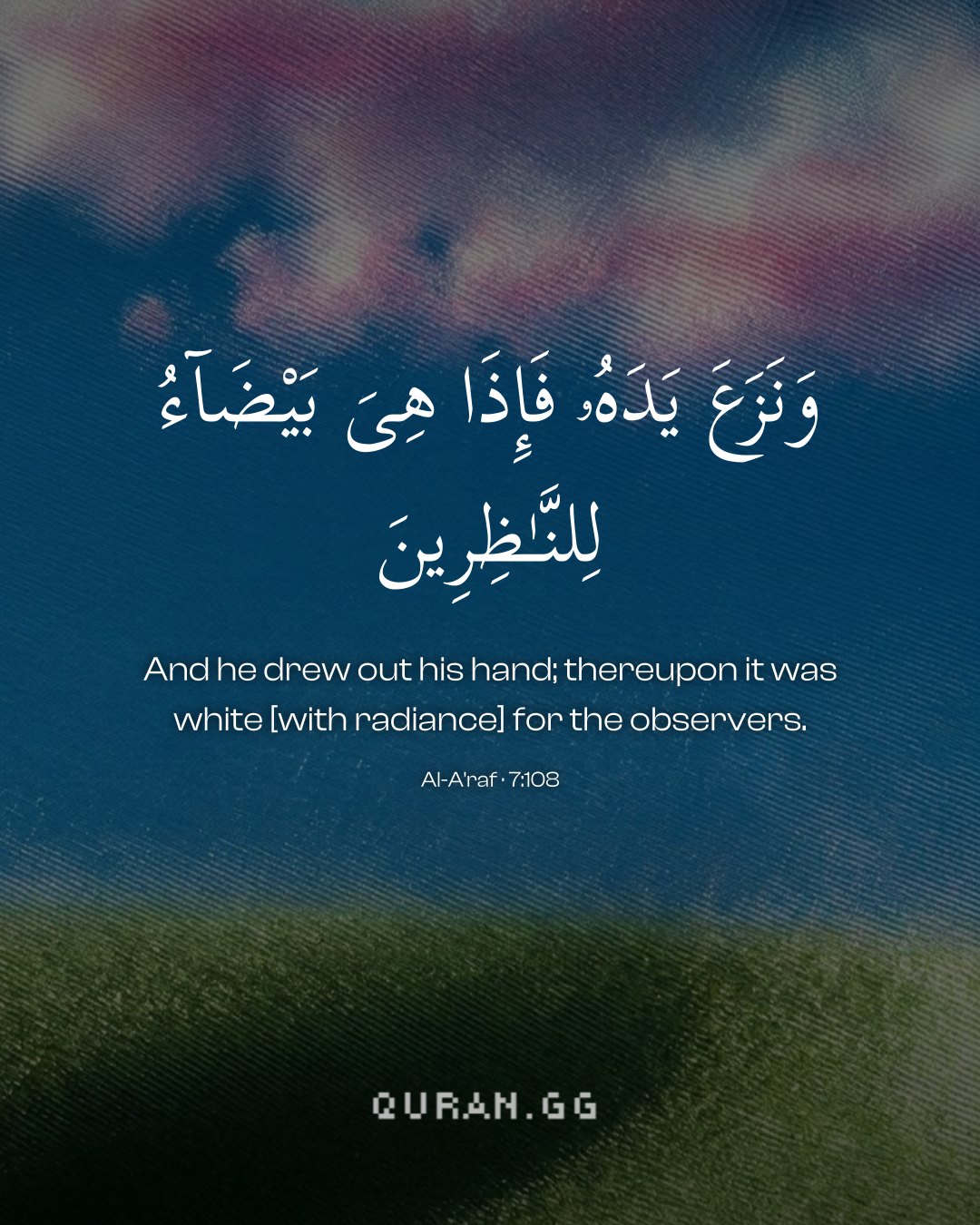
Thereafter, the verse (7:108) said, وَنَزَعَ يَدَهُ فَإِذَا هِيَ بَيْضَاءُ لِلنَّاظِرِينَ 'And he drew out his hand, and it was white light to the onlookers.'
The Arabic word: نَزع naza` a signifies extracting something from another thing with force. Here this word indicates that the prophet Musa (علیہ السلام) applied some force while drawing out his hand. The verse does not speak of a place from where he drew out his hand. In other verses, however, we find mention of two things. In a verse (27:12) we find the words أَدْخِلْ يَدَكَ فِي جَيْبِكَ 'enter your hand under your robe.' The other verse (20:22) contains the words (وَاضْمُمْ يَدَكَ إِلَىٰ جَنَاحِكَ ) 'put your hand under your arm.' The two phrases indicate that he used to draw out his hand either from under his arm or from under his shirt. Arabic word: بَيْضَاءُ 'bay’ da' means white. The whiteness of hand may also be due to some disease, it is perhaps, why the Holy Qur'an has added the words 'without an evil' in other (28:32, 27:12) verse to eliminate any possible doubt of a disease. We know from a Tradition reported by the Companion ` Abdullah ibn ` Abbas ؓ that this whiteness was not of ordinary kind. It had light that illuminated the whole surrounding. (Qurtubi) The Arabic word 'nazirin' signifying the 'onlookers or viewers' indicates that this light was so surprising for the people that they gathered to see it.
The prophet Musa (علیہ السلام) performed two miracles at this occasion on the demand of the Pharaoh. First, the transformation of his staff into a serpent, second, drawing his hand out from under his arm, emanating light from it. The first was to serve as warning for the unbelievers while the second aimed at inviting them to the truth. It also indicated that the message of the prophet Musa (علیہ السلام) was a light and to follow it would lead people to eternal success.
Tazkirul Quran
Maulana Wahiduddin KhanOn ayahs 102–111
God has blessed man with the powers of observation, hearing and thinking, so that he may learn lessons and, with their help, may understand the signs of God. But when a man does not utilize these powers for the purpose for which they were intended, then it inevitably happens that the sensitivity of his heart starts waning until his feelings become blunted; the seal of insensitivity is thus fixed on his heart and mind. Now, his position becomes that of one who does not see in spite of having eyes, does not hear in spite of having ears and does not understand in spite of having a mind; and in spite of being a human being, he loses his humanity. The human race began with the followers of Adam. Thereafter, when they fell into wrong ways, the prophets of God came to admonish them. Now those who reformed themselves on the advent of the prophets were saved and those who refused to be reformed were destroyed. Again the following generations forgot the vows of submission to God made to their prophets, and they suffered the same consequences as those of the later generations of Adam’s followers. Such a state of affairs has occurred again and again, so much so that the history of the greater part of the human race has become that of disobedience and the breaking of pledges.
Uthmani text of the Madinah mushaf (King Fahd Complex). Translation: Saheeh International. Tafsir via Quran.com.