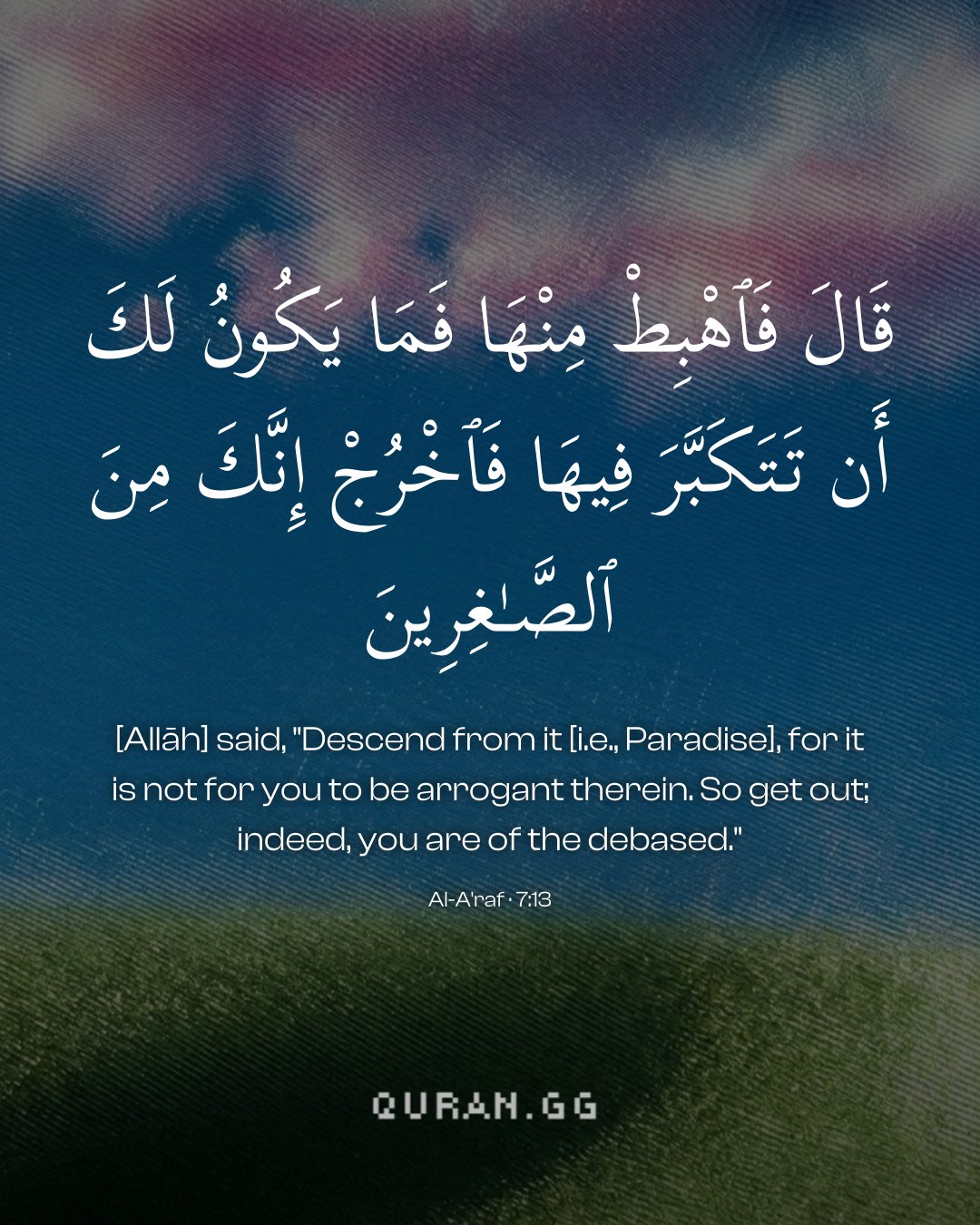
(Get down from this) "because you defied My command and disobeyed Me. Get out, it is not for you to be arrogant here," in Paradise, according to the scholars of Tafsir. It could also refer to particular status which he held in the utmost highs. Allah said to Iblis,
فَاخْرُجْ إِنَّكَ مِنَ الصَّـغِرِينَ
(Get out, for you are of those humiliated and disgraced.) as just recompense for his ill intentions, by giving him the opposite of what he intended (arrogance). This is when the cursed one remembered and asked for respite until the Day of Judgment,
(Then allow me respite till the Day they are raised up. (Allah) said: "Then you are of those respited.") 15: 36-37 Allah gave Shaytan what he asked for out of His wisdom, being His decision and decree, that is never prevented or resisted. Surely, none can avert His decision, and He is swift in reckoning.
Ma'arif al-Qur'an
Mufti Muhammad ShafiOn ayahs 12–18
Commentary
The event relating to Sayyidna 'Adam (علیہ السلام) and the Shaytan has appeared earlier in Section four of Surah Al-Baqarah (Ma` ariful-Qur'an, English Translation, under verse 34). Some aspects of the subject have been covered in comments given there. Answers to some others are being given here.
How Long was the Respite given to Iblis?
It was exactly at the time Iblis was under the wrath of Allah, he made a prayer, a strange prayer indeed. He asked for a lease of life until the day of Resurrection. The words in which Allah Ta` ala answered the prayer, as they appear in this verse, are no more than: إِنَّكَ مِنَ الْمُنظَرِينَ (Respite is given to you). From these words, given the nature of the question and the answer, it can be understood that this respite was given until the Resurrection as asked by him. But, what is not stated in this verse clearly is whether the giving of respite mentioned here is until the Resurrection as asked by Iblis, or is for some other duration. But, in another verse, the words: إِلَىٰ يَوْمِ الْوَقْتِ الْمَعْلُومِ ﴿38﴾ (Till the day of the appointed time - 15:38) appear at this place which, on the surface, seem to suggest that the respite till the day of Qiyamah as asked by Iblis was not given. Instead, given to him was a respite till a particular time which is preserved in Divine knowledge. The outcome is that the prayer of Iblis was answered - though not completely. He was given respite till a particular time and not till the day of Resurrection or Qiyamah.
Whatever God has bestowed upon man in this world has been given for the purpose of eliciting his gratitude. But this is the very thing which man does not offer to his Lord. The reason for this is that Satan contrives to distort his feelings and steers him away from any expression of gratitude. It becomes evident from the story of Adam and Satan what the real criterion is for the judgement of one’s case. Man is being judged at the point where feelings of jealousy and pride develop in the human heart. In this world of trial it happens again and again that one man rises above another; sometimes one man receives a greater share of wealth and honour as compared to his fellow men. Sometimes, in a deal between two persons, it happens that one of them considers his discharging of the other’s legitimate rights as degrading to himself. On all such occasions man is being judged whether he responds positively or reacts negatively.
Uthmani text of the Madinah mushaf (King Fahd Complex). Translation: Saheeh International. Tafsir via Quran.com.