Surah Al-A'raf Ayah 136 (7:136) — Meaning & Tafsir | Quran.GG

Surah Al-A'raf, Ayah 136

7:136 · Meaning and tafsir

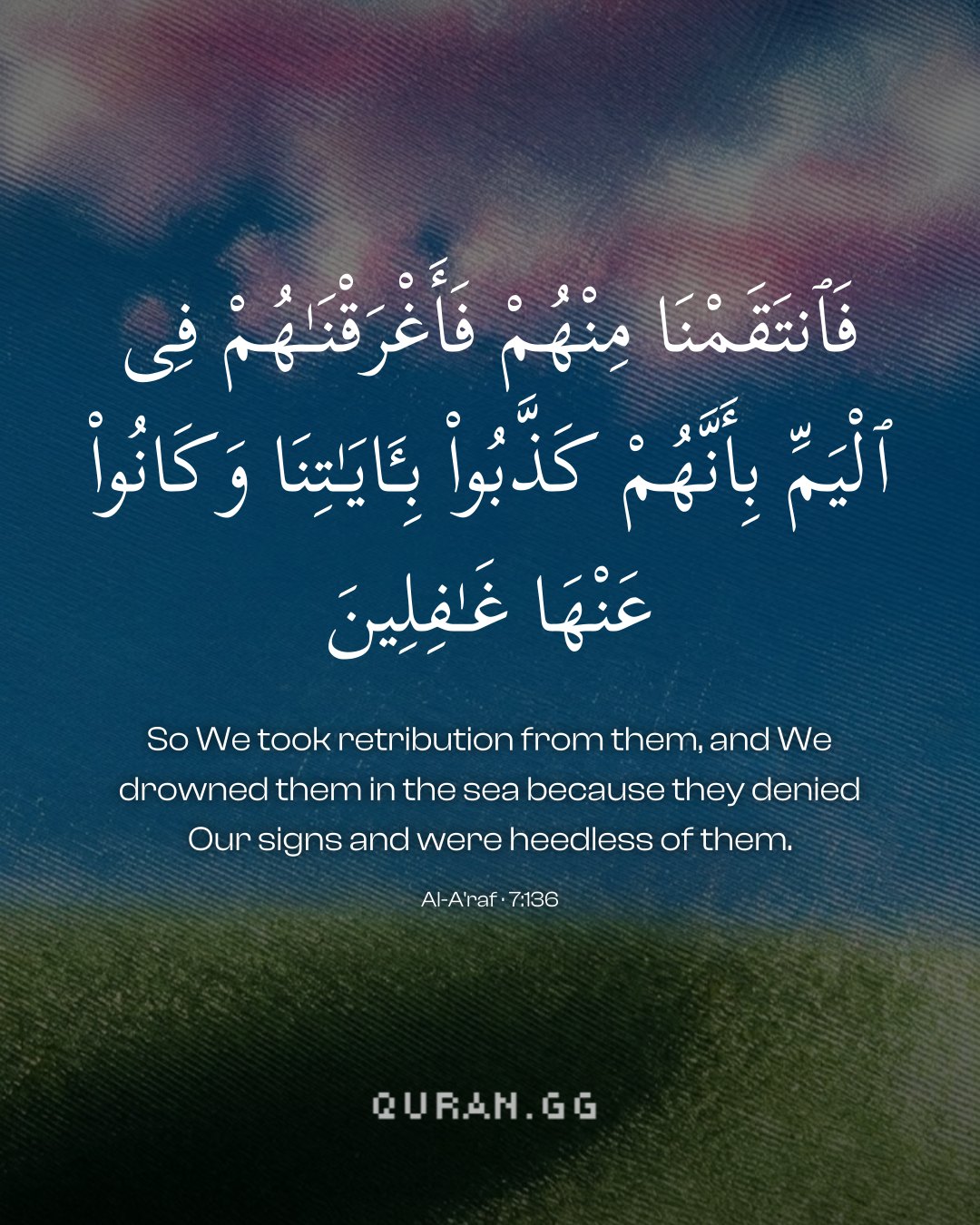
فَٱنتَقَمْنَا مِنْهُمْ فَأَغْرَقْنَـٰهُمْ فِى ٱلْيَمِّ بِأَنَّهُمْ كَذَّبُوا۟ بِـَٔايَـٰتِنَا وَكَانُوا۟ عَنْهَا غَـٰفِلِينَ ١٣٦

So We took retribution from them, and We drowned them in the sea because they denied Our signs and were heedless of them.

Surah Al-A'raf 7:136 in Arabic with its translation: “So We took retribution from them, and We drowned them in the sea because they denied Our signs and were…”

Make something with this ayah

Turn it into a video for Stories, Reels or TikTok, recited by the reciter you pick, or an image on a background you choose. Free, in your browser.

Download this image

Tafsir Ibn Kathir (abridged)

The People of Fir`awn drown in the Sea; the Children of Israel inherit the Holy Land

Allah states that when the people of Fir`awn rebelled and transgressed, even though He inflicted them with consecutive signs, one after another, He took retribution from them by drowning them in the sea that Musa parted by Allah's power, and he and the Children of Israel passed through. In their pursuit, Fir`awn and his soldiers went in the sea chasing Musa and his people. When they all had gone inside the water, the sea closed in on them and they all drowned, because they belied the Ayat of Allah and were heedless of them. Allah said that He has granted the people who were considered weak, the Children of Israel, to inherit the eastern and western parts of the land. Al-Hasan Al-Basri and Qatadah commented that Allah's statement,

مَشَـرِقَ الاٌّرْضِ وَمَغَـرِبَهَا الَّتِى بَارَكْنَا فِيهَا

(...the eastern parts of the land and the western parts thereof which We have blessed.) refers to the Sham area (Greater Syria). Also, Mujahid and Ibn Jarir said that Allah's statement,

وَتَمَّتْ كَلِمَتُ رَبِّكَ الْحُسْنَى عَلَى بَنِى إِسْرءِيلَ بِمَا صَبَرُواْ

(And the fair Word of your Lord was fulfilled for the Children of Israel, because of their endurance.) is explained by Allah's other statement,

وَنُرِيدُ أَن نَّمُنَّ عَلَى الَّذِينَ اسْتُضْعِفُواْ فِى الاٌّرْضِ وَنَجْعَلَهُمْ أَئِمَّةً وَنَجْعَلَهُمُ الْوَارِثِينَ - وَنُمَكِّنَ لَهُمْ فِى الاٌّرْضِ وَنُرِىَ فِرْعَوْنَ وَهَـمَـنَ وَجُنُودَهُمَا مِنْهُمْ مَّا كَانُواْ يَحْذَرونَ

(And We wished to do a favor to those who were weak (and oppressed) in the land, and to make them rulers and to make them the inheritors. And to establish them in the land, and We let Fir`awn and Haman and their hosts receive from them that which they feared) 28:5-6. Further, Allah's statement,

وَدَمَّرْنَا مَا كَانَ يَصْنَعُ فِرْعَوْنُ وَقَوْمُهُ

(And We destroyed what Fir`awn and his people produced,) meaning, We destroyed what Fir`awn and his people produced, such as agriculture and buildings.

وَمَا كَانُواْ يَعْرِشُونَ

(and what they erected.) Ibn `Abbas and Mujahid said that

يَعْرِشُونَ

(they erected) means, they built.

Ma'arif al-Qur'an

The sixth punishment has been mentioned in the Qur'an by the Arabic word: رِجز 'Rijz' which signifies plague or pestilence. The number of Egyptians killed in this plague is reported to have been more than seventy thousand. They were relieved of this punishment by the prayer of the prophet Musa (علیہ السلام) . Again they broke their promise as before. Now, when they showed no sign of understanding they were finally caught by the last punishment - the death. Leaving behind all their lands, houses and possessions they chased the prophet Musa (علیہ السلام) and his people and were drowned in the sea.

Tazkirul Quran

Moses performed his prophetic mission in Egypt for about forty years. There were two parts of his mission—one, to give the message of the oneness of God to Pharaoh and secondly, to lead the Children of Israel out of Egypt, settle them in the Sinai Desert and give them religious training in that untainted atmosphere. The Children of Israel (the progeny of Joseph) at that time were in the the grip of the Copt ruler (Pharaoh). The Copts used to utilise them as labourers in their agricultural and construction works. So, the Copt rulers did not want the Israelites to leave Egypt. Initially, when Moses demanded that Pharaoh should allow the Children of Israel to leave Egypt along with him, Pharaoh and his courtiers gave his request a political colour and accused Moses of intending to remove the Copt from Egypt ( 7:110 ). This was absolutely meaningless, because Moses’s plan was to remove himself from Egypt. At that time Pharaoh and his companions had an inflated opinion of their power and that is why they saw even a straight proposition in a crooked way. But, in later stages, God subjected Pharaoh and his community to all types of calamities. For many years they had continuously to face famines; they had severe hail-storms with lightning and thunder; swarms of locusts invaded their country and ate up their crops and gardens and completely destroyed all greenery; lice so proliferated that clothes and beds became infested with them; and in the houses and on the pathways, frogs were hopping about everywhere; the water in the rivers and lakes became bloody. When Pharaoh and his community began to suffer these strange afflictions, they asked Moses to pray to his Lord to relieve them of these troubles, then they would allow the Children of Israel to leave with Moses. Moses’s demand, which had earlier appeared to the Copts as a political conspiracy to evict them, now appeared to them simply as a migration of the Children of Israel themselves.

Continue reading the tafsir of ayahs 135–136

Uthmani text of the Madinah mushaf (King Fahd Complex). Translation: Saheeh International. Tafsir via Quran.com.