Surah Al-A'raf Ayah 150 (7:150) — Meaning & Tafsir | Quran.GG

Surah Al-A'raf, Ayah 150

7:150 · Meaning and tafsir

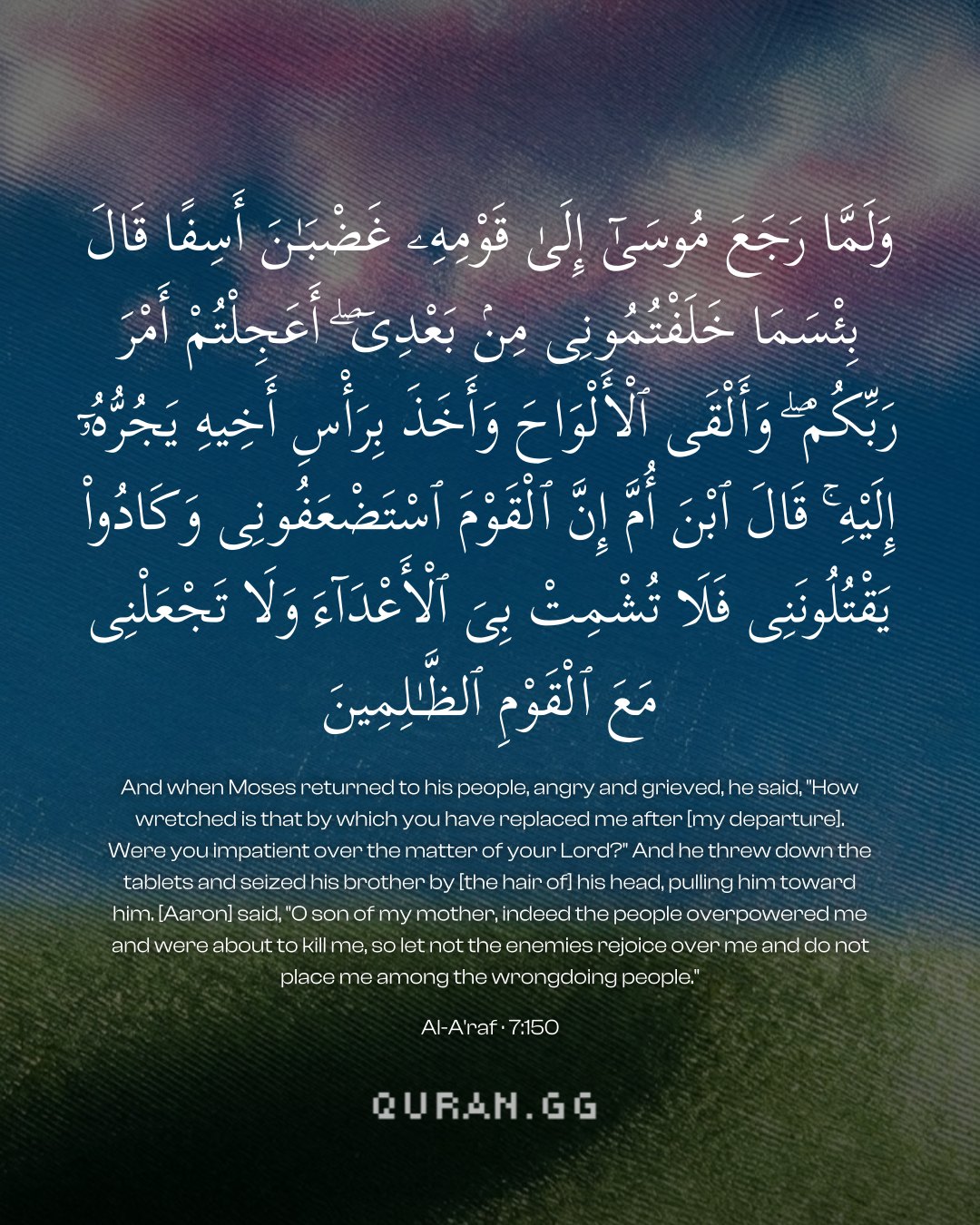
وَلَمَّا رَجَعَ مُوسَىٰٓ إِلَىٰ قَوْمِهِۦ غَضْبَـٰنَ أَسِفًا قَالَ بِئْسَمَا خَلَفْتُمُونِى مِنۢ بَعْدِىٓ ۖ أَعَجِلْتُمْ أَمْرَ رَبِّكُمْ ۖ وَأَلْقَى ٱلْأَلْوَاحَ وَأَخَذَ بِرَأْسِ أَخِيهِ يَجُرُّهُۥٓ إِلَيْهِ ۚ قَالَ ٱبْنَ أُمَّ إِنَّ ٱلْقَوْمَ ٱسْتَضْعَفُونِى وَكَادُوا۟ يَقْتُلُونَنِى فَلَا تُشْمِتْ بِىَ ٱلْأَعْدَآءَ وَلَا تَجْعَلْنِى مَعَ ٱلْقَوْمِ ٱلظَّـٰلِمِينَ ١٥٠

And when Moses returned to his people, angry and grieved, he said, "How wretched is that by which you have replaced me after [my departure]. Were you impatient over the matter of your Lord?" And he threw down the tablets and seized his brother by [the hair of] his head, pulling him toward him. [Aaron] said, "O son of my mother, indeed the people overpowered me and were about to kill me, so let not the enemies rejoice over me and do not place me among the wrongdoing people."

Surah Al-A'raf 7:150 in Arabic with its translation: “And when Moses returned to his people, angry and grieved, he said, "How wretched is that by which you have…”

Make something with this ayah

Turn it into a video for Stories, Reels or TikTok, recited by the reciter you pick, or an image on a background you choose. Free, in your browser.

Download this image

Tafsir Ibn Kathir (abridged)

قَالَ بِئْسَمَا خَلَفْتُمُونِى مِن بَعْدِى

(He (Musa) said: "What an evil thing is that which you have done during my absence.") evil it is that which you committed after I departed and left you, by worshiping the calf,

أَعَجِلْتُمْ أَمْرَ رَبِّكُمْ

(Did you hasten in the matter of your Lord) Musa said, `You wanted me to rush back to you, even though being there this was Allah's decision' Allah said next,

وَأَلْقَى الأَلْوَاحَ وَأَخَذَ بِرَأْسِ أَخِيهِ يَجُرُّهُ إِلَيْهِ

(And he threw down the Tablets and seized his brother by his head and dragged him towards him.) This Ayah demonstrates the meaning of the Hadith,

«لَيْسَ الْخَبَرُ كَالْمُعَايَنَة»

(Information is not the same as observation.) It indicates that Musa threw down the Tablets because he was angry at his people, according to the majority of scholars of early and latter times. Allah said,

وَأَخَذَ بِرَأْسِ أَخِيهِ يَجُرُّهُ إِلَيْهِ

(and seized his brother by (the hair of) his head and dragged him towards him.) for Musa feared that Harun might have not tried hard enough to forbid them from their evil action. In another Ayah, Allah said,

قَالَ يهَـرُونُ مَا مَنَعَكَ إِذْ رَأَيْتَهُمْ ضَلُّواْ - أَلاَّ تَتَّبِعَنِ أَفَعَصَيْتَ أَمْرِى - قَالَ يَبْنَؤُمَّ لاَ تَأْخُذْ بِلِحْيَتِى وَلاَ بِرَأْسِى إِنِّى خَشِيتُ أَن تَقُولَ فَرَّقْتَ بَيْنَ بَنِى إِسْرءِيلَ وَلَمْ تَرْقُبْ قَوْلِى

.(He Musa said: "O Harun ! What prevented you when you saw them going astray. That you followed me not (according to my advice to you) Have you then disobeyed my order" He Harun said: "O son of my mother! Seize (me) not by my beard, nor by my head! Verily, I feared lest you should say: `You have caused a division among the Children of Israel, and you have not respected (waited or observed) my word!"') 20:92-94. Here, Allah said that Harun said,

ابْنَ أُمَّ إِنَّ الْقَوْمَ اسْتَضْعَفُونِى وَكَادُواْ يَقْتُلُونَنِى فَلاَ تُشْمِتْ بِىَ الأَعْدَآءَ وَلاَ تَجْعَلْنِى مَعَ الْقَوْمِ الظَّـلِمِينَ

("O son of my mother! Indeed the people judged me weak and were about to kill me, so make not the enemies rejoice over me, nor put me among the people who are wrongdoers.") Harun said, `Do not place me on the same level as they are, as if I was one of them.' Further, Harun said, `O son of my mother', so that Musa would feel more mercy and leniency towards him, even though Harun was also the son of Musa's father. When Musa was satisfied that his brother was innocent,

وَلَقَدْ قَالَ لَهُمْ هَـرُونُ مِن قَبْلُ يقَوْمِ إِنَّمَا فُتِنتُمْ بِهِ وَإِنَّ رَبَّكُمُ الرَّحْمَـنُ فَاتَّبِعُونِى وَأَطِيعُواْ أَمْرِى

(And Harun indeed had said to them beforehand: "O my people! You are being tried in this, and verily, your Lord is (Allah) the Most Gracious, so follow me and obey my order.") 20:90, this is when,

قَالَ

(he said) Musa,

رَبِّ اغْفِرْ لِى وَلأَخِى وَأَدْخِلْنَا فِي رَحْمَتِكَ وَأَنتَ أَرْحَمُ الرَحِمِينَ

("O my Lord! Forgive me and my brother, and admit us into Your mercy, for you are the Most Merciful of those who show mercy.") Ibn Abi Hatim recorded that Ibn `Abbas said that the Messenger of Allah ﷺ said,

«يَرْحَمُ اللهُ مُوسَى لَيْسَ الْمُعَايِنُ كَالْمُخْبِرِ أَخْبَرَهُ رَبُّهُ عَزَّ وَجَلَّ أَنَّ قَوْمَهُ فُتِنُوا بَعْدَهُ فَلَمْ يَلْقَ الْأَلْوَاحَ فَلَمَّا رَآهُمْ وَعَايَنَهُمْ أَلْقَى الْأَلْوَاح»

(May Allah grant His mercy to Musa! Surely, he who observes something is nothing like he who is informed about it. His Lord, the Exalted and Most Honored, told him that his people were tested after him, but he did not throw the Tablets. When he saw them with his eyes, then he threw the Tablets.)

Ma'arif al-Qur'an

while the verse 150 describes the events followed by the arrival of the Prophet Musa (علیہ السلام) from the mount of Sinai. It described that the Prophet Musa (علیہ السلام) was extremely angry when he saw his people in this state of ignorance. It is reported that Allah had informed him of their perversion on the mount of Sinai. Now seeing them in this state with his own eyes filled him with indignation. First, he turned to his people and said: بِئْسَمَا خَلَفْتُمُونِي مِن بَعْدِي "How bad is the thing you have done in my absence". أَعَجِلْتُمْ أَمْرَ‌ رَ‌بِّكُمْ "How did you act in haste against the command of your Lord?" That is, you must have waited until the book of Allah came to you. Some of the commentators have said that it meant that they hastily decided that the Prophet Musa (علیہ السلام) was dead. Then he turned to the Prophet Harun (علیہ السلام) whom he has left among them as his deputy. He wanted to free his hand in order to grab him. He quickly put down the tablets of the Torah and grabbed the head of his brother. This has been termed as having dropped. The Arabic word used here is: القاء Ilga' which signifies dropping or throwing. This gives rise to a doubt that the Prophet Musa (علیہ السلام) showed disrespect to the tablets of the Torah by throwing or dropping them down. It is obvious that throwing the tablets of the Torah was great sin, and equally obvious is the fact that all the Prophets (علیہم السلام) are innocent and free of all sins. The implication of the verse, therefore, is that he put away the Tablets as quickly in order to free his hands, as seemed like having been dropped. The Holy Qur'an has described it by using this word as a gesture of warning. (Bayern a1-Qur'an)

Tazkirul Quran

There was a clever man named Samiri among the Israelites. When Moses left for the mountain, leaving his people in the care of Aaron, Samiri started misleading them. He collected pieces of jewellery from the people and moulded them into the shape of a calf. The sculpting art of the ancient Egyptians was such that when air passed through it, a bellowing sound came out of the calf’s mouth. People are generally awed by strange things. So this ‘miracle’ of the calf led them to believe that there was something sacred about it and they began worshipping it. Thanks to Samiri’s engaging way of speaking, people started gathering around him. His influence increased to such an extent that he soon acquired a large number of followers, except for Aaron and a few of his companions. Nobody dared to openly protest against him. In the face of this mass following, even the protests of Aaron were not strong enough to sway the people and no other member of the community had the courage to speak up. This has always been the reaction of the public from ancient times to the present day. A clever person by his sheer eloquence may draw a huge crowd, even on some non-issue. The public who are attracted to trivialities which are unrelated to the facts do not have the ability to think deeply enough to analyse what is true and what is not. That is why they rally to the side of such a person, thus adding to his popularity and importance. And if anyone attempts to reveal the truth, he is simply ignored in the same way as Aaron was.

Uthmani text of the Madinah mushaf (King Fahd Complex). Translation: Saheeh International. Tafsir via Quran.com.