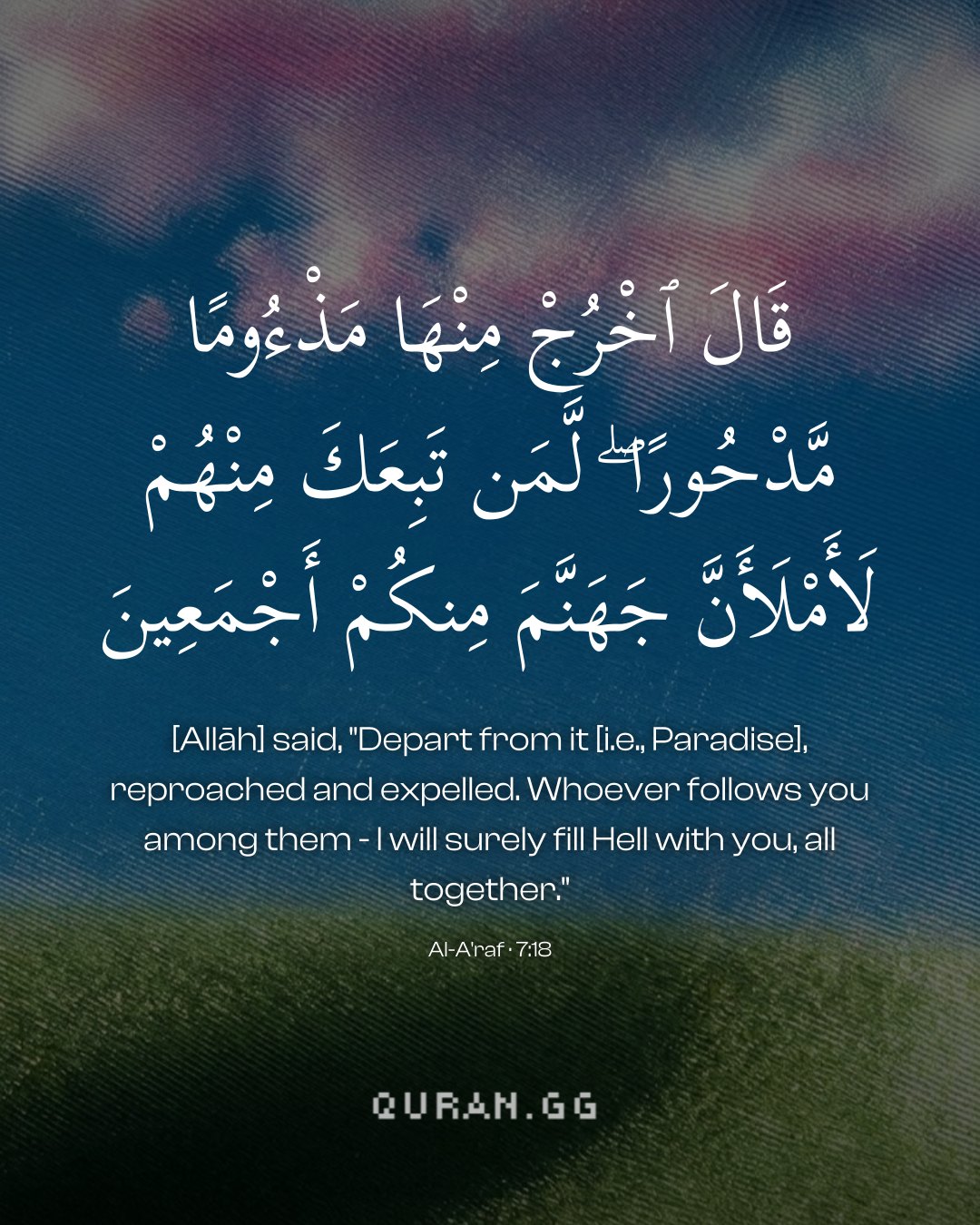
[Allāh] said, "Depart from it [i.e., Paradise], reproached and expelled. Whoever follows you among them - I will surely fill Hell with you, all together."
(Get out from this (Paradise), Madh'uman Madhura) "despised." `Ali bin Abi Talhah reported that Ibn `Abbas commented on,
اخْرُجْ مِنْهَا مَذْءُومًا مَّدْحُورًا
(Get out from this (Paradise), Madh'uman Madhura) 7:18 "Belittled and despised", while As-Suddi commented, "Hateful and expelled." Qatadah commented, "Cursed and despised", while Mujahid said, "Expelled and banished." Ar-Rabi` bin Anas said that `Madh'um' means banished, while, `Madhura' means belittled. Allah said,
((Allah) said: "Go, and whosoever of them follows you, surely, Hell will be the recompense of you (all) an ample recompense. And gradually delude those whom you can among them with your voice, make assaults on them with your cavalry and your infantry, share with them wealth and children, and make promises to them." But Shaytan promises them nothing but deceit. "Verily, My servants -- you have no authority over them. And All-Sufficient is your Lord as a Guardian.") 17:63-65
Ma'arif al-Qur'an
Mufti Muhammad ShafiOn ayahs 12–18
Commentary
The event relating to Sayyidna 'Adam (علیہ السلام) and the Shaytan has appeared earlier in Section four of Surah Al-Baqarah (Ma` ariful-Qur'an, English Translation, under verse 34). Some aspects of the subject have been covered in comments given there. Answers to some others are being given here.
How Long was the Respite given to Iblis?
It was exactly at the time Iblis was under the wrath of Allah, he made a prayer, a strange prayer indeed. He asked for a lease of life until the day of Resurrection. The words in which Allah Ta` ala answered the prayer, as they appear in this verse, are no more than: إِنَّكَ مِنَ الْمُنظَرِينَ (Respite is given to you). From these words, given the nature of the question and the answer, it can be understood that this respite was given until the Resurrection as asked by him. But, what is not stated in this verse clearly is whether the giving of respite mentioned here is until the Resurrection as asked by Iblis, or is for some other duration. But, in another verse, the words: إِلَىٰ يَوْمِ الْوَقْتِ الْمَعْلُومِ ﴿38﴾ (Till the day of the appointed time - 15:38) appear at this place which, on the surface, seem to suggest that the respite till the day of Qiyamah as asked by Iblis was not given. Instead, given to him was a respite till a particular time which is preserved in Divine knowledge. The outcome is that the prayer of Iblis was answered - though not completely. He was given respite till a particular time and not till the day of Resurrection or Qiyamah.
Sometimes God chooses a messenger to convey His word to the people, but his status as a guide is not readily acceptable to them. For this would imply that they were inferior to the messenger as they had failed to arrive at the truth. On such occasions Satan stirs up feelings of jealousy and pride. Puffed up with the feeling: ‘I am better,’ a man is not prepared to acknowledge the superiority of his brother. In the eyes of God, this amounts to treading the path of Satan. In such instances, one who treads the path of jealousy and pride makes himself deserving of the fate of hell, while one who remains humble proves that he deserves to find an abode in the gardens of Paradise. Whatever a man receives comes from God. So, the admission of someone else’s superiority is in fact an admission of the propriety of God’s endowments. Thus, denying the superiority of a well-endowed person is like the denial of God’s own decree. Similarly, when one man yields to another on the basis of some truth, he is not bowing down before just some man but before God; he does so in response to God’s command and not because of the other’s personal superiority.
Uthmani text of the Madinah mushaf (King Fahd Complex). Translation: Saheeh International. Tafsir via Quran.com.