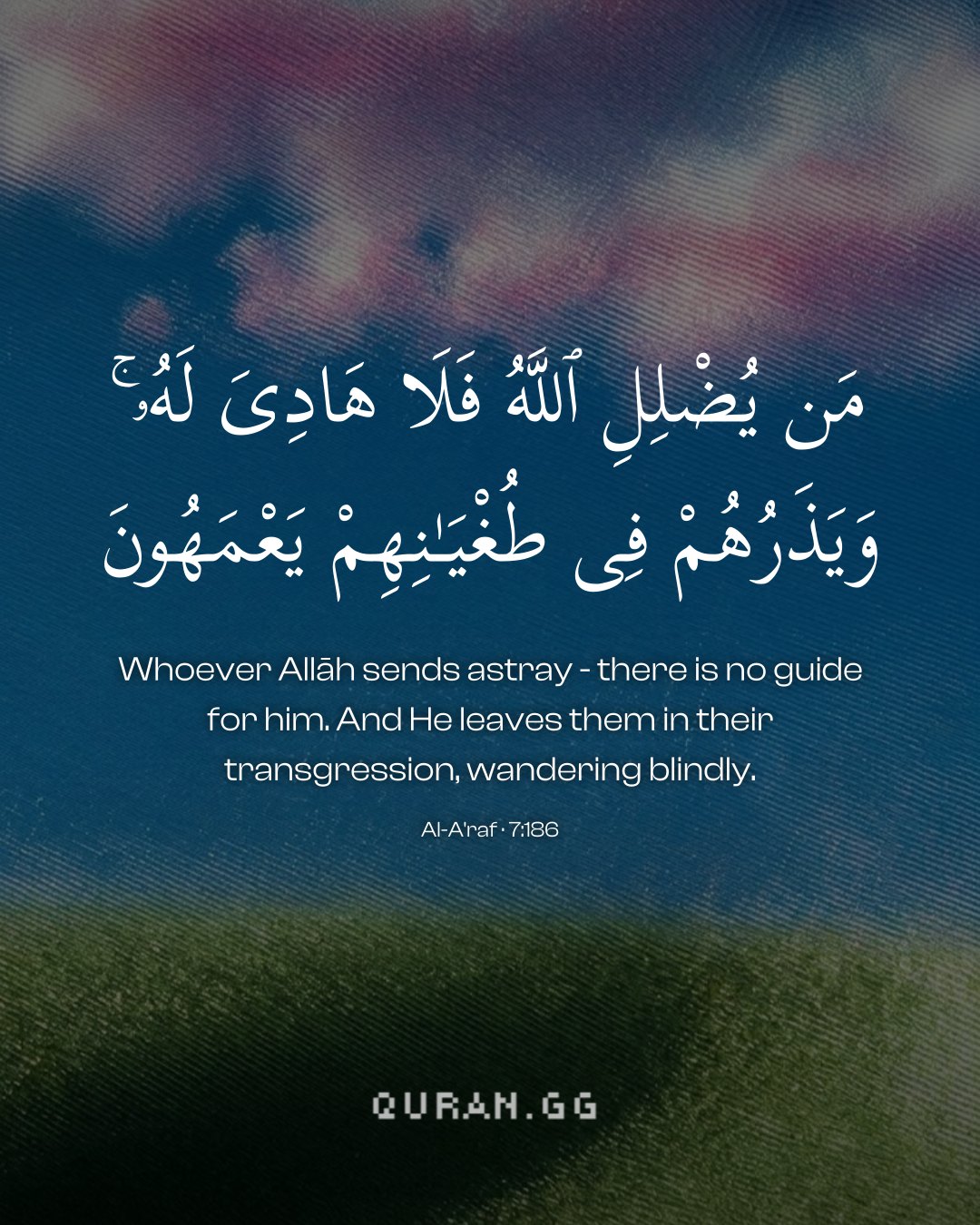
(And whomsoever Allah wants to put in Fitnah (error, because of his rejecting of Faith, or trial), you can do nothing for him against Allah) 5:41, and,
(Say: "Behold all that is in the heavens and the earth," but neither Ayat nor warners benefit those who believe not) 10:101.
Ma'arif al-Qur'an
Mufti Muhammad Shafi
The preceding verses spoke of the obstinate ignorance of the disbelievers who rejected the true Faith, despite all the clear signs given to them by Allah. This could be a source of grief to the Holy Prophet ﷺ as he was highly considerate and the greatest well-wisher of the mankind. The verse 186 provides him with a consolation saying that whomsoever Allah leaves wandering in his ignorance and lets him go on with his evil deeds can never be guided by any one and Allah leaves him at the mercy of his abject desires. That is to say, the Holy Prophet ﷺ has done his duty by conveying the message of Allah as explicitly as was possible, and that their rejection of the true faith was not for any of his faults.
Among the themes of this Surah (Al-A` raf) three topics are of great importance: the unity of Allah (Tauhid), the Prophethood (Risalah) and the life in the Hereafter (آخرَت). These three principles are, in fact, the mainstay of the whole edifice of Islam. Exposition of the first two principles, the Tauhid and the Risalah have been provided in the foregoing verses.
Tazkirul Quran
Maulana Wahiduddin KhanOn ayahs 184–187
A man with a mission is a man of principle. His thinking is unconditioned thinking. He has risen above all kinds of worldly interests. Truth becomes his sole concern. He sacrifices his life and property for a goal, which does not appear to yield any result in this world. That is why a man with a mission is called crazy, out of his mind. A prophet of God was the greatest man with a mission of his time. So, people in every age have called the prophets of God fanatics. To call a missionary of God’s religion a madman is the greatest of all transgressions, because the message with which he comes is one which is corroborated by the entire heaven and earth. He calls mankind towards God who is supremely manifest in His Creations in the Universe. He informs people of the Hereafter which, in heaven and on the earth, is equal in gravity to a full pregnancy in a woman’s womb. But people are not serious about the truth. So, a man who sacrifices his life for the sake of the truth appears mad to them. Had they known the real value of truth, they would never have used the word ‘mad’.
Uthmani text of the Madinah mushaf (King Fahd Complex). Translation: Saheeh International. Tafsir via Quran.com.