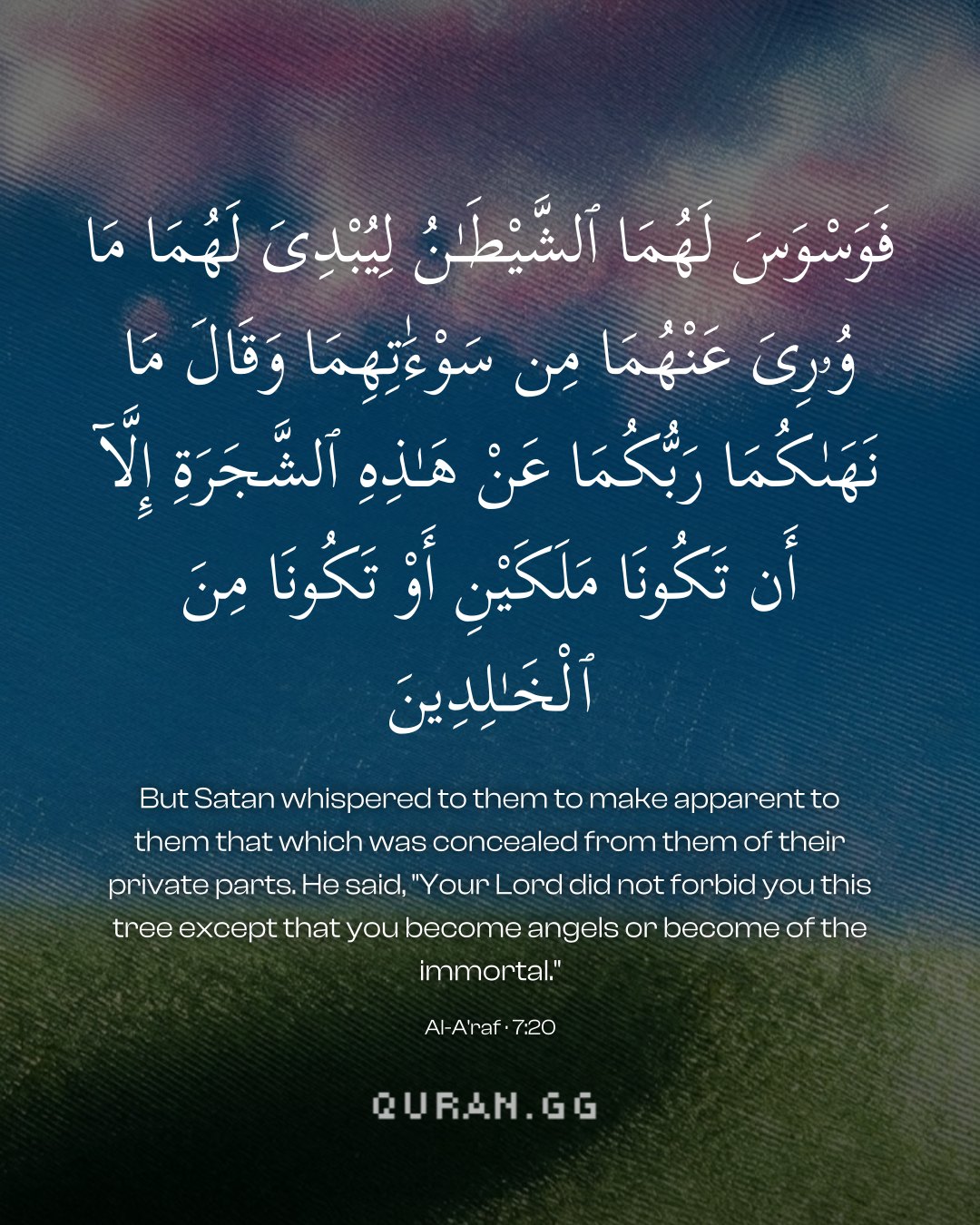
But Satan whispered to them to make apparent to them that which was concealed from them of their private parts. He said, "Your Lord did not forbid you this tree except that you become angels or become of the immortal."
Shaytan's Deceit with Adam and Hawwa' and Their eating from the Forbidden Tree
Allah states that He allowed Adam and his wife to dwell in Paradise and to eat from all of its fruits, except one tree. We have already discussed this in Surat Al-Baqarah. Thus, Shaytan envied them and plotted deceitfully, whispering and suggesting treachery. He wished to rid them of the various favors and nice clothes that they were enjoying.
("Your Lord did not forbid you this tree save you should become angels...") meaning, so that you do not become angels or dwell here for eternity. Surely, if you eat from this tree, you will attain both, he said. In another Ayah,
The story of Sayyidna 'Adam (علیہ السلام) and Iblis mentioned in the present verses has appeared in the fourth section of Surah Al-Baqarah.
Detailed comments have been given in the Tafsir of that Surah. If needed, please see Ma‘ariful-Quran, English Translation, Volume I, Pages 170-187.
Tazkirul Quran
Maulana Wahiduddin KhanOn ayahs 18–20
Sometimes God chooses a messenger to convey His word to the people, but his status as a guide is not readily acceptable to them. For this would imply that they were inferior to the messenger as they had failed to arrive at the truth. On such occasions Satan stirs up feelings of jealousy and pride. Puffed up with the feeling: ‘I am better,’ a man is not prepared to acknowledge the superiority of his brother. In the eyes of God, this amounts to treading the path of Satan. In such instances, one who treads the path of jealousy and pride makes himself deserving of the fate of hell, while one who remains humble proves that he deserves to find an abode in the gardens of Paradise. Whatever a man receives comes from God. So, the admission of someone else’s superiority is in fact an admission of the propriety of God’s endowments. Thus, denying the superiority of a well-endowed person is like the denial of God’s own decree. Similarly, when one man yields to another on the basis of some truth, he is not bowing down before just some man but before God; he does so in response to God’s command and not because of the other’s personal superiority.
Uthmani text of the Madinah mushaf (King Fahd Complex). Translation: Saheeh International. Tafsir via Quran.com.