Remembering Allah in the Mornings and Afternoons
Allah ordains that He be remembered more often in the mornings and the afternoons. Just as He ordered that He be worshipped during these two times when He said,
وَسَبِّحْ بِحَمْدِ رَبِّكَ قَبْلَ طُلُوعِ الشَّمْسِ وَقَبْلَ الْغُرُوبِ
(And glorify the praises of your Lord, before the rising of the sun and before (its) setting.) 50:39 Before the night of Isra', when the five daily prayers were ordained, this Ayah was revealed in Makkah ordering that Allah be worshipped at these times, Allah said next,
تَضَرُّعًا وَخِيفَةً
(humbly and with fear) meaning, remember your Lord in secret, not loudly, with eagerness and fear. This is why Allah said next,
Continue reading the tafsir of ayahs 205–206Ma'arif al-Qur'an
Mufti Muhammad Shafi
Sajdah: Some merits and rules
Sajdah (prostration) as a unit of the Islamic ` Ibadah of Salahhas been mentioned here exclusively since it occupies a distinct place among the rest of the units of Salah.
It appears in Sahih Muslim that a person asked Sayyidaa Thawban ؓ 'tell me about something I should do that will take me to Paradise.' Sayyidna Thawban remained silent. He repeated the question. He still remained silent. When he came up with the question the third time, he said, 'I had asked the same question from the Holy Prophet ؓ and he had ordered me to make sajdah repeatedly because for every sajdah you do, Allah Ta` ala increases a rank and forgives a sin.' This person says that following his meeting with Sayyidna Thawban ؓ he met Sayyidna Abu al-Darda' ؓ . He put the same question to him and he was given the same answer.
Again in Sahih Muslim, but on the authority of Sayyidna Abu Hurairah ؓ ، it has been reported that the Holy Prophet ؓ said, 'a servant of Allah is closest to his Lord when in sajdah.
Therefore, when you are in a state of sajdah, pray most ardently, for it is strongly hoped that it will be answered. 1'
1. It should be borne in mind that supplication in sajdah should be in nafl salah and using the Arabic prayers either mentioned in the Holy Qur'an or in the sunnah of the Holy Prophet . However, in a sajdah meant for supplication only, one can pray in whatever language he wishes (Muhammad Taqi Usmani)
Let us bear in mind that Sajdah, by itself, is not a recognized act of ` Ibadah. Therefore, according to Imam Abu Hanifah, prostrating in Sajdah abundantly means that one should offer nafl Salah abundantly. An increased number of nafl Salah would naturally result in an increased number of Sajdahs.
But, if a person were to go in Sajdah alone and supplicate after that, it really does not matter. As for the instruction to supplicate in Sajdah, it is particular to Nafl Salats. It is not mandatory.
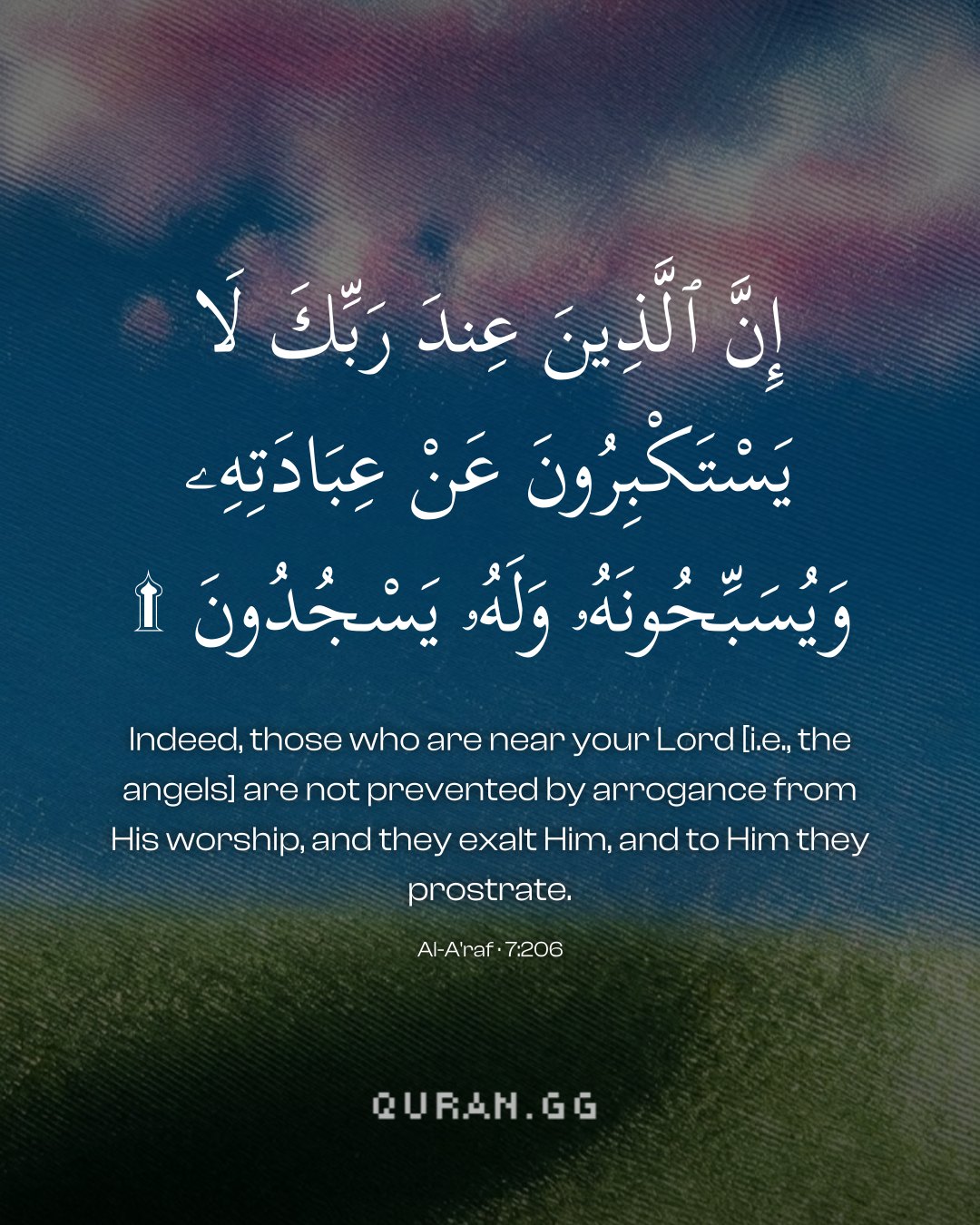
Surah al-A` raf ends here. Its last verse is an Ayah of Sajdah (requiring the person reciting and the person listening to prostrate in Sajdah). According to a report from Sayyidna Abu Hurairah al appearing in Sahih Muslim, the Holy Prophet ﷺ said, ` when a son of Adam recites a verse of Sajdah and then prostrates in Sajdah, the Shaitan runs crying. He says: Alas, man was asked to prostrate in Sajdah and when he obeyed, Paradise became his home, and I was asked to prostrate in Sajdah and when I disobeyed, Hell became my home.'
Tazkirul Quran
Maulana Wahiduddin Khan
The Makkans used to ask the Prophet that if he was a Prophet of God why he did not bring miracles from God. It would indeed have been very easy for God to send His messenger with miracles. But if the Prophet had come with miracles, the real purpose of his coming would have been defeated. For instance, let’s suppose he was given a modern car with loudspeakers fixed to it in order to facilitate the communication of his message. One thousand five hundred years ago such a car would surely be a breathtaking miracle. Had this been so, people’s attention would have been diverted from the message. The real purpose of the coming of the prophet was that God’s word should serve to produce deep thinking in the people so that they might use their mental faculties to give deep thought to the words of God in order to purify their souls and establish contact with God. But given miracles, their attention would have been diverted, and they would have been lost in miracles instead of in God. True religion consists of paying attention to the word of God, in order to establish a profound relation with God. The devotee’s heart is softened. He becomes one who always remembers God. His heart and mind are overwhelmed with God’s majesty, making him truly modest and fearful of God. We are told to develop an angelic character in order that we may find the company of angels in the next life. When man frees himself from arrogance, he is so engrossed with God’s marvels expressed in creation that he cannot but remember God always from the innermost recesses of his heart. He attains the level of angels. The highest point for human achievement in his world is that, being a human being, one comes to develop an angelic character.
Uthmani text of the Madinah mushaf (King Fahd Complex). Translation: Saheeh International. Tafsir via Quran.com.