Disbelievers commit Sins and claim that Allah commanded Them to do so!
Mujahid said, "The idolators used to go around the House (Ka`bah) in Tawaf while naked, saying, `We perform Tawaf as our mothers gave birth to us.' The woman would cover her sexual organ with something saying, `Today, some or all of it will appear, but whatever appears from it, I do not allow it (it is not for adultery or for men to enjoy looking at!)."' Allah sent down the Ayah,
وَإِذَا فَعَلُواْ فَـحِشَةً قَالُواْ وَجَدْنَا عَلَيْهَآ ءَابَاءَنَا وَاللَّهُ أَمَرَنَا بِهَا
(And when they commit a Fahishah (sin), they say: "We found our fathers doing it, and Allah has commanded it for us.")7:28 I say, the Arabs, with the exception of the Quraysh, used to perform Tawaf naked. They claimed they would not make Tawaf while wearing the clothes that they disobeyed Allah in. As for the Quraysh, known as Al-Hums, they used to perform Tawaf in their regular clothes. Whoever among the Arabs borrowed a garment from one of Al-Hums, he would wear it while in Tawaf. And whoever wore a new garment, would discard it and none would wear it after him on completion of Tawaf. Those who did not have a new garment, or were not given one by Al-Hums, then they would perform Tawaf while naked. Even women would go around in Tawaf while naked, and one of them would cover her sexual organ with something and proclaim, "Today, a part or all of it will appear, but whatever appears from it I do not allow it." Women used to perform Tawaf while naked usually at night. This was a practice that the idolators invented on their own, following only their forefathers in this regard. They falsely claimed that what their forefathers did was in fact following the order and legislation of Allah. Allah then refuted them, Allah said,
Continue reading the tafsir of ayahs 28–30Ma'arif al-Qur'an
Mufti Muhammad Shafi
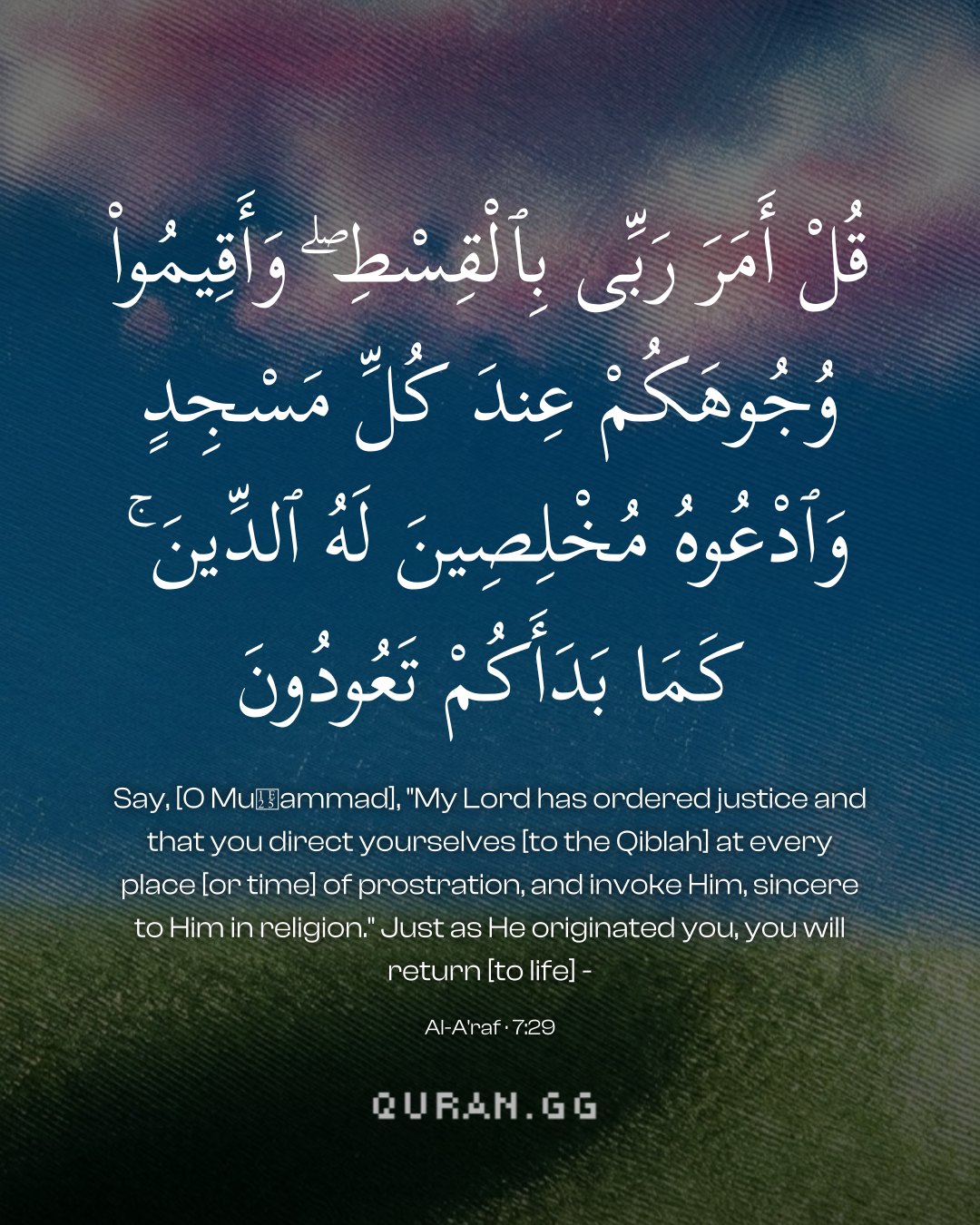
Said in the second verse was: قُلْ أَمَرَ رَبِّي بِالْقِسْطِ (Say, "My Lord has bid-den me to do justice). Here, the Holy Prophet ﷺ has been asked to tell those ignorant people, who were falsely attributing the justification of their naked Tawaf towards Allah, that Allah always commands justice. The word used here is: اَقِسط (al-qist) which essentially means justice, balance and moderation. At this place, ` al-qist' refers to a conduct which is free of excess or deficiency, that is, which neither falls short, nor exceeds the appointed limits - as is the case with all injunctions of the Shari'ah. Therefore, under this sense of qist' included there are all acts of worship and obedience as well as all general injunctions of the Shari'ah. (Ruh al-Ma'ani)
After having stated the command of justice and moderation, two injunctions of the Shari'ah relevant to their erroneous conduct have been particularly mentioned. These are: وَأَقِيمُوا وُجُوهَكُمْ عِندَ كُلِّ مَسْجِدٍ (and yourself be aright at each occasion of prostration) and: وَادْعُوهُ مُخْلِصِينَ لَهُ الدِّينَ (and pray to Him with pure faith in Him). The first command relates to what one does physically and outwardly. The other belongs to the heart, the spiritual dimension. In the first injunction, the word: مسجِد (Masjid), according to most commentators, appears in the sense of prostration (sajdah, sujud or ‘Ibadah) and it means that one should be aright at the time of every Salah or any other act of worship. It could also mean that one should make an effort and be particular to keep one's orientation straight towards the Qiblah. And being aright or keeping the orientation straight could also mean that one should sub-ordinate everything one says or does to what Allah has commanded, maintaining an orientation and stance that never varies, never dwindles and moves elsewhere. Given this meaning, this injunction will not remain particular for Salah only - instead, it would comprehend all acts of worship, dealings and transactions.
The second injunction means that one should worship Allah, purely and exclusively, without associating in that act anyone else in any capacity, even to the limit that such worship should also be free from, and untainted with, what is known as al-Shirk al-Khafiyy (concealed Shirk of associating others with the Divinity of Allah), that is, hypocrisy and riya' (show off).
By mentioning both injunctions together, the indication being given could be that one must correct, align and synchronize both dimensions of one's person, the outward and the inward, the physical and the spiritual, with the injunctions of the Shari'ah. Not enough is obvious obedience (Ita` ah) without sincerity (Ikhlas), nor can simple sincerity of the heart become sufficient without following the Shari` ah as visible outwardly too. Instead of that, it is binding on everyone that one should correct and align one's outward bearings in accordance with the Shari` ah and never forget to keep his or her inward state of being too reserved for Allah Ta` ala alone. This helps us see the error (dichotomy) of those who take Shari` ah (the outward or physical adherence to faith) and Tariqah (the inward or spiritual adherence to faith) as two different ways to approach religion. Some of them would even presume that it was sufficient to correct one's inward dimension as shown by Tariqah - even if they go about doing what is contrary to the Shari` ah! This is a gaping error.
At the end of the verse (29), it was said: كَمَا بَدَأَكُمْ تَعُودُونَ (As He originated you, so you will return). It means that it was He who created you first and it will be He who will make you rise again on the day of Qiyamah. For His perfect power, this was not difficult at all. Perhaps to indicate this element of convenience what was said here is: تَعُودُونَ (ta` udun: you will return) and not: یُعِیدُکُم ' (We shall make you rise) since making to rise again requires not much action. (Ruh al-Ma'ani)
There is an additional benefit of introducing this sentence here. It helps one in abiding by the injunctions of the Shari’ ah - because it is the realization that there is a life-to-come, and a Last Day, the Day of Qiyamah, and reward or punishment for deeds, good or bad, which makes what is difficult easy, and what is painful bearable. Experience bears out that man is a tough customer. Unless one is under such grip-ping apprehension, no word of advice can make him do what is right, nor can the restriction of any law stop him from going into crimes.
Uthmani text of the Madinah mushaf (King Fahd Complex). Translation: Saheeh International. Tafsir via Quran.com.