(And (remember) when they said: "O Allah! If this (the Qur'an) is indeed the truth (revealed) from You, then rain down stones on us from the sky or bring on us a painful torment.") Muhammad bin Ishaq said that the people of Hud used to worship several idols, such as Suda', Samud and Al-Haba'. This is why Hud, peace be upon him, said to them,
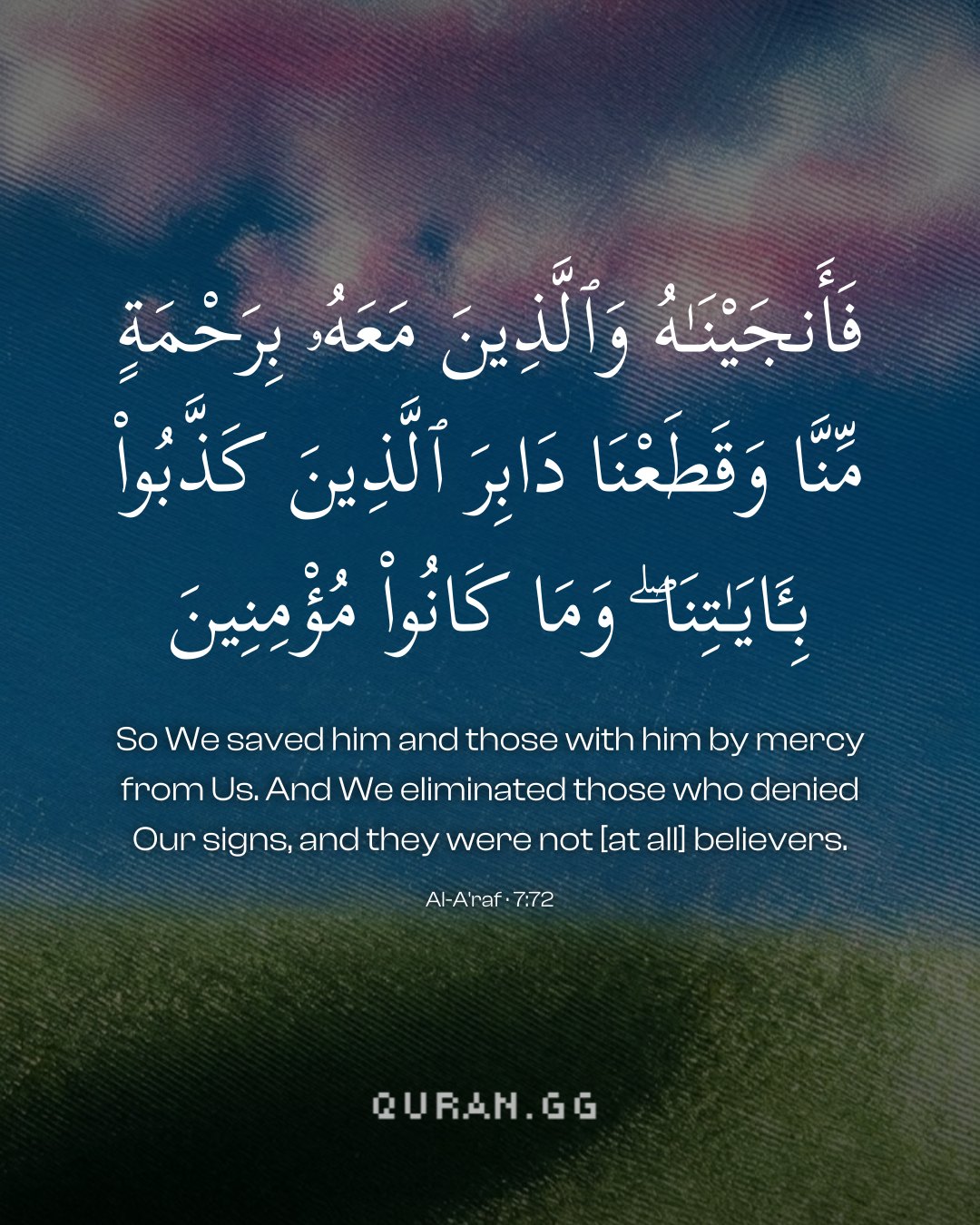
(5)-In the last verse (72) it was said that the final outcome of the entire struggle of Sayyidna Hud (علیہ السلام) against the contumacy of the people of ` Ad was that Allah Ta` ala kept Sayyidna Hud (علیہ السلام) and those who had believed in him safe from the punishment and cut off the root of those who had belied him - and they were not of those who would have believed.
This story leaves a trail of good counsel. It reminds heedless human beings to keep remembering Allah and take to a life style which is marked with obedience to Him. Then, to those who elect to reject honest advice and refuse to learn a lesson, it shows what to expect the end. And, as for preachers and reformers, it is a mirror of the prophetic method of communication in Tabligh and Islah.
Tazkirul Quran
Maulana Wahiduddin Khan
Man is able to imagine virtues or qualities through names. If a good word is attached to a person, he appears to be good and if a bad word is attached to him he appears to be bad. Things or beings other than God who become the centre of the attention of men come to be such because of these names. Certain individuals come to be called by such names as ghaus-e-pak (holy hearer of plaints), ganj bakhsh (granter of treasure), gharib nawaz (benefactor of the poor), or mushkil kusha (solver of difficulties). Gradually these names become so attached to their personalities that people start believing that the person called ghaus really has the power to hear plaints and pleas; and that the person known as mushkil kusha can really solve difficulties. But the truth is that names of this kind are all devised by human beings. There is nobody existing who carries these names. There is no religious or rational argument in their favour. The above kind of tradition in names is that which is prevalent among the ignorant masses. However, there is a civilized form of this tradition which is popular among educated people. In this, too, extraordinary words are attached to certain personalities, for example, qudsi sifat (having the attributes of angels), mahbub-e-khuda (beloved of God), sutun-e-Islam (pillar of Islam), najat dehenda-e-millat (saviour of the community), etc. Gradually, these words become integral parts of the names of the respective persons. People start considering them as being as extraordinary as their conferred names and titles indicate. Whatever, as a result of long-standing conventions, has acquired the holiness attaching to the past, assumes great importance and loftiness in the eyes of the people. Compared to it, the call of today’s preacher appears to be trivial. So, they ignore the present missionary considering him unimportant. They are confident that nothing will harm them, as they consider themselves the inheritors of the glory of their forefathers. Recklessness in respect of God gradually makes a man insensitive. He does not remain capable of reforming himself through the language of admonition or remembrance. It will be only when he hears the voice of God pronouncing the verdict of divine retribution that he will become aware of his own shortcomings.
Uthmani text of the Madinah mushaf (King Fahd Complex). Translation: Saheeh International. Tafsir via Quran.com.