Thamud: Their Land and Their Lineage
Scholars of Tafsir and genealogy say that (the tribe of Thamud descended from) Thamud bin `Athir bin Iram bin Sam bin Nuh, and he is brother of Jadis son of `Athir, similarly the tribe of Tasm, and they were from the ancient Arabs, Al-`Aribah, before the time of Ibrahim, Thamud came after `Ad. They dwelled between the area of the Hijaz (Western Arabia) and Ash-Sham (Greater Syria). The Messenger of Allah ﷺ passed by the area and ruins of Thamud when he went to Tabuk (in northern Arabia) during the ninth year of Hijrah. Imam Ahmad recorded that Ibn `Umar said, "When the Messenger of Allah ﷺ went to the area of Al-Hijr in Tabuk with the people, he camped near the homes of Thamud, in Al-Hijr and the people brought water from the wells that Thamud used before. They used that water to make dough and placed the pots (on fire) for cooking. However, the Prophet commanded them to spill the contents of the pots and to give the dough to their camels. He then marched forth with them from that area to another area, near the well that the camel (as will follow) used to drink from. He forbade the Companions from entering the area where people were tormented, saying,
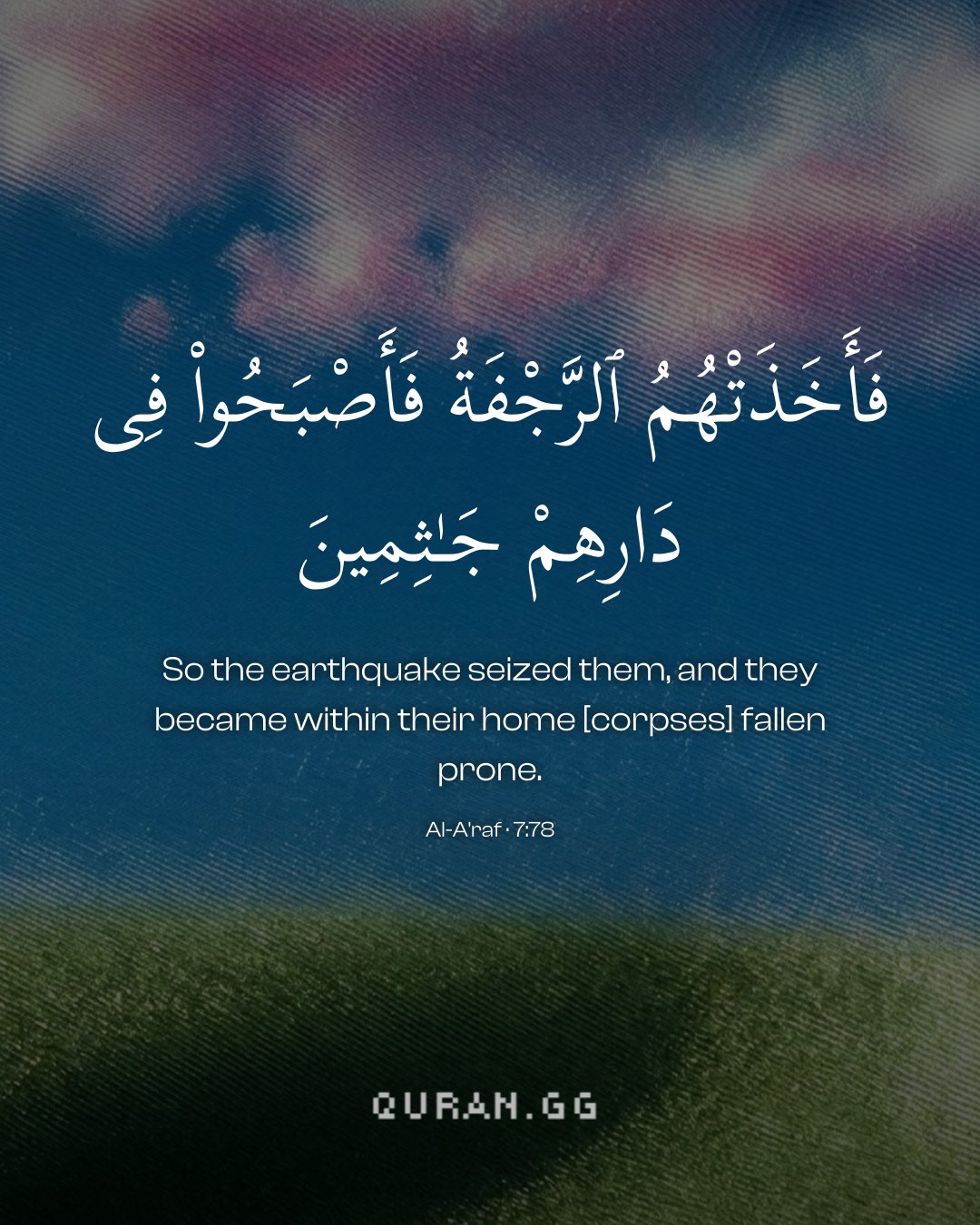
Continue reading the tafsir of ayahs 73–78 Other verses of the Qur'an have also mentioned: فَأَخَذَتْهُمُ الصَّيْحَةُ (that is, a Cry or Sound seized them - 15:83). The word: الصَّيْحَةُ (As-Saihah) means a shrill cry or severe sound. From these two verses, we find out that two kinds of punishment had simultaneously converged on the people of Thamud, the earthquake from below and the ` Saihah' from above. The result was: أَصْبَحُوا فِي دَارِهِمْ (and they were [ found dead ] in their homes, fallen on their knees - 77). The word: جَاثِمِين (jathimin) is a derivation from the verbal noun: Juthum, which means to be rendered senseless and motionless at one spot, or remain sitting (Al-Qamus). The sense is that everyone lay dead as and where one was. نَعُوذُ بِاللہِ مِن قَھرِہِ وَ عَذَابِہِ (We seek refuge with Allah from His Wrath and His Punishment).
Important parts of this story of the people of Thamud (علیہ السلام) have been mentioned in the different Surahs of the Qur'an itself. Some parts appear in Hadith narrations. There are some others which commentators have taken from Israelite narratives, but the proof of an event or its reality does not depend on them.
It appears in a Hadith of the Sahih of Al-Bukhari that, during a journey related to the Battle of Tabuk, the Holy Prophet ﷺ and his Sahabah passed by Hijr, the place where the people of Thamud had faced their punishment. At that spot, he gave instructions to the Sahabah that no one should go into the land area of that punishment-stricken habitation, nor should anyone use water from its wells. (Mazhari)
According to some narrations, the Holy Prophet ﷺ said: When the punishment overtook the people of Thamud, no one survived except one person, Abu Righal. He was in the Haram of Makkah at that time. Allah Ta` ala spared him of the punishment at that time because of the sanctity of the Haram of Makkah. Finally, when he came out of the Haram, the same punishment which had seized his people visited him as well, and right there he met his death. The Holy Prophet ﷺ also showed people the marks of the grave of Abu Righal on the outskirts of Makkah; and he also said that a walking stick made of gold was also buried with him. When the Sahabah opened the grave, they found the gold stick there which was taken out. Mentioned in the same narration is that Banu Thaqif, the inhabitants of Ta'if are the progeny of this very Abu Righal. (Mazhari)
Allah Ta` ala, in His infinite wisdom, has allowed these habitations of punished peoples to stay as signposts of lesson for coming generations. The Holy Qur'an has repeatedly warned the people of Arabia that these places which come on their travel route to Syria should bring home to them their essential lesson in the rise and fall of peoples: that is, (these are the dwellings of ungrateful people We لَمْ تُسْكَن مِّن بَعْدِهِمْ إِلَّا قَلِيلًا which) have not been lived in after them, except a little - 28:58).
After the mention of the event of punishment which overtook the people of Sayyidna Salih (علیہ السلام) it was finally said: فَتَوَلَّىٰ عَنْهُمْ وَقَالَ يَا قَوْمِ لَقَدْ أَبْلَغْتُكُمْ رِسَالَةَ رَبِّي وَنَصَحْتُ لَكُمْ وَلَـٰكِن لَّا تُحِبُّونَ النَّاصِحِينَ ﴿79﴾ (So, he turned away from them and said, "0 my people, I have certainly delivered to you the message of my Lord, and wished your betterment, but you people do not like the sincere advisers - 79), that is, after the visit of punishment on his people, Sayyidna S-alih (علیہ السلام) and those who had believed in him left that place and went somewhere else. In some narrations, it appears that there were four thousand believers with Sayyidna Salih (علیہ السلام) . He went along with them to Hadramaut in Yaman. It was there that Sayyidna Salih (علیہ السلام) passed away from this mortal world. However, some narrations report his going to Makkah al-Mu` azzamah and where it was that he passed away.
From the outward arrangement of the text, it appears that Sayyidna Salih (علیہ السلام) addressed his people while departing - 0 my people, I have certainly delivered to you the message of my Lord and have wished the best for you, but you do not seem to like honest advisers.
The question is when his people have been destroyed by the punishment, what is the use of addressing them now. The answer is that one good that may come out of it is that people in general would learn their lesson. This form of address resembles the address of the Holy Prophet ﷺ when he had said a few words addressing dead disbelievers from the tribe of Quraysh in the Battle of Badr. And then, it is also possible that this saying of Sayyidna Salih (علیہ السلام) came to pass before the coming of the punishment and the destruction of his people - though, in the textual arrangement, it has been mentioned later.
The people of Thamud perfected the art of construction. They were definitely well versed in related branches of knowledge, for example, mathematics, geometry and engineering, otherwise such development could not have been possible. But they were held guilty not of material developments but of spreading disturbance on the earth. This means that God does not prohibit progress within legitimate limits. But, in the matter of how he conducts his life, man should follow the balanced system which God has enforced in the whole universe. When a prophet comes to the world, he is a controversial figure in his time rather than an established personality. Moreover, he is not surrounded by worldly glories. He is not the occupier of any of the important seats of the time. That is why his contemporaries, unable to understand his prophethood, reject him. They find it difficult to believe that one whom they know as an ordinary person is the very individual whom God has chosen to deliver His message. ‘We are believers in that with which he has been sent.’ This reply of Salih’s companions tells us the difference between them and others. Those who deny the truth looked at the personality of Salih while the believers looked at the real message. Since, for those who denied the truth, no outward glory surrounded the personality of Salih, they ignored him. The believers, on the contrary, saw glimpses of Truth in Salih’s message, so they immediately accepted his words and became his companions.
Uthmani text of the Madinah mushaf (King Fahd Complex). Translation: Saheeh International. Tafsir via Quran.com.