Prophet Shu`ayb forbade his people from setting up blockades on the roads, saying,
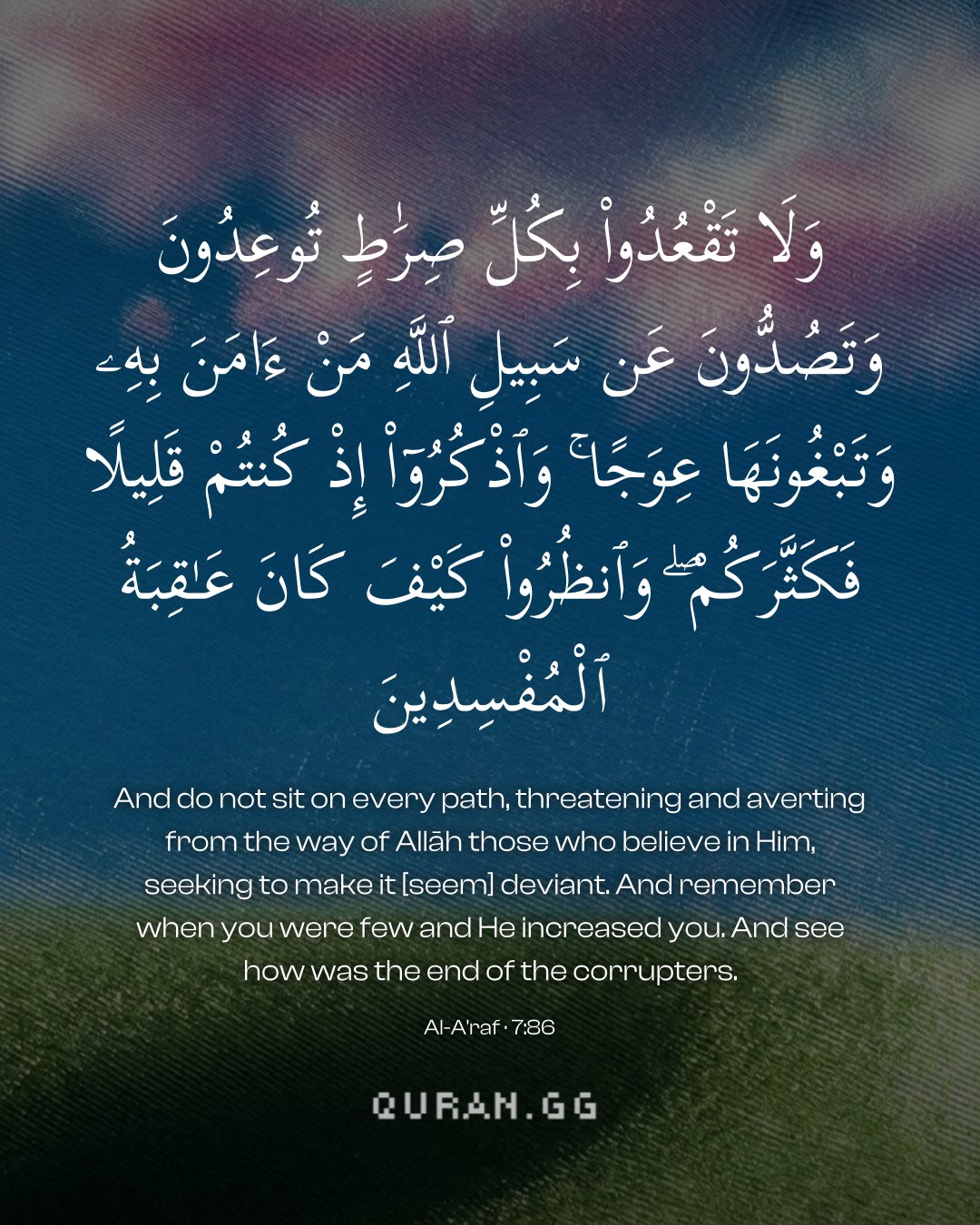
وَلاَ تَقْعُدُواْ بِكُلِّ صِرَطٍ تُوعِدُونَ
("And sit not on every road, threatening,") threatening people with death if they do not give up their money, as they were bandits, according to As-Suddi. Ibn `Abbas, Mujahid and several others commented:
وَلاَ تَقْعُدُواْ بِكُلِّ صِرَطٍ تُوعِدُونَ
("And sit not on every road, threatening.") the believers who come to Shu`ayb to follow him." The first meaning is better, because Prophet Shu`ayb first said to them,
بِكُلِّ صِرَطٍ
("on every road...") He then mentioned the second meaning,
وَتَصُدُّونَ عَن سَبِيلِ اللَّهِ مَنْ ءَامَنَ بِهِ وَتَبْغُونَهَا عِوَجًا
("and hindering from the path of Allah those who believe in Him, and seeking to make it crooked.") meaning, you seek to make the path of Allah crooked and deviated,
وَاذْكُرُواْ إِذْ كُنتُمْ قَلِيلاً فَكَثَّرَكُمْ
("And remember when you were but few, and He multiplied you.") meaning, you were weak because you were few. But you later on became mighty because of your large numbers. Therefore, remember Allah's favor.
وَانظُرُواْ كَيْفَ كَانَ عَـقِبَةُ الْمُفْسِدِينَ
("And see what was the end of the mischief-makers. ") from the previous nations and earlier generations. See the torment and punishment they suffered, because they disobeyed Allah and rejected His Messengers. Shu`ayb continued;
وَإِن كَانَ طَآئِفَةٌ مِّنكُمْ ءامَنُواْ بِالَّذِى أُرْسِلْتُ بِهِ وَطَآئِفَةٌ لَّمْ يْؤْمِنُواْ
("And if there is a party of you who believes in that with which I have been sent and a party who does not believe,") that is, if you divided concerning me,
فَاصْبِرُواْ
("so be patient") that is, then wait and see,
حَتَّى يَحْكُمَ اللَّهُ بَيْنَنَا
("until Allah judges between us,"), and you,
وَهُوَ خَيْرُ الْحَـكِمِينَ
("and He is the best of judges.") Surely, Allah will award the best end to those who fear and obey Him and He will destroy the disbelievers.
Ma'arif al-Qur'an
Mufti Muhammad Shafi
In the last sentence of verse 86, it was said: وَاذْكُرُوا إِذْ كُنتُمْ قَلِيلًا فَكَثَّرَكُمْ ۖ وَانظُرُوا كَيْفَ كَانَ عَاقِبَةُ الْمُفْسِدِينَ. (And remember the time when you were few, then He increased you in number. And look, how was the fate of mischief makers). The twin aspects of persuasion and intimidation were employed to warn these people. The first was persuasion when they were reminded of the blessing of Allah who increased their insignificant numbers to become a large nation, or changed their economic weakness into need-free financial strength. Then, to chasten them through intimidation, it was said that they could do much better if they had a look at the sad end of peoples who had engineered disorder on the earth. The peoples of Nuh, ` Ad, Thamud and Lut (علیہم السلام) were examples of so many different punishments, which should help them understand their own situation and make the correction needed.
One of the sons of Abraham was Madyan who was born of his third wife, Quatura. The people of Midian (or Madyan), his decendants, settled on the Arabian coast of the Red Sea. These people believed in God and professed to be of Abraham’s religion. But, five hundred years after the time of Abraham, they fell into wrong ways. They were a trading community; so their evil found expression in their dealings. They did not maintain the principles of honesty in weights, measures and transactions. Injustice in dealing with others is against the balanced system (islah) enforced by God. God has caused the system of this world to work on the basis of perfect justice. Here, there is nothing like taking more from others and giving less in return. Here everything functions on the principles of justice to the point of mathematical exactness. If this does not happen, then it would amount to creating a disturbance in the well-balanced world of God.
Uthmani text of the Madinah mushaf (King Fahd Complex). Translation: Saheeh International. Tafsir via Quran.com.